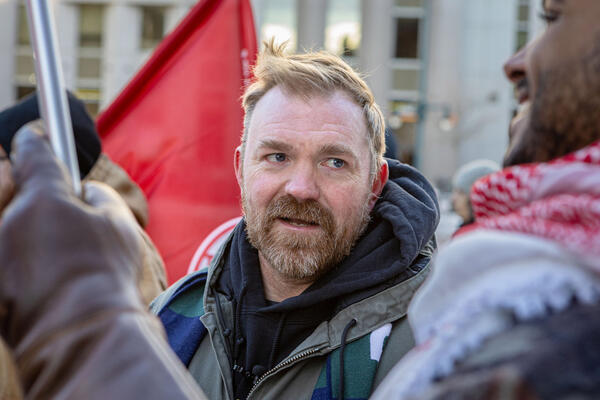
My wife is a novelist, and she’ll tell you that the best surprise ending should feel initially shocking but inevitable in hindsight. That’s an apt descriptor of this horrible Graham Platner arc. The one-time Maine Senate hopeful initially seemed like a burst of fresh air when he exploded onto the scene last year with the sort of salty, brawny energy the Democratic Party has been salivating over. A blue-collar-coded populist with a military background, an oyster farmer, and a guy looking to pick a fight with billionaires—many Democratic operatives thought he was almost too good to be true. They were right.
The red flags appeared almost immediately, the most startling of which was a literal Nazi tattoo on his chest—he claimed not to have known its meaning when he got it, and has since had it covered. It wasn’t the first crack, and it wouldn’t be the last: ex-girlfriends described “physically threatening” behavior, old Reddit posts surfaced with bigoted language, evidence of infidelity leaked, and his résumé included a stint with a hedge fund-owned successor to Blackwater, the notorious private security firm behind dark international scandals like the Nisour Square massacre.
Apparently, none of this was a dealbreaker for Democratic primary voters. Platner sailed through the Democratic primary—with some people even framing his rough edges as man-of-the-people bona fides. But a handful of Democratic leaders started quietly backing away. Then, on Monday, the shocking-but-inevitable reveal: a former girlfriend came forward with a serious and credible allegation of sexual assault.
This was the final straw for many, including early endorser Sen. Bernie Sanders of Vermont and fellow progressive wunderkind New York City Mayor Zohran Mamdani. On Wednesday, Platner said he would end his campaign.
But others, like novelist, prolific Democratic donor, and Maine resident Stephen King, called for forgiveness. “Tell you what–if you knew the whole truth about everyone in the Senate and House of Reps, those chambers would be dead empty,” he posted in a since-deleted tweet on X. “Jesus said, ‘Let him without sin cast the first stone.’” King got excoriated for the post and backtracked the next day: “If he committed rape, he should bow out.”
This is a very common response to the bad behavior of public figures. You saw it with other political figures like President Donald Trump and Secretary of Defense Pete Hegseth, along with celebrities like Louis C.K.
And, of course, public Christian figures facing serious allegations get this treatment all the time. The argument tends to involve some mixture of: God calls us to forgive, even King David fell into sin, let him without sin cast the first stone, and so on.
READ MORE: Kaya Oakes: The Failures of American Christian Forgiveness
Maybe we shouldn’t be surprised to find that forgiveness is such a confusing concept in a nation as morally compromised as ours. But I think by examining these calls to forgive public people who’ve done bad things, we can unearth a couple of common misconceptions around forgiveness that have crept into our own lives.
The first is one of the most aggravating to me, personally: the notion that we can forgive these people at all. I am not going to forgive Graham Platner for the simple reason that he didn’t do anything to me. Forgiveness is between Platner and the people he hurt. They may choose to forgive him, or they may not; it’s not really any of my business. I bring this up because I strongly suspect that the calls for us to “forgive” are actually calls to simply forget. Unless you were the one directly harmed by a person’s actions, you are in no place to forgive. But what you can do, in the case of public figures, is amend your expectations and support accordingly.
Very few of us are in any position to actually forgive Platner, but anyone who supported him, materially or otherwise, is absolutely in a position to rethink that support. The initial barrage of red flags already spoke of ill character and, at absolute best, spectacularly poor judgment. The latest allegation speaks to something tangibly horrifying that can’t be chalked up to ignorance. The people of Maine deserve better leadership, and it isn’t ungracious to say so.
The second misconception you see around forgiveness here is the idea that forgiveness means moving on as if the bad behavior had never happened—to “forgive and forget,” so to speak. Author and theologian C.S. Lewis derided this thinking in Mere Christianity,where he argued that “loving my enemies does not apparently mean thinking them nice … That is an enormous relief. For a good many people imagine that forgiving your enemies means making out that they are really not such bad fellows after all, when it is quite plain that they are.”
It seems to me forgiveness has less to do with how I assess the facts of a person’s behavior and more about how I navigate my own feelings towards them; it’s not about feigning ignorance of their bad deeds, but about surrendering my resentment toward them. It has to do with, as journalist Elizabeth Bruenig writes, “forsaking an emotionally salient set of rights or privileges one acquires when injured.” When someone hurts you, you are entirely justified in experiencing all sorts of very natural, very human, and very negative feelings about them. Forgiveness is what happens when you deliberately release those feelings—or, at least, start trying.
But even if the forgiver does begin the often difficult process of forgiveness, that doesn’t involve pretending the person they’re forgiving hasn’t done anything wrong. If I seriously break a friend’s trust, they might choose to forgive me—I hope they do—but they will probably not trust me with sensitive information or big responsibilities anytime soon. This isn’t necessarily because they’re holding a grudge and refusing to forgive me, but because they’re making rational decisions about how to treat me based on my actions.
I’m not trying to devalue forgiveness here. As a matter of fact, I think correcting our misconceptions around forgiveness reveals how valuable, challenging, and ultimately, beautiful it actually is. If you’ve spent time in a church, you’ve likely experienced a leadership failure and been encouraged to hastily forgive the leader and welcome them back to the pulpit, no questions asked. This is cheap forgiveness—forgiveness as a weapon that ruins lives instead of restoring them.
Real forgiveness is hard. You often hear people talk about how it feels even better for the forgiver than it does for the forgiven. That’s not been my experience. It actually kind of sucks. But humanity simply cannot exist without forgiveness; it’s how we repair the foundations of our communities when they’re damaged. As Paul told the Ephesians, we are to “be kind to one another, tenderhearted, forgiving one another, as God in Christ has forgiven you” (4:32).
Forgiveness is much too important to waste on political campaigns and the egos of would-be leaders. Used that way, forgiveness is little more than a tool to shame the wounded into keeping quiet and getting in line. But if we treat forgiveness with the respect it deserves—offering it to others in the same way God gave it to us—then it achieves its full power: shocking initially, inevitable in hindsight, like any good twist ending.
Forgiveness is much too important to waste on political campaigns and the egos of would-be leaders.

Did this article have an impact on you? Tell us how! Whether you’re moved to take action, have a question, or want to share a comment (good or bad), we value your feedback!