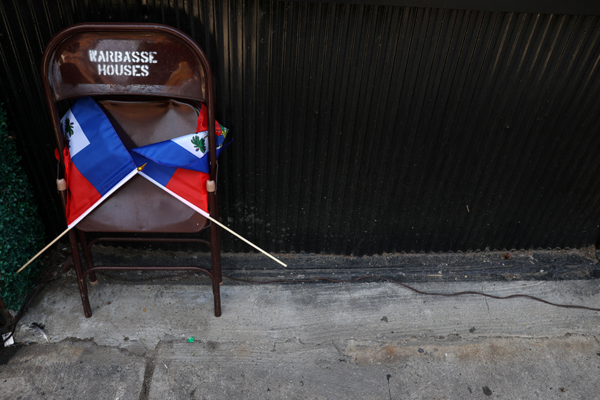
Despite preparing for the possibility, advocates still felt the grim reality set in when the Supreme Court decided to allow the Trump administration to end Temporary Protected Status for immigrants whose home countries were previously deemed too dangerous to force their return.
Christopher Kerr, executive director of the Ignatian Solidarity Network, said in a statement that the ruling “strips vital humanitarian protections from our migrant neighbors and leaves families in a dangerous place.
“This ruling separates families and uproots students in our schools, leaders in our parishes, and friends in our communities. Catholic teaching reminds us that every person has a right to life and the conditions necessary for human flourishing,” Kerr said. “To force individuals back to nations gripped by violence and instability is a moral failure of our obligation to our neighbors.”
In the pair of rulings, Mullin v. Dahlia Doe and Trump v. Miot, the Supreme Court ruled that it could not reverse or review the administration’s fall 2025 terminations of TPS for Syrians and Haitians.
The Court’s majority said its decision, which affects around 350,000 people, rested largely on procedure. Congress created Temporary Protected Status under President George H.W. Bush’s administration as expedited humanitarian relief for citizens of countries affected by war and natural disasters. The 1990 law places discretion over qualifying countries exclusively in the hands of the executive branch. That authority now rests with the Department of Homeland Security director, and the law limits the extent to which courts can review decisions. The Court rejected the claim that anti-Black and anti-Haitian rhetoric from the Trump administration violated constitutional protections against discrimination.
The Court also, that same day, ruled that asylum seekers could be turned away at the border before entering the U.S. As a pair, advocates said, the decisions were telling.
Faith leaders decry ‘whims of prejudice’
Cameron Vickrey, of FaithWorks, a Christian social justice organization based in Texas, called the decisions “disastrous.”
“We have failed to pass immigration reform through Congress and left immigration policies to the whims of whoever is president, and those whims, prejudices, and hatreds have been affirmed by the Supreme Court,” Vickrey said.
Syrians first gained TPS in 2012 during the country’s civil war. As of 2025, 3,860 Syrians were under TPS in the U.S. For Haiti, TPS began in 2010, after an earthquake killed between 200,000 and 300,000 people. By 2025, 330,000 Haitians were in the U.S. under TPS. Because the status only lasts for six, 12, or 18 months at a time, it had to be renewed repeatedly and had been until 2025, when DHS Secretary Kristi Noem announced that conditions in both countries had improved enough that it was safe for nationals in the U.S. to return, despite both countries having the highest travel advisory warning, “Level 4: Do not travel,” from the State Department.
Current Homeland Security Secretary Markwayne Mullin said on CNN after the decision that the decade-plus of extensions for both countries went beyond the intention for TPS. “Temporary Protected Status was never intended to be permanent,” Mullin told CNN’s Jake Tapper.
Mullin also argued that TPS holders should have “changed their status” by now. The statement is familiar to Matthew Soerens, vice president of advocacy and policy for World Relief. He hears it a lot in the churches he visits when people are first learning how the immigration system works. People assume that it’s easy to simply “apply” for permanent residency, he told Sojourners in an interview after the decision. But the reality is that most Haitians do not have another program through which to qualify for a green card. The administration has continued to close avenues for asylum, and few, if any, have employer sponsorship. Though he would support Congress creating a legal pathway to a green card for TPS holders, Soerens said, one does not exist.
“There’s really no options for these Haitians, and that’s a frustrating dynamic,” he said. “It’s then more frustrating for the Secretary of Homeland Security to suggest that this was their choice, that they were maybe too lazy or too uninformed to fill out the right paperwork.”
‘They view nonwhite immigrants as less human’
Whether or not a decade of refuge was ever the intention of the law, in that time Haitians and Syrians legally in the U.S. have had families. Their children are U.S. citizens. Those families now face a difficult choice. Myal Greene, World Relief’s president and CEO, said in a statement that though TPS is intended to be temporary, “some crises are not.”
“When that happens, we have a responsibility to honor our commitments to law-abiding, tax-paying residents who have become beloved members of our community—and for whom returning home would mean entering into untenable chaos, potentially tearing apart families whose U.S. citizen children are admonished by the State Department not to travel to their parents’ countries of origin,” Greene said.
The U.S. citizen children of Haitian and Syrian TPS holders raise an important issue for advocates who see a broader agenda in the Trump administration’s approach to the immigration policies and programs. When Tapper asked Mullin about the State Department travel advisories for Haiti and Syria, Mullin said advisories only apply to U.S. citizens and falsely claimed that violence would only be directed at U.S. citizens traveling abroad.
But even if that were true, immigration advocates say it would not answer a grave concern for Haitian Americans and Syrian Americans.
“It’s not shocking that our government would prioritize the lives of U.S. citizens, but in this case they’re also saying that the lives of Haitian American U.S. citizen children are less valuable, either because they are sent into danger or left behind to be raised by strangers,” Soerens said.
At the same time, the Trump administration had sought to end birthright citizenship, which the Court narrowly defended in a June 30 ruling. Neither decision—to surrender TPS to the executive branch or to uphold birthright citizenship—came as a surprise to advocates, who say they are watching an imperfect system be stripped of humanitarian values.
“The words and actions of this government send the message every day that they view nonwhite immigrants as less human, and unworthy of the most basic dignity and rights,” said Mary Katherine Morn, president and lead executive officer of the Unitarian Universalist Service Committee, in a statement. “Our religious and ethical traditions and the best of our country’s aspirations say the opposite.”
In Ohio, where tens of thousands of Haitians have settled, the Catholic bishops issued a statement of concern ahead of the decision. It expressed concern for the safety of Haitians who would be forced to leave “familial stability, jobs, and community due to policy decisions” before issuing a pastoral rebuke.
“Welcoming immigrants and refugees represents the Christian ideals our country stands on. The denial of a dignified life for law-abiding families fleeing an unstable home and contributing to the common good signifies how much easier it is to declare that we are ‘One Nation Under God’ rather than to actually do the will of our Heavenly Father.”
“It’s not shocking that our government would prioritize the lives of U.S. citizens, but in this case they’re also saying that the lives of Haitian American U.S. citizen children are less valuable.”—Matthew Soerens, vice president of advocacy and policy for World Relief
Did this article have an impact on you? Tell us how! Whether you’re moved to take action, have a question, or want to share a comment (good or bad), we value your feedback!