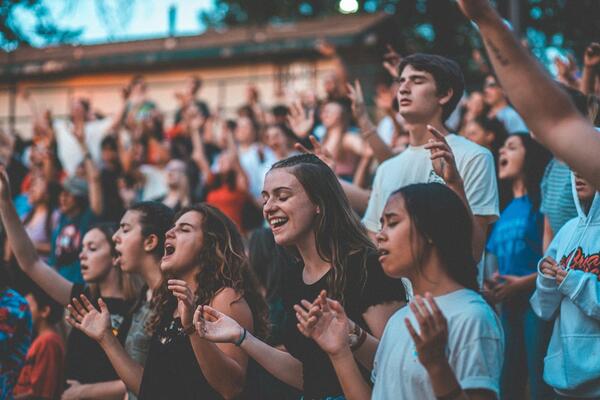
At the start of this year, Ruth-Ann Briscoe filled her calendar with different churches to try each Sunday, determined to find a community to call home. Belonging to Generation Z, Briscoe’s story is one anecdote in the flood of media and ecclesial narratives about young people and religious revival.
While religious service attendance has been on the decline globally for the last 15 years, multiple studies in recent years have sought to quantify those anecdotes.
According to the Public Religion Research Institute, “younger Americans continue to be less religious than older Americans, in terms of both religious affiliation and regular church attendance.”
Overall, young people are still significantly underrepresented in churches. Millennials and Gen Z make up about 43% of the U.S. population but only 14% of church attendees. Baby Boomers and the Silent Generation, those ages 65 and older, make up just 18% of the U.S. population, but account for about 35% of church participants.
But the frequency of church attendance among younger groups may be rising, especially since the pandemic. A 2025 report from the Hartford Institute for Religion Research, which surveys congregations, found that younger church participants in the U.S. are most likely to have increased their frequency of attendance in the past five years. A report from Barna similarly found that Millennial and Gen Z churchgoers now attend more frequently than older generations.
The daughter of pastors, Briscoe said she had found that genuine friendships were sometimes easier to foster in secular spaces rather than church. But after the pandemic, she moved to Kingston, Jamaica, and wanted a church to help provide regular connection and guidance as a young adult navigating new life decisions.
“Life just feels better when it’s not just your faith walking alone,” Briscoe said. “Knowing that you can have biblical conversations with somebody … it just helps to keep you accountable as well.”
Allison Norton, co-director at the Hartford Institute, said the pandemic exacerbated loneliness and weakened opportunities for meaningful connection. In response, young people of faith leaned into their spirituality and grew their weekly commitments.
“We've been studying this over 5 years and asking ‘as a result of the pandemic, what has happened to your faith and to your sense of spirituality,’” Norton said. “We did find that the younger folks were more likely to have a positive increase in their faith and their spirituality.”
Briscoe’s parents pastored at a megachurch about an hour away from their hometown, St. Catherine Parish, Jamaica, for many years before her dad started a separate ministry when she was about 12-years old. For Briscoe, community and connections at the megachurch only went surface deep.
“I was very involved, and I was surrounded by a lot of people, but I can't tell you that I had people that I could lean on consistently if I needed someone to pray for me or to help me through a rough season,” Briscoe said. “That wasn’t until we moved and were in a smaller church community.”
READ MORE: CJ the X: The Nonbinary Philosopher Shaping Gen Z’s Spiritual Imagination
According to PRRI, there’s also a gender gap in how young people are relating to religious affiliation. The rate of men ages 18–29 who identify as religiously unaffiliated has remained consistent at 35% within the last 12 years. What has changed, however, is young women’s religious affiliation. Since 2013, the rate of young women who don’t affiliate with a religion has increased from 29% to 43%.
At the beginning of March, Briscoe found a church that she eventually felt comfortable formally joining by May. The church’s outreach programs won her over. Even when she missed a few weeks because of work and life, members showed support by checking in on her.
Nearly 40% of congregations that the Hartford Institute surveyed said they strongly agree that they are actively seeking new members and trying to incorporate newcomers. Even with an emphasis on outreach, 20% of church attendees were newcomers in 2025, according to Hartford's report, only 1% higher than pre-pandemic results in 2019.
But for some folks, like Gabrielle Long, a Gen Z Christian in Pensacola, Fla., it’s harder to find acceptance in traditional church spaces.
“I feel like in churches you can feel judged compared to other spaces to meet people [where] you can just be yourself,” Long said. “I work a lot in theater, and that's where I make a lot of my connections. That has been much easier, and I’ve built lots of strong relationships over the years. Sometimes I get lucky and those people are also Christians, and then it's an even stronger bond.”
Like Briscoe, Long is a pastor’s kid. For her, that meant spending nearly every day of the week at her dad’s nondenominational church growing up. Although church attendance was obligatory and eventually felt forced, she said the connection with her church family was a natural and expected part of her routine that she could depend on. But her parents' divorce when she was 14 created the first hairline fracture in Long’s relationship with church.
“I was trying to figure out if I still go because my dad's there or do I not because my mom's in a different church,” Long said. “It was just so much confusion, and what do I really do?”
College was the first time in her life that she felt tasked with fostering a church community rather than routinely interacting with one that she inherited from her parents. Despite those difficulties, she was able to try denominations she didn’t grow up with and to begin defining her own beliefs about God and faith.
Of the 24,000 people whom the Hartford Institute polled in a 2024 survey, 38% were new to their congregation within the previous five years. About 70% of the new attenders were people who were not attending church for the very first time. Rather, they were individuals who had switched churches for different reasons like politics or health and religious convictions.
Since graduating from college in 2021, Long has been back in her hometown and has found herself once again tasked with finding a church that feels right for her. She desires to be plugged in with like-minded people her age who share her faith, but she doesn’t feel comfortable rejoining her dad’s church. While community is a priority, she also wants teachings that go beyond just a general salvation message. She also wants opportunities to serve in the church and throughout her city. For now, she’s still on the hunt for a new church to call home.
Editor’s note: This article was updated on July 8, 2026 to clarify that Ruth-Ann Briscoe’s parents were pastors, not the senior pastors, at the megachurch she mentioned.
“I feel like in churches you can feel judged compared to other spaces to meet people [where] you can just be yourself.” —Gabrielle Long

Did this article have an impact on you? Tell us how! Whether you’re moved to take action, have a question, or want to share a comment (good or bad), we value your feedback!