A FEW YEARS ago, when I served as an elder at a largely Black Caribbean Seventh-day Adventist church, I grew tired of seeing the U.S. flag at the front of our sanctuary. So, one Saturday after service, I decided to move it to a back room. It only rarely returned. (Imitate at your own risk.)
This was not unprecedented behavior for me. In 2004, as a new sixth-grade student at my local SDA school, I learned that my teacher, wanting to instill respect for the U.S. flag, would have our class hoist and lower the flag at the beginning and end of each school day. I, however, wanted it to be known that the flag was just a piece of cloth—one that absolutely was allowed to touch the ground. And then, with an overconfident 11-year-old’s flair, I would demonstrate. This earned my immigrant parents a phone call from a classmate’s concerned parent. I was correctly told to stop my shenanigans.
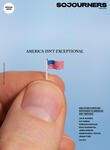
Oddly enough, I think the United States has a nice flag. A grand ol’ flag, in fact. But my life has taught me that the people who wave the flag most vigorously seem to be the same people who work hardest to undercut our country’s most inclusive ideals.
That said, my anti-flag proclivities have been challenged recently. Probably because I’ve been attending a few too many Black SDA churches’ International Days. I love these worship services.
A 2014 Pew Research Center study of the religious landscape in the U.S. found that “37% of adults who identify as Seventh-day Adventists are white, while 32% are Black, 15% are Hispanic, 8% are Asian and another 8% are another race or mixed race,” making the SDA church the most racially and ethnically diverse religious group in the country. It makes sense that these churches celebrate and highlight their diversity through dress, music, food, and presentations.
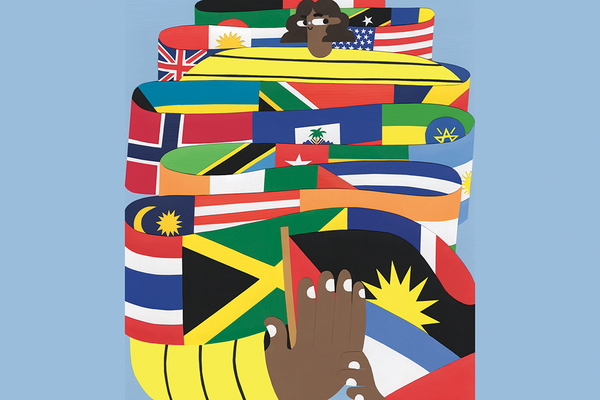
Frequently, an International Day service begins with something akin to the Olympics Parade of Nations. People march in carrying the flag with which they identify. There often are several Haitians, which I appreciate—my dad was born there. But Antigua, where my mom was born, is a much smaller island. So I normally see one or two Antiguans—proud but scant—carrying their flag.
Parades of nations are interesting, whether at the Olympics or in a church. When the spotlight is on a particular country, I always see a flag and often learn a factoid about the country. But I’ve never heard anyone proclaim during a parade of nations that their country is the “best in the world.” I suspect because you have to temper your grandiosity when you know there will likely be more Jamaicans than you, anyway. And because you know Norway will probably win the most medals at the Winter Olympics, again. Perceptions are different when your flag is next to another flag, not standing alone.
After International Days are over, the non-U.S. flags tend to return to wherever flags go, probably some back room. Upon reflection I’ve realized: Maybe my problem isn’t the presence of the U.S. flag. Maybe my problem is that it all too often stands alone.
I used to think that keeping the U.S. flag out of a church’s sanctuary would, at least subtly, announce to congregants that the church rejects a mythologized history that proclaims the United States was designed to be—or should be—a “Christian nation.” But do you know who else argued against having the American flag in his church? Doug Wilson—that Doug Wilson, senior pastor of Christ Church in Moscow, Idaho, and a co-founder of the network of churches that U.S. Defense Secretary Pete Hegseth attends.
Wilson once wrote in Christianity Today, “Placing a flag in a sanctuary has many possible implications. It could convey the idea that we claim some sort of ‘favored nation’ status.” I agree with that! But then he continued to explain his “ideal scenario”: “The elders who vote in session to remove the American flag from the sanctuary should all have that same flag on their pickup trucks, right next to the gun rack.”
That’s ... not my ideal scenario. And the intentional absence of the American flag in Wilson’s church sanctuary didn’t stop him from, in a 2024 video titled “Christian Nationalism Basics,” questioning the number of H-1B visas the United States offers each year because, he said, “That’s a lot of Hindus.”
Maybe simply removing the U.S. flag from the sanctuary misses the point.
Perceptions are different when your flag is next to another flag, not standing alone.
Here’s a reminder that could help instead: Every church in the United States, both the ones displaying the U.S. flag and the ones who don’t, has a story that didn’t begin in 1776. Some churches in the United States that are predominantly composed of people from one national background, like Haitian SDA churches and Ethiopian Orthodox Tewahedo churches, honor this reality regularly. In those sanctuaries, the Haitian or Ethiopian flag sits next to the United States flag. Multiple flags communicate, “We live here, but my people are also from there.”
I absolutely agree with people, even Wilson, who reject having a single flag in a sanctuary because it announces national allegiance; a church’s allegiance should only truly be to Jesus. But a flag can symbolize something else. When I see an Antiguan flag while visiting a church on their International Day, I think, there might be a home for my mom here. If used properly, flags can announce belonging. These days, we need much more of that.
A flag is still a piece of cloth. But here’s a message for 11-year-old me: Cloth can carry meaning.
Do you want to find a tangible way to counter American exceptionalism and Doug Wilson’s version of Christian nationalism? Maybe your church needs more pieces of cloth, not fewer.

Did this article have an impact on you? Tell us how! Whether you’re moved to take action, have a question, or want to share a comment (good or bad), we value your feedback!