Trump Admits That the U.S. Simply Cares About War More Than Kids

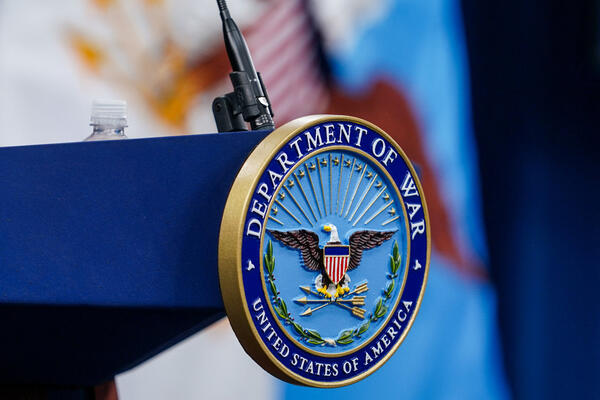
A seal for the Department of War appears on the podium, after the Trump administration renamed the Department of Defense to the Department of War in 2025, on the day of a briefing on the Iran war at the Pentagon in Washington, D.C., U.S., April 16, 2026. REUTERS/Nathan Howard

Earlier this month, at a private Easter luncheon at the White House, President Donald Trump delivered some of the most revealing comments of his second presidency.

In his remarks, Trump said he told Russell Vought, the White House budget director: “Don’t send money for day care, because the United States can’t take care of day care. That has to be up to a state. We can’t take care of day care. We’re a big country. We have 50 states. We have all these other people. We’re fighting wars. We can’t take care of day care. You got to let a state take care of day care, and they should pay for it too.” Later, Trump added, “It’s not possible for us to take care of day care, Medicaid, Medicare, all these individual things. They can do it on a state basis. You can’t do it on a federal. We have to take care of one thing: military protection. We have to guard the country.” 

It’s a blunt assessment of the president’s priorities: Spending upwards of $1 billion per day to maintain an illegal war that has, by conservative estimates, killed 3,500 people in Iran, 1,500 people in Lebanon, dozens of Iraqis and Israelis, and 13 U.S. service members. According to Trump, this is necessary. But spending the roughly $35 billion per year it would take to implement universal pre-K for 3- and 4-year olds? “Not possible,” he says.

In late March, Secretary of State Marco Rubio appeared on Good Morning America to criticize Iran’s financial priorities. He asked viewers to “imagine in Iran that instead of spending their wealth, billions of dollars, supporting terrorists or weapons, had spent that money helping the people of Iran, you’d have a much different country.” He’s right. But why does that logic apply to Iran but not to us here in the U.S.? Do we dare imagine what our lives would be like if the money currently being dumped into an illegal and immoral war was instead being invested in things like child care?

READ MORE: There Is No Biblical Justification For This War

Trump’s remarks are in line with the longstanding and distorted logic that the U.S. needs to prioritize military spending above all else. His administration has frozen access to certain federal child care and family assistance funds for five states controlled by Democrats. His One Big Beautiful Bill Act, which passed last year, significantly shifted the cost of the Supplemental Nutrition Assistance Program to states and cut $1 trillion in annual Medicaid spending over the next year while giving the top 1% of taxpayers equivalent savings in tax breaks.

This distorted logic continues to undermine our nation’s priorities. In response to the jaw-dropping cost of the war in Iran, conservative legislators are reportedly insisting that the Iran war supplemental be fully paid for by cutting back on federal health spending or cuts to common good programs like “70-plus means-tested welfare programs,” according to House Budget Chairman Jodey Arrington (R-Tex.). Meanwhile, the president’s budget blueprint for 2027 calls for funding the military at $1.5 trillion—a massive increase of more than 40%—while cutting $73 billion from programs outside the military.

These mind-boggling levels of spending should prompt taxpayers of all political stripes to press for assurances their money is being spent responsibly, especially since the Pentagon has famously never passed an audit, has been mired in price-gouging scandals, and has reported $10.8 billion in confirmed fraud since 2017. On Capitol Hill, emphasizing financial responsibility could be the seeds of real bipartisan action.

But morally, there’s a larger argument to make: Cutting social programs to endlessly double down on military spending has become far too normalized. As we’ve long said at Sojourners, budgets are moral documents because they signal who and what we prioritize. From the perspective of Christian faith, the moral test of our budget is how it treats the most vulnerable members of society. And right now, our budget is saying that increasing funding to fight costly and misguided wars is more important than ensuring many of our most vulnerable children and families have access to affordable health care and child care.

Rev. Martin Luther King Jr. gave one of the best and most lasting critiques of the immoral tradeoffs of unnecessary and immoral war in his “Beyond Vietnam” speech, delivered at Riverside Church one year before his assassination. At one point in the speech, he says:

“A few years ago there was a shining moment … It seemed as if there was a real promise of hope for the poor—both black and white—through the poverty program. There were experiments, hopes, new beginnings. Then came the buildup in Vietnam, and I watched this program broken and eviscerated, as if it were some idle political plaything of a society gone mad on war, and I knew that America would never invest the necessary funds or energies in rehabilitation of its poor so long as adventures like Vietnam continued to draw men and skills and money like some demonic destructive suction tube. So, I was increasingly compelled to see the war as an enemy of the poor and to attack it as such.” 

As King makes clear, federal spending on war is frequently put in direct conflict with spending to help people on the margins by politicians wishing to spend more on the former and less on the latter. History is seemingly rhyming. King morally condemns this way of thinking in a passage that reads just as starkly relevant today as it was in 1967: 

“A true revolution of values will lay hand on the world order … A nation that continues year after year to spend more money on military defense than on programs of social uplift is approaching spiritual death.” 

As Congress returns from recess and takes up building out its budget and appropriations for next year, we must heed King’s words, otherwise we will continue on a path of spiritual death.

In an interdependent world, our collective security won’t be secured by military might and coercion. As Christians we need to make sure our representatives know that our priorities are caring for our most vulnerable and making investments to ensure everyone can thrive—not astronomically increasing an already bloated and often unaccountable military budget. Instead, Trump is recklessly abusing his powers as commander in chief, including through his alarming threats last week to blow up Iran’s bridges and power plants and to “send it back to the stone ages,” threats that would constitute war crimes and genocide.

When Trump says “We can’t take care of day care,” we must expose the lie: Our nation absolutely could take care of child care and medical coverage; we’re just choosing to spend taxpayer money—to the tune of around $12 billion so far—on a war in Iran.

Christians need to be clear: The administration’s budget and bellicose approach to national security inverts our biblical values. The prophet Isaiah speaks of a nation that “will beat their swords into plowshares and their spears into pruning hooks. Nation will not take up sword against nation, nor will they train for war anymore” (2:4). The U.S. is doing the exact opposite. If we seek the “true revolution of values” that King spoke of, we need to start by advocating and organizing to demand a more moral budget.

When Trump says “We can’t take care of day care,” we must expose the lie: Our nation absolutely could take care of child care and medical coverage; we’re just choosing to spend taxpayer money—to the tune of around $12 billion so far—on a war in Iran.