After Chávez Abuse Allegations, Faith Leaders Refocus on Farmworkers

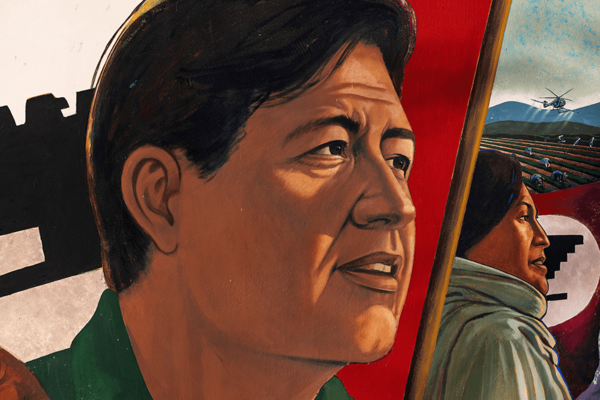
A life-size statue of Cesar Chavez was removed by City of San Fernando, Calif., workers from Cesar Chavez Memorial Park. Murals throughout the park, like the one photographed here on March 19, are also set to be covered as the city determines the site’s future. Photo by Ted Soqui/SIPA USA via Reuters  

Anyra Cano learned a little bit about César Chávez, Dolores Huerta, and the United Farm Workers movement growing up in the 1990s in El Paso, Texas, but the state curriculum didn’t go deep. It wasn’t until she became a pastor that she began to dig into the work of the legendary civil rights leaders. She knew she wanted to dedicate her ministry to social justice for the most vulnerable. In labor organizing, especially Huerta’s work, she saw a model.

“She did the work in homes. She did it at their kitchen tables,” Cano said. “The work of justice is not about getting on a platform. It’s about proximity.”

Cano said that as a Latina, she was keenly aware of the way women of color, especially those speaking up on behalf of the poor, are overlooked and often disregarded, even by their allies. Now, as localities across the U.S. celebrate Farmworkers Day, those celebrating are grappling with the revelations that César Chávez sexually abused multiple women and girls—including Huerta.

Cano, who helps organize churches to advocate for immigrants, is thinking a lot about how Huerta was able to stand with “people who were scared,” in part because Huerta herself knew the risks involved in speaking up for labor injustice amid racism and misogyny.

“She was up against a lot of things,” Cano said. “And now we understand even more.”

The Times investigation

On March 18, Huerta issued a statement, following a New York Times report that she had been among the women and children Chávez sexually abused. “I am nearly 96 years old, and for the last 60 years have kept a secret because I believed that exposing the truth would hurt the farmworker movement I have spent my entire life fighting for.”

The Times investigation described Chávez’s pattern of using “many of the women who worked and volunteered in his movement for his own sexual gratification.” Some were girls as young as 12 and 13—daughters of active union members—the first time he abused them. Both instances of Chávez’s abuse of Huerta ended in pregnancies that she hid from him; the baby girls were given to other families “that could give them stable lives,” Huerta’s statement read.

260331-Chavez2.png

United Farm Workers leaders Dolores Huerta and Cesar Chavez display photos of the conditions that farmworkers endure in San Joaquin Valley farm labor camps at a news conference outside U.S. District Court in Fresno, Calif., on Nov. 21, 1989. Richard Darby/Fresno Bee via ZUMA Press Wire and Reuters

Rumblings of the investigation were spreading weeks before its release. The United Farm Workers canceled César Chávez Day marches around the country. Huerta herself was scheduled to attend an event in Corpus Christi, Texas, but pulled out as the cancellations were announced. On March 17, the day before the Times investigation broke, the UFW issued a statement saying that the union would not be participating in any César Chávez Day activities due to “deeply troubling allegations that one of the union’s co-founders, César Chávez, behaved in ways that are incompatible with our organization’s values.”

Chávez as a figure of Catholic nonviolence

At the same time, Vanguard University historian Michael Jimenez was finalizing his latest journal article, “Blessed Are the Peacemakers: Exploring Joan Baez’s Commitment to Nonviolence with César Chávez and Thomas Merton.” When the Times investigation was published, Jimenez said, he knew he’d be doing more than final edits.

The Catholic historian thought he had read everything there was to read about Chávez in his research on intersections between church history and Chicano history. The labor leader often used Christian imagery and practice in his activism, such as praying and fasting. In 1968, Chávez broke a 25-day hunger fast by receiving the Eucharist alongside Sen. Robert Kennedy, called the “most famous reception of communion in California history,” by the Jesuit magazine America. Chavez won the support of Catholic leaders like Dorothy Day, whose famous portrait seated in a chair among protestors was taken on a UFW picket line in California. She was also arrested alongside Chávez.

When Jimenez learned about the abuse, he was immediately reminded of John Howard Yoder and Jean Vanier, two other prominent Christian peace activists found to be serial sexual abusers. It was hard to make sense of “people who make a living preaching pacifism, nonviolence, and care for the oppressed,” Jimenez said, “then you find out the private side is just monstrous.”

READ MORE: When Leaders Like César Chávez Fall, Abuelitas Remain

Response to the investigation and Huerta’s confirming statement came quickly. City councils in major cities across the U.S. began to discuss renaming streets and parks named in the disgraced labor leader’s honor. In San Antonio, the city immediately dissolved its César E. Chávez Legacy & Educational Foundation. On March 24, Los Angeles Unified School District began procedures to change the names of two schools named in Chávez’s honor.

“The erasure has been swift,” Jimenez said. “I’ve never seen anything like it.”

Accountability, wrestling with legacy

Jimenez said that accountability is necessary, but as a historian, he knows how much of the country’s awareness of labor issues is tied to Chávez, who made his own body—through fasting, marching, and being seen with world leaders—a symbol of the movement.

Cano has mixed feelings about the reaction, though she had always felt that Chávez had taken much of the honor due to Huerta. She noted that celebrating serial sexual abusers is antithetical to justice work but wondered aloud where such swift action and accountability is when it comes to allegations against other prominent men, including President Donald Trump.

“There is a lot of—for me—double standards,” Cano said. “It’s difficult not to see that.”

In Texas, where Cano lives, the state has issued guidance to “eliminate, modify and otherwise alter any learning activities, individual lessons, and ancillary materials to remove references to Chávez.” While the guidance was tied to the recent allegations, Texas has undergone years of debate about how Mexican-American history is taught in schools, and how the Chicano movement—one of many Civil Rights era movements with close ties to the United Farm Workers under the unifying message of “La Causa”—should be studied in public schools.

If erasing memorials to Chávez is taken as an opportunity to suppress farmworker history in conservative states, it would be exactly the backlash Huerta said she feared. It’s also a familiar pressure felt by survivors of clergy abuse, who often describe being told to stay silent when assaulted by pastors, so as not to compromise the man’s ministry.

260331-Chavez3.png

April 3, 1990, Bakersfield, California, USA: Cesar Chavez at the Villa La Paz Conference & Education Center in Bakersfield, Calif., on April 3, 1990. Mark Richards/ZUMAPRESS.com via Reuters

Historians have uncovered accusations of toxic leadership and sexual harassment across progressive movements. In organizations such as the Southern Christian Leadership Conference and the Black Panther Party, leaders at times exercised increasingly centralized control. Chávez presided over internal practices at the UFW that emphasized conformity. While often framed as necessary for survival, that consolidation of authority can also suppress dissent and make internal accountability harder to sustain.

After 30 years in both faith communities and social justice movements, Ingrid McIntyre said she empathizes with Huerta. McIntyre is the Tennessee faith caucus co-chair for Gamaliel, a national organizing network. “Those things happen and we stay silent for the success of the movement,” she said. At the same time, she said, the movement is shifting.

As more women step into leadership in churches and community organizing, she hopes they’ll be afforded justice within their own ranks, not just within the causes they champion. For now, though, women still carry much of the movement’s essential labor. Women, she said, provide much of the care, coordination, and silent work that sustains the rank and file for the long haul, while leaders fixate on high-profile actions and policy wins.

“I think a lot about how the silent work is so ingrained that you’re not even cognizant of what you’re doing,” McIntyre said.

That invisibility makes women’s contributions easy to overlook, even discard, while men in public-facing roles become assets to be protected, their reputations bound up with the movement itself.

The Times investigation revealed that while Huerta may have been silent, Chávez’s abuses were an open secret within the movement. For decades, leaders weighed the cost of taking victims’ allegations seriously, and, based on their inaction, found the price too steep. Even Huerta, in an interview with Latino USA, spoke to her own decision to stay silent, calling it her “personal problem.”

“And, you know, I think it was worth it, you know, because it was my cross to bear,” she said. A scandal would have jeopardized the movement, Huerta said, so her silence was one of many sacrifices.

But sacrifice from those at the bottom and privilege for the leadership level is the opposite of a real movement that claims to represent the most vulnerable, said Baldemar Velásquez, leader of the Farm Labor Organizing Committee. After his personal conversion to Christianity, Velásquez said he approached his organizing work with a keen awareness of aiming for leadership to be the first to sacrifice, not the first to feel entitled.

“You’re asking people to have the self-discipline to go forward with confidence, yes, but with humility,” he said.

Honoring movements, not charismatic leaders

The reckoning with Chávez has underscored a familiar risk for organizers: the dangers of agenda-setting charismatic leaders, as opposed to movements rooted in collective, bottom-up leadership where no single figure comes to embody the whole. Granting too much symbolic weight to one person can become a liability to coalitions built on solidarity.

When movements try to shield harmful charismatic leaders, they suffer as troubling truths about those leaders emerges. Even organizations without formal ties to UFW have benefited from the attention to Chávez, who became a prominent figure for labor justice organizing as much as he did farmworkers in particular. But with that glow, comes the liability as well.

“We’ve had other hits in the farmworker movement over the years,” Velásquez said. “This is a big one, but we have to be resolved to not lose sight of our purpose.”

That purpose goes beyond a union contract or a single policy victory, Velásquez said. Working to change entire exploitative systems, including global food chains and immigration policy, is slow work, and it happens outside the spotlight.

In fact, sometimes the celebration of the man distracts from the actual work, organizers said. The streets and parks and foundations bearing Chávez’s name lent a sense of legitimacy to the entire cause. But they also gave a false sense of solidarity with the nation’s workers, including farm laborers.

In Colorado, the capital city of Denver is racing to rename Cesar Chavez Park and has renamed the March 31 from honoring Chávez to “Sí Se Puede Day,”—meant as symbols of solidarity with farmworkers. But at the same time, the state’s general assembly passed a bill raising the overtime pay threshold for agricultural workers to 56 hours.

For Cano, McIntyre, and others who see organizing as a vital part of justice work, the idea of a leader being beyond accountability flies in the face of what they believe is God’s preference for the poor. If something should be celebrated, it should be every human being that participated, the group, Velasquez said.

“You honor the work, not just the people who are guiding it.”

“The erasure has been swift. I’ve never seen anything like it.” —Michael Jimenez