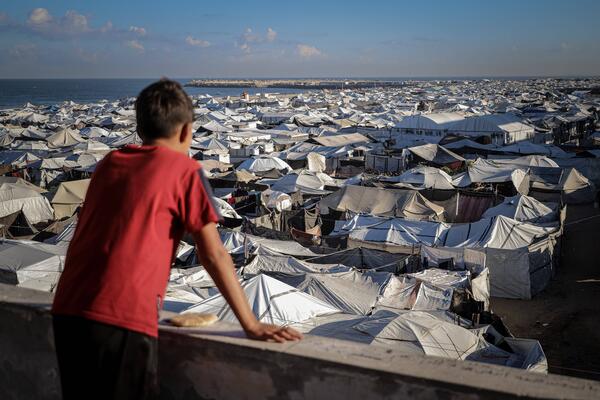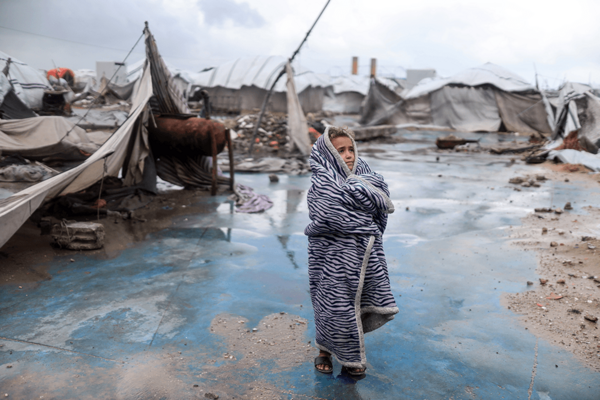
Disintegrating refugee tents, babies freezing to death, and extreme malnutrition are samples of the horrid conditions aid workers with the American Friends Service Committee have been witnessing in Gaza as they and other organizations provide the bulk of health and human services in the decimated region. But soon even those services could be gone. Under new registration requirements from the Israeli government, 37 aid organizations are set to be expelled from the region in March.
“It’s a red flag. It’s a shining light that says things are going to get worse,” Kerri Kennedy, AFSC international associate general secretary, told Sojourners. Kennedy oversees the 100-year-old nonprofit’s work in Gaza. AFSC and dozens of other aid groups have protested the new registration requirements and warned that their expulsion is a harbinger of things to come. “I can’t imagine the horrors and the lives that will be lost,” she said.
First reported by The AP, Israel announced in March 2025 that new registration requirements that aid groups say put their workers at risk and sought to politicize humanitarian groups—a serious concern in Gaza, where more than 180 aid workers were killed in 2024. In December, the government announced that 37 groups had not re-registered under the new requirements, including Doctors Without Borders, CARE, Mercy Corps, and World Vision. Per the announcement, which some aid groups say they have seen only in media and general communications without direct contact from the state of Israel, those organizations have 60 days to cease operations in all Israeli-controlled territory. The requirements, which include handing over lists of their partners and workers, as well as signing ideological statements are “a bright red line that we will not cross,” Kennedy said. AFSC works all over the world, and she said that only North Korea has more strict demands of international aid groups.
Israel said that the new requirements were put in place to prevent Hamas from infiltrating aid groups, the same justification it used for barring the United Nations Relief and Works Agency for Palestine Refugees in the Near East in late 2024. Aid groups—which currently operate 60% of Gaza’s field hospitals and provide 75% of non-food aid and more than 50% of food aid—have responded saying that they vet their workers in accordance with international protocols, comply with donor-mandated audits, follow counterterror financing controls, and do not employ or provide cover for members of insurgent groups. A joint letter from 53 aid groups, including Oxfam, Pax Christi, and Amnesty International, made clear that the obstruction of aid constitutes a breach of international law.
“This is not a technical or administrative matter, but a deliberate policy choice with foreseeable consequences,” the letter said. “Humanitarian access is not optional, conditional, or political. It is a legal obligation under international humanitarian law.” The letter outlined the dire needs in Gaza and the signatory organizations’ unreplicable role in meeting it: “Their removal would close health facilities, halt food distributions, collapse shelter pipelines, and cut off life-saving care.”
‘Worse than hell on earth’
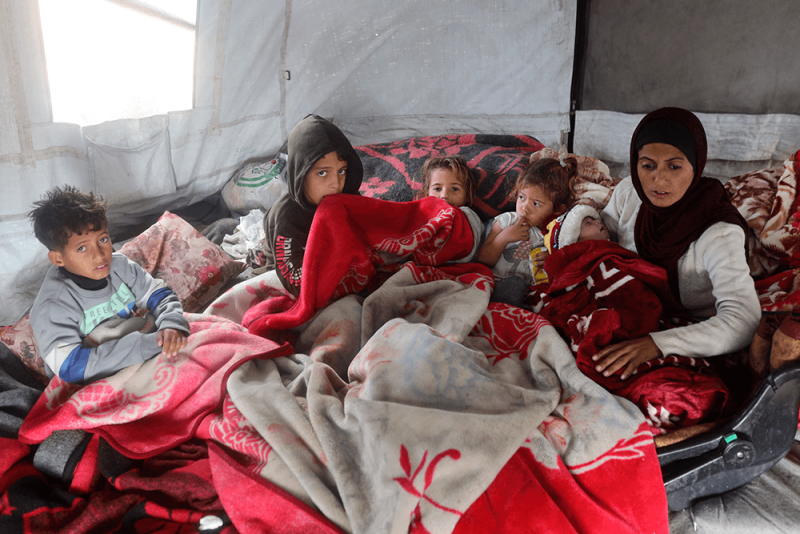
This summer, a representative for the International Red Cross told the BBC that the situation in Gaza was “worse than hell on earth.” Now, as a bitter winter continues in Gaza, floods have made the already dire conditions in tented camps even more deadly. Malnutrition is rampant and doctors have reported four infants have died from hypothermia. Disease and infection are spreading due to lack of adequate sanitation and the compromised immunity of the population. According to the joint letter, a quarter of families in Gaza live on one meal a day. While an October 2025 ceasefire has stopped the heaviest bombing, the Palestinian Health Authority has reported at least 425 deaths from Israeli attacks, including direct targeting of children, since then. With the continued violence, declining conditions, and now the expectation that aid will become scarcer, Kennedy said, “Hope is starting to die.”
260114-GazaAidGroups2.png
AFSC has been working in the territory since it was brought in during the 1948 expulsion of at least 700,000 Palestinians after Israel declared national independence, and with it, claim to Palestinian territory. Known to Palestinians as the Nakba or “the catastrophe,” the displacement marked a turning point for Arabs’ status in their homeland and the beginning of the territorial dispute as it is understood today. In the ensuing humanitarian crisis, the United Nations commissioned AFSC—which had just been awarded the Nobel Peace Prize for its work with Jewish refugees in World War II—to aid refugees, and the organization has been there ever since. While they have not been directly notified of their de-registration, she said, the new uncertainty marks a critical shift.
“This is absolutely a step in the authoritarian play doc,” she said. “We have been set back 80 years on all the progress we’ve made on international law and humanitarian norms … We’re really at a dark time.”
Churches for Middle East Peace, a coalition that includes several of the de-registered organizations, signed the joint letter and spoke to Sojourners, echoing a larger concern for the future of political and religious freedom. Faith-based aid groups—particularly Christian groups—have long been spared politicized scrutiny, because their activities were explicitly aligned with a religious mandate, said Kyle Cristofalo, senior director of advocacy and government relations for CMEP. Now, he said, governments seem to be more willing to restrict religious aid in accordance with their political aims.
“This really is life or death, and people need to understand that as Christians, we’re supposed to feed the hungry and clothe the naked,” he told Sojourners. “It doesn’t say ‘if they agree with your beliefs’ or ‘if you like them,’ it says do it.”
Serving as witnesses
In addition to the tangible aid work the organizations do, Kennedy said, they also serve as witnesses to the conditions on the ground. Israel has already cut off access to Gaza for most journalists. Kennedy herself has not been allowed in for almost two years, and relies on reports from the AFSC workers who have been able to get in and the local organizations they partner with, a structure that will allow some work to continue. But the fewer outside eyes are on Gaza, she said, the more dangerous it becomes for the people inside, including AFSC partners.
In the vacuum created by the pushing out of independent observers and aid, state control of information and resources grows.
Cristofalo was also troubled by the announcement that humanitarian aid would be handed over to private entities, which he said was reminiscent of a sort of “Gaza Humanitarian Foundation 2.0.” The GHF, an Israeli-run, U.S.-backed aid company, came under criticism as Israel shot and killed a reported 410 Palestinians seeking aid at GHF distribution sites between May and June 2025. In November, the company declared its humanitarian mission to be accomplished and ceased operations.
Disrupting the delicate aid network right now will be catastrophic, Cristafalo said. The expertise of the aid groups on the de-registry list is irreplaceable—they are some of the only organizations in the world with experience in places as fragile and complex as Gaza.
“They are the backbone of providing what little services are available,” Cristafalo said. Without them, “more people will die.”

Did this article have an impact on you? Tell us how! Whether you’re moved to take action, have a question, or want to share a comment (good or bad), we value your feedback!