This Christmas, I’m looking forward to curling up on a snowy morning with one of my favorite stories: J.R.R. Tolkien’s The Lord of the Rings. Whether in book or film, Tolkien’s high fantasy remains politically relevant and holds a prescient message for the Advent season.
But before we get to that message, we need to revisit an October social media post from billionaire Elon Musk, celebrating British anti-migration activist Tommy Robinson. Musk attempted to make this endorsement palatable by wrapping Robinson’s hateful rhetoric in a comforting metaphor: The “gentlefolk of the English shires” can be understood as equivalent to the famously meek hobbits created by Tolkien. Such innocent people, Musk argued, needed the “hard men of Gondor” to protect them. In Musk’s eyes, Robinson was acting like a hero from Gondor, swooping in to save British citizens from “illegal immigration.”
Musk isn’t alone in borrowing elements of Tolkien’s classic for political messaging. When the film adaptation of The Two Towers premiered in 2001, figures on the Right used it to galvanize support for the War on Terror. More recently, the Department of Homeland Security has posted memes using The Lord of the Rings to imply that immigration enforcement is the “great battle of our time.” Vice President JD Vance cites The Lord of the Rings as an inspiration to his political career.
Last year, my colleague J.K. Granberg-Michaelson wrote for Sojourners about the power of The Lord of the Rings to move people to action. Considering this, I’m not surprised to see the recent rise in authoritarian figures using the story for their own ends. I think those in positions of power are uniquely prone to interpret the strong, wealthy, or impressive as heroic figures.
This is all part of a wider trend of powerful people misinterpreting Tolkien’s true ideas about strength and heroism. When I see powerful people twist a story I love to serve their own ends, whether it’s The Lord of the Rings or the Bible, I’m reminded of why it’s so important to meditate on how God uses the foolish and weak to shame the strong (Luke 1:46-56; 1 Corinthians 1:27). It is not the military might of Gondor that saves the hobbits, but the overlooked hobbits who save Gondor and the entire realm of Middle-Earth. Musk gets Tolkien’s classic almost entirely backward.
When I see powerful people twist a story I love to serve their own ends, whether it’s The Lord of the Rings or the Bible, I’m reminded of why it’s so important to meditate on how God uses the foolish and weak to shame the strong.
Seeing such a dramatic misinterpretation in the public square almost makes me feel bad for Musk. There are few fandoms more concerned about the fine-grain details of their fictional world of choice than Tolkien fans. Any group of people who are willing to argue in forums for decades about whether a balrog has wings or not based on some odd word choices in a few paragraphs from a book that is more than 1,000 pages long are a force to be reckoned with.
The backlash was swift. In an article for WIRED, John Semley called such shallow usage of Tolkien’s work “Shire-posting,” in reference to the hobbit’s fictional homeland. To help illustrate why drawing such a lesson from Tolkien’s novels is directly contrary to their actual message, I’d like to turn to the text itself. Specifically, let’s take a look at the character arcs of Boromir and his father, Denethor, two of the supposed “hard men of Gondor.”
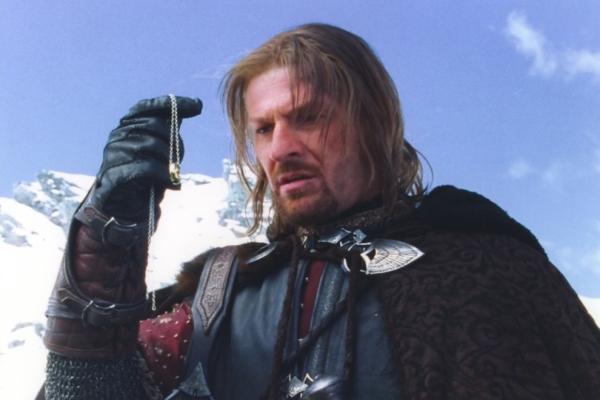
In The Fellowship of the Ring, a council of elves, dwarves, hobbits, and humans ponder the fate of a ring that was made by the Dark Lord Sauron to control the land which they all share, known as Middle-Earth. Boromir, who represents the human kingdom of Gondor, argues that this all-powerful ring, known as the “Ruling Ring,” should be used to protect Middle-Earth and, more specifically, the race of man. But the council ultimately decides that the “Ruling Ring” must be destroyed in the fires of Mount Doom. The council decides a fellowship of nine heroes will travel to Mount Doom to destroy this ring. Boromir joins the fellowship.
While on the journey to destroy the ring, Boromir begins to covet it. Eventually, his lust for power leads to a madness that results in his tragic demise. Despite his moment of greed, Tolkien portrays Boromir as a valiant and complicated character. Ultimately, Boromir’s death and its far-reaching consequences vividly illustrate how desiring power damages even the noblest heart.
Something similar happens to Boromir’s father, Denethor. He is the Steward of Gondor, which has long been besieged by Sauron’s armies. In desperation, Denethor consults a palantir, a magic stone that the strong-willed can use to see the future. However, Denethor doesn’t realize Sauron has corrupted the seeing stones, and his visions drive him deeper into despair. Through their strength, both father and son fall victim to pride and greed. Their moral failures cause irreparable suffering and endanger the whole quest to destroy the ring.
Clearly, Tolkien did not intend the men of Gondor to be the primary heroes of his books. And yet, The Lord of the Rings has many examples of martial valor in its pages. So to a certain extent, it makes sense that some readers would walk away convinced that Tolkien is praising the warrior ethos. If you build a highlight reel of cinematic moments from the series, it’s possible to mistake the whole thing as a war-fighting montage.
But embracing such an interpretation is foolish. In reality, Tolkien consistently chose to elevate the weak with his writing style. As Tolkien scholar Michael D.C. Drout argues in The Tower and the Ruin, even the role of narrator is often taken by the weakest character in a scene.
READ MORE: Sojourners’ Top Movies of 2025
Tolkien’s commitment to showcasing unexpected characters is perhaps most obvious in his portrayal of the hobbits. In the prologue, the author calls them “unobtrusive” and “sheltered” while noting that despite many years removed from the world’s troubles, they remained “curiously tough.” Throughout the narrative, the four principal hobbits are constantly being left uninvited from war councils, mocked as “children” on account of their small size, and mistaken for luggage. But these discounted characters are the true heroes of the narrative.
Take, for example, the hobbit Frodo, the one who has been tasked with carrying the ring to Mount Doom. While on his journey, Frodo is incapacitated and taken prisoner. His hobbit companion, Sam, manages to evade capture and save the ring. In order to save Frodo, Sam decides to put the ring on. Unlike Boromir, that brave but flawed man of Gondor, Sam does not give in to the temptation for power. Sam’s humility allows him to resist the temptation.
Tolkien’s dramatic flip of what heroism looks like doesn’t end with Sam taking off the ring. Discerning readers will realize that his actions happen at the very same moment as some of the grandest battles in the story are unfolding far away. The message is clear: These hobbits’ actions do more to assure the safety of all Middle-Earth than whatever happens between kings and armies.
During Advent, our beliefs about heroism are challenged. For Christians, we meditate on our conviction that the savior of the world was not born as a king or a mighty warrior, but as a poor Jew under Roman occupation. Still, some Christians wrongly attempt to portray our messiah as a hard man of Gondor—an earthly conqueror who has more in common with Christian nationalists than he does with persecuted immigrants.
Taking the men of Gondor to be the heroes of The Lord of the Rings is almost as asinine as reading Jesus’ birth story in Matthew 2 and coming away with the belief that King Herod was actually the real hero. Upon hearing the news of the messiah’s birth, the biblical narrative tells us that King Herod flies into a fit of rage: Herod interprets Jesus’ birth as messiah to be a threat to his power, and decides to kill all the boys in and around Bethlehem who were two years old or younger.
Jesus’ mother Mary seems to have always known, even before his birth, that his existence would unsettle traditional sources of power like King Herod. When the angel Gabriel tells her she will give birth to God’s son, her response is a song we now call the Magnificat. In it, Mary praises God, saying:
“He has scattered the proud in the imagination of their hearts. He has brought down the powerful from their thrones, and lifted up the lowly; he has filled the hungry with good things and sent the rich away empty” (Luke 1:51-53 NIV).
Tolkien and Mary were on the same page when it came to understanding true strength. Beyond the singing and slaying, the quiet repetition at the core of The Lord of the Rings is that power is a corrupting force, no matter whether a hero or a villain wields it.
The Lord of the Rings helps me remember to look for heroes in Bethlehem and Bag End. The core lesson of The Lord of the Rings is an echo of the radical reassessment of what’s valued in the kingdom of God, where the “last will be first, and the first will be last” (Matthew 20:16). If we read it carefully, Tolkien’s masterpiece is a reminder that a time is coming when the proud will be brought low and the humble exalted. That’s a kingdom worth waiting for.

Did this article have an impact on you? Tell us how! Whether you’re moved to take action, have a question, or want to share a comment (good or bad), we value your feedback!