How Christians Can Offer Persuasive Alternatives to War

Most politicians are comfortable debating if a war meets certain criteria for legitimacy. But there is a better framework for deciding moral action.

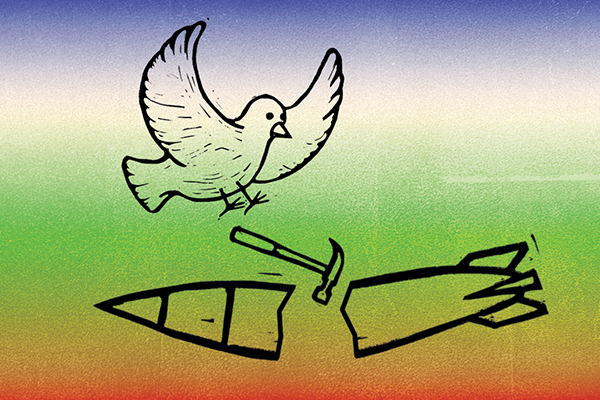
Illustration by Ben Wildflower

THE UNITED STATES is now engaged in another war. This time with Iran. How might we break out of this horrendous cycle of violence and what moral guidance might we offer, especially as Christians? Predictably, the resort by Israel to a violent “defense” against Gaza in 2023, supported by the U.S., has now metastasized into another major escalation in the region, with Iran, Israel, and the U.S. each claiming “legitimate defense.”

In the first few weeks of lethal engagement this winter, at least 1,230 people were killed in Iran, including more than 100 children at a girls’ primary school after an illegal U.S. air strike. Deaths in Lebanon and Israel continued to rise. The war spread across at least 13 countries in the Middle East. Each destroyed home, livelihood, and life increases the bitterness, trauma, and threat. Destroying military equipment, nuclear sites, or killing key leaders does not address root causes of injustice nor the unmet needs behind perceived or real threats.

Some U.S. political and religious leaders continue to debate whether this war meets certain criteria for legitimacy, such as vital national interest, immediate threat, proportionality, probability of success, legitimate authority, and last resort. After 14 years of living in Washington, D.C., and participating in advocacy to government officials, I can report that most politicians are fine with this level of discourse. It allows those with the most direct decision-making responsibility to have the widest possible maneuvering room. They can interpret, and even spin, these debates in ways that maintain their war-making, now or in the future.

To shift not only the debate but the very ground under these leaders, it’s critical to change the discourse and the power dynamic—to offer a moral frame that actually breaks cycles of violence and promotes conditions for human thriving. This is how we gain the power to potentially defuse an ongoing war and prevent the next one. Christians have a particular responsibility to offer alternatives to war and model paths to peace.

One approach is to employ a “just peace” ethical framework to decide moral action. Just peace refers to a positive peace (not simply the absence of violence) rooted in just relationships and societal systems that respect the dignity of all people and the earth. This orientation, as I’ve written in A Just Peace Ethic Primer, envisions a way of cooperation for the common good, the prevention and defusing of violence, and the transformation of conflict by nonviolent strategies. It is rooted in the empirical research of effective strategies.

Just peace norms operate in three categories that may overlap. These include practical norms: 1) engage conflict constructively, 2) break cycles of violence, and 3) build sustainable peace. They apply to all stages of conflict. Strategies and actions chosen must enhance or at least not obstruct these norms.

The war has spread across at least 13 countries.

In the context of ongoing war and to break the cycles of violence, just peace encourages: employing the principle of reflexivity (keeping means and ends consistent); rehumanizing all parties; practicing conflict transformation; acknowledging responsibility for harm; engaging in nonviolent direct action; and working toward what Pope Francis called “integral disarmament,” collectively reducing armed weapons and reducing bitterness, hostility, and hatred within individuals and communities.

The current U.S.-led militarized strategy fails to enhance and even obstructs some of these norms. It moves us farther away from an integral disarmament—and may even exacerbate the conventional and nuclear arms race. This deadly military approach also significantly raises the inconsistency between means and claimed ends, such as sustainable peace. A just peace ethic can show that this strategy of war is not morally just, even when leaders claim imminent threat or legitimate defense.

In addition, a just peace approach offers practical initiatives.

Activate nonviolent direct action. This requires people in the U.S. to disrupt perceived agreement with the U.S. war against Iran through public witnesses and strategic noncooperation coordinated with advocacy efforts that can increase the likelihood of a U.S. policy change. An even stronger response would be for those against the war in the U.S. to work with the nonviolent anti-war movement in Israel, such as Standing Together, a social movement that emphasizes peace, justice, and independence for Israelis and Palestinians, Jews and Arabs.

Reengage in consistent, constructive diplomacy. Diplomats must focus on the needs (such as security, respect, and acknowledgment of harm) of the various parties, as well as the root causes. Coordinating with credible third parties, such as France, India, Qatar, or the U.N., diplomats can put in place concrete steps that increase security for all parties. In 2025, security experts proposed an Israel-Iran nonaggression pact as a way forward with obstinate leaders. Additionally, some have been working on a “regional enrichment consortium” to manage and monitor nuclear enrichment jointly. There are diplomatic ways forward.

Begin independent initiatives to transform conflict. What if U.S. political, religious, or civil society leaders publicly acknowledged U.S. responsibility for the killing of more than 100 young girls at the school in Minab, Iran? Offering apologies and concrete resources to that community as a gesture of reparation would be an unexpected independent initiative and a valuable step toward justice. Such actions begin to shift the tone and dynamic away from hatred, blame, and tit-for-tat destruction. They can reduce tension, build trust, and create a pathway out of war.

Rehumanization in our language, narratives, and symbols. Once war has broken out, our language often increasingly frames the opponent as inhumane. Rehumanization does not mean ignoring harmful acts. However, describing the adversary as “evil,” “monsters,” “rats,” “better off dead,” or that “they’ll only respond to violent force,” as U.S. leaders have recently said about Iran, increases disconnection and dehumanization. This enables cycles of violence both in real life and in our own hearts and psyches.

A just peace ethical framework is a robust set of moral decision-making frames and concrete actions. There are also correlated long-term measures that address root causes, unmet needs, and a more sustainable just peace. As followers of Christ, we can all take steps that move us toward “an unarmed and disarming peace,” as Pope Leo said in his World Day of Peace message this year.

This appears in the May 2026 issue of Sojourners