Join us in Sacred Resistance Donate

'We Will Continue'

Sidebar to "Convicted to the Gospel"

It is the first Sunday after Easter, and Rev. John Fife is preaching to children. "Sometimes, to be a disciple of Jesus means to go places you would rather not go," Fife says, accentuating Jesus' words to Peter.

A few minutes later, Fife is preaching a slightly harder message to a somewhat older group: "The risen Christ is to be found in the persecuted and the suffering who live in the faith and die in the faith....To experience the risen Christ, you must stand with the persecuted who live and die in the faith....That's not us, folks," he interjects. "Don't be fooled by what's going on in a federal courtroom."

It was a regular Sunday morning service at Tucson's Southside Presbyterian Church, the congregation John Fife has pastored for 17 years. But less than four weeks later, the hearing and preaching of the Word on that Eastertide Sunday had taken on a new and far more personal application.

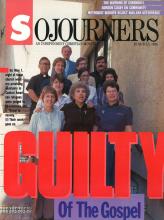
Because a federal jury had found John Fife and seven other sanctuary workers guilty for standing with the persecuted of Central America, Southside's pastor faced the prospect of being led to prison, where he would rather not go.

The jury's verdict, and its serious implications for Fife, marked an important juncture in the journey Southside has been on in the four years since all but two members of the congregation voted to make Southside the first sanctuary church in the United States. The worst-case scenarios the congregation had prepared for had become realities, but members of Southside did not despair. The night after the jury rendered its shocking verdict, the congregation had a special service—and a party. For with the guilty verdict, and all the spiritual trials it would mean, came a promise: a fuller knowledge of the risen Christ.

For all the publicity it has received, Southside remains a simple and humble congregation, a church whose building is too small and whose worship services are refreshingly real and full of life. Southside is a church that thrives because—even in the midst of its sanctuary work and the sanctuary trial—it continues to be faithful to such fundamental tasks as visiting the sick and praying for missionaries.

On any given Sunday, some 147 members and large numbers of visitors crowd into the white-and-blue stucco building on a scraggly corner in one of Tucson's poorest and bleakest neighborhoods, Inside, the liturgy reflects the remarkable diversity of the congregation. The choir, including Fife and his wife, Marianne, sings the gospel hymn "Because He Lives"; the congregation, using Spanish hymnals, sings "Christ the Lord is Risen Today" in Spanish; the gospel is read in English and Spanish; and blacks, Hispanics, Native Americans, and whites, along with a former Catholic nun, a retired Baptist preacher, single mothers, laborers, families, and professionals serve communion to one another.

BUT THE TRIAL has left its mark—on Fife and on the congregation.

"It's been a very difficult time for the congregation," Fife says. "They haven't had a pastor now for a year, a year and a half. I mean, I have been preoccupied with the trial, spending all but two or three days a week [on it], sometimes more than that. And that's difficult in the life of any congregation.

"It's meant that many people in the congregation who would have expected and who would have received pastoral care in times of their own crises have not had those services, on behalf of the church and the community of faith. And I'm sure that's placed a lot of strain on people...The grace of God really is—had better be—pretty broad for folks like me in that situation. So those times have been very difficult for all of us.

"But on the other hand," Fife continued, "it's been a profound time of spiritual renewal for this congregation. They have looked at the indictment and possible conviction and imprisonment of their pastor, and it has meant for them being together as a community of faith, a uniting around a decision, a commitment to ministry, to refugees, of saying, 'Look, no matter what happens to John, our ministry and our call to that ministry goes on.'

"So they have selected a pastor to succeed me [if I go to jail], Rev. Marguerite Reed [a Southside member involved in sanctuary work]. They have arranged for that with the presbytery, and they have put in her job description, 'You can probably expect to be indicted or arrested in this position. And we are going to continue to provide sanctuary for Central American refugees—no matter what. Because we believe that we are called to that particular mission by God, and we cannot sell our souls. And if they put our pastor in prison, we will call another pastor, and we will continue to provide leadership and ministry in that particular mission. We will continue.'

"All of that has been wonderful," Fife said. "It's been delightful to see a congregation who has understood that kind of commitment and has come together as one around that decision, who has not been afraid in the face of a threat from the civil authorities, who has understood that faith is that important to them and is common to them, and who can discover that and celebrate it—and have a sense of humor about it.

"The spiritual joy of that congregation at worship is something that has kept me on track and grounded through all the emotional ups and downs of the trial. And I never expect to have such an experience in ministry again."

This appears in the July 1986 issue of Sojourners