Subscribe and Get Our New Book Subscribe

Cultivating a Better Future

To survive this moment, can we find hope in what can sprout in the rubble of history?

maxbelchenko / Shutterstock

AS WE CLOSE the first quarter-century of the new millennium, the situation seems dire. Political violence, wars, and disasters abound. But zooming out from the immediacy of our moment may help us gain some footing for what’s to come.

Half a century ago, in 1975, the Vietnam War ended, Bill Gates and Paul Allen founded Microsoft, and Taco Bell was beginning its ascendancy in fast food chains.

A century ago, the United States was in the thick of the Roaring ’20s, a time of opulence and optimism, of flappers, radio, and moving pictures. But the bubble of endless economic expansion was about to burst with the 1929 stock market crash and the subsequent Great Depression. The rich got richer—until society couldn’t sustain it anymore.

A thousand years ago, the United States didn’t exist. The Mayan civilization was on the verge of collapse. Some scholars recently suggested this was due to climate change being made worse by unchecked development. The Song Dynasty in China and the Islamic world in Baghdad, Cairo, and Córdoba were experiencing golden ages of cultural and technological flourishing. In Europe, the Christian church was blessing and legitimizing the feudal systems of lords, vassals, and peasants.

In each era, the seeds of the following eras are planted, watered, and taking root. Empires—whether political, technological, or cultural—rise and fall. As the apostle Paul said, we reap what we sow (Galatians 6:7).

The phrase that always comes to mind when I think about our current era is “the dying gasps of late capitalism.” It feels we are on the cusp of a new era, though those who love the “good old days” of American dominance and Leave It to Beaver simplicity will cling tightly and sometimes violently to what is comfortable.

At the end of this year, we will also close out the first half of what many have called the “decisive decade” between 2020 and 2030 when humankind determines how much we will check our runaway consumption and extraction to curb the climate crisis.

The question isn’t if things will fall apart, but when and how. But as the infrastructure of our so-called American Dream implodes from within, with great fanfare and fury, seeds are already sprouting for a different way of life. So many of us thought the pandemic would be a wake-up call to our belongingness to each other. Five years later, we are disappointed to observe our culture’s rush back to business as usual and mindless digital apathy. But sometimes seeds lie dormant until the conditions are right.

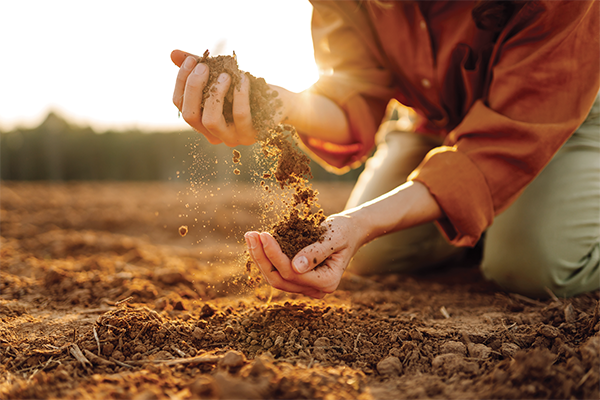
Like fungal networks in the humus, new pathways and possibilities are emerging underfoot. Though a look at this past year reveals so much political and cultural rot, if we look closely, as well as historically, we may see the beginnings of compost—the fertile conditions for God’s “kin-dom” to flourish. May we each play our part in this deep, enduring cultivation work.

This appears in the December 2025 issue of Sojourners