CREATION STORIES, WHETHER modern or ancient, share an impulse to explain the situation of those telling it. Consider the first creation story we encounter in Genesis. In six wondrously efficient days, God transforms “the complete chaos, and darkness” covering the Earth into an organized universe. The orderly creation of Genesis 1-2:4a, written during a catastrophic period in ancient Israel, is meant to reassure the Israelites that God is indeed fully in charge of the world, and all is not lost, no matter how terrible things seem. Stories of the “founding” of America by the Puritans likewise imbued the country’s early self-understanding with a supposedly divine mandate. That way of thinking continues to inform and justify the behavior of the U.S. to this day.
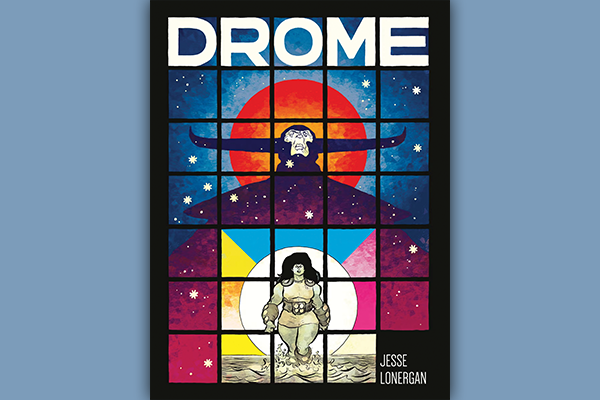
In his new graphic novel Drome, Pennsylvania artist Jesse Lonergan accomplishes a difficult task—he creates a meaningful creation story from the vantage point of the brutal and chaotic world of today.
In marked contrast to the organized, step-by-step creation of life in Genesis, Drome imagines existence beginning with violence. A spooky, extradimensional male god-figure quietly drops seeds into the earth. From them emerges first one man, then another. As soon as the first sees the second, he seizes a stone and beats that man to death.
Before we can get our bearings, the earth explodes with every form of life—birds and humans, tigers, insects, and giant crabs. And as with the first man, no sooner do those creatures emerge than they all begin tearing one another apart, their eyes wide with rage and confusion.
Across the 320 gorgeously drawn, largely wordless pages that follow, Lonergan takes us on a journey from chaos to civilization, as a divinely appointed female figure is sent to the world to bring about order. While she initially succeeds and finds love, humanity quickly casts aside her leadership in favor of a society unified around its hunger for power and violence.
Where the typical creation story often protects its creators from judgment, in Drome, civilization’s collapse is a direct result of the male deity’s continued intervention. In a violent, unjust world, no one’s hands are clean, not even those of our gods.
In addition to providing some kind of rational explanation for a community’s current situation, creation stories generally have a forward-looking intention. Genesis wants to give its readers hope for the future and perhaps courage to face it. In our modern world, where so many sacred texts have been used to justify horrors, Lonergan refuses to propose another potential justification. Humanity does not need more excuses for its behavior, Drome suggests. It does not need reassurance that all shall be well or explanations of how we all got here. It needs to be confronted with the reality of our existence: the seemingly endless seductiveness of violence and oppression in human history, no matter the supposed “goodness” of its people.
Is human civilization truly capable of growing beyond the foundational violence from which it emerges? In the end, Lonergan offers only a haunting, fitting silence. The answer, like the state of our world, is up to us.

Jim McDermott is a freelance screen and magazine writer in New York. He writes a Substack on pop culture and spirituality at Pop Culture Spirit Wow.

Did this article have an impact on you? Tell us how! Whether you’re moved to take action, have a question, or want to share a comment (good or bad), we value your feedback!