
AS ANTI-GOVERNMENT protests in 2025 erupted in Indonesia, Nepal, the Philippines, Morocco, Madagascar, France, and the U.S., observers and journalists noticed demonstrators flying an unusual flag. The “Jolly Roger”—a white skull and crossbones on a black field—wearing a distinctive yellow hat was instantly recognizable to fans of Japanese anime culture. This flag belongs to the fictional Straw Hat Pirates from One Piece, a Japanese manga by Eiichiro Oda. This particular shonen (“youth”) graphic novel series has become a global symbol of revolution, resistance, and hope against government oppression and corruption among young protesters.
First published in 1997, One Piece, with more than 500 million copies sold, is the most popular manga in the world. It has spun off more than 1,100 animated episodes and a live-action Netflix adaptation and continues—three decades on—to run in Shonen Jump, Japan’s influential weekly manga anthology.
In the Netflix show, some characters possess special abilities gained from eating “Devil Fruits.” Monkey D. Luffy, the adventure-seeking captain of the Straw Hat Pirates who ate the Gomu Gomu no Mi (“Gum-Gum Fruit”), now has a comically stretchy rubber body. Luffy leads a diverse crew and traverses the Grand Line, an ocean route with countless islands inhabited by different races and nations. The crew continuously chases after the treasure called “the One Piece.” The rulers of their planet, the World Government, enforces its authority through the Marines. All is not well in this world. Pirates—whether adventurers, explorers, or outlaws—often defy government control, plundering and fighting their way toward the treasure. Those who resist official rule face brutal suppression by the World Government. Although claiming to uphold justice and peace, the Marines ultimately serve the Celestial Dragons, a self-proclaimed divine aristocracy who exploit and enslave others. In many ways, the Celestial Dragons resemble our global one percent: They have shaped the world’s laws and economic order to benefit themselves even when they don’t formally govern.
If the Celestial Dragons reflect the world’s oligarchs, dictators, and technocrats like Jeff Bezos and Elon Musk, Luffy is more of a Jesus figure. He declares an alternative authority and kingdom by exuberantly proclaiming, “I’m going to be the King of the Pirates!” He rejects the imperial logic that denounces pirates, and sets out to sea as a teenager, assembling a boisterous crew of nakama—friends bound by deep loyalty and companionship. Through his chaotic adventures, Luffy frees slaves, dismantles racial hierarchies, inspires the downtrodden, and leads rebellions against the Marines and the World Government.
apr26culture2.png
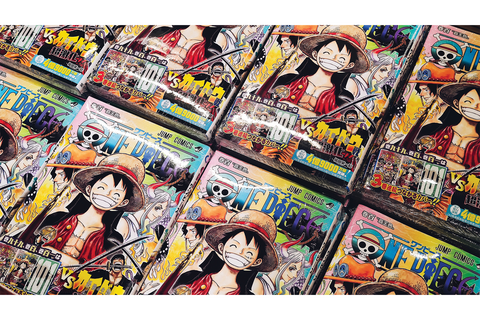
As the story unfolds, his powers grow increasingly absurd. We learn that he is the second coming of Joy Boy, a messianic figure from ancient history whose very heartbeat is known as the “Drums of Liberation.” It’s easy to see why Luffy—a figure who undermines oppressive authority, frees captives, and inspires hope through joy—resonates with younger protesters around the world who have grown up with anime.
Like Luffy and his crew, or Jesus and his disciples, our survival and flourishing depend on one another.
For followers of Jesus, the echoes of the gospel are hard to miss. In One Piece, as in the Bible, we meet a messianic savior who frees people from bondage. Salvation does not come from the halls of power but from the most unlikely places and people. “Can anything good come out of Nazareth?” asked Nathanael upon hearing of Jesus’ hometown. Likewise, Oda asks, “What good can come out of East Blue—from an elastic, goofy, rebellious, parentless teenager?” We see that Luffy’s defiance shakes the foundations of power. Even the highest authorities in the World Government fear that their propaganda—and their grip on history may crumble because of him.
Similarly, Jesus threatened the Roman Empire and religious establishment so profoundly that they subjected him to their ultimate punishment: Submit yourself to imperial law and order, renounce your challenge to the emperor, or die. Yet Jesus offered an alternative path in an upside-down kingdom—worship only God, love your neighbor, love even your enemies, lay your lives down for others, bless those who are persecuted, remember the forgotten on the margins of society, and do not seek worldly power. To those dehumanized by power, Jesus offers dignity, reminding them they are seen, loved, and made in the image of God.
As a protest symbol, the One Piece flag also reveals something about the kind of hope protesters carry. Just as activists in Portland donned frog costumes to mock state authority, flying a cartoon pirate flag amid militarized riot police and murderous ICE agents exposes the absurdity of violence against protesters. As is customary of shonen manga—and in sharp contrast with Jesus—Luffy’s battles are violent in nature. But the wildness with which he fights and the joy he exudes transforms even enemies into allies. Joy Boy never loses his laughter or playfulness.
apr26culture3.png

This joy—defiant in the face of despair—is precisely what the Christian faith offers to movements against authoritarianism. In a world where rulers seek to crush our spirits, the practice of joy itself becomes an act of resistance. Scripture continually calls us to rejoice—in suffering; in Christ, that our joy may be made complete; and in the hope that joy will come in the morning. Those who fly the Straw Hat flag may be drawn to this same resistance: a resistance marked by joy.
As followers of Jesus, we are called to counter hatred with love, to draw from a deep well of hope, and to dance on the grave of the devil with joy. In One Piece, Luffy never dances alone. The Straw Hat crew is, in many ways, dysfunctional apart from one another. Luffy is impulsive and led by his stomach. His first mate, Zoro, is hilariously directionally challenged. Sanji flees from his past and abusive family. Usopp hides his cowardice behind tall tales. Nico Robin is fleeing from the authorities as a survivor and witness of state genocide, and Nami is a thief haunted by trauma. Yet Luffy’s rise as a Yonko (the four most powerful pirates) depends entirely on his nakama—on their mutual care and shared purpose.
This dynamic mirrors Jesus’ motley crew of disciples, which includes a few fishermen, a religious extremist, and a tax collector. Resistance to oppressive imperial logic cannot be sustained by individuals alone. Members of the body of Christ sustain and protect one another as we seek the well-being of our neighbors. Like Luffy and his crew, or Jesus and his disciples, our survival and flourishing depend on one another. Those who fly the Straw Hat flag are doing what we as Christians should be doing: calling others to resist oppression and inequality for the sake of communal flourishing. Like the church that steps in to distribute groceries to immigrant neighbors being terrorized by ICE, or like clergy who put their bodies on the line in solidarity with protesters, they are calling us to an alternative narrative and community; one that overcomes evil with love, and where anyone who chooses joy, hope, and freedom for the sake of others is welcome.

Chuck Liu is an otaku (“superfan”) and as assistant professor of psychology at Wheaton College in Illinois.

Did this article have an impact on you? Tell us how! Whether you’re moved to take action, have a question, or want to share a comment (good or bad), we value your feedback!