Institute on Religion & Democracy

The United Methodist Church’s top court has ruled that the consecration of an openly gay pastor as bishop is against church law.
But, in a somewhat muddled ruling that could reflect the ongoing struggle to determine how great a role LGBTQ members can play in the second largest Protestant denomination in the U.S., the court also ruled that the Rev. Karen Oliveto, its first openly gay bishop, “remains in good standing.”
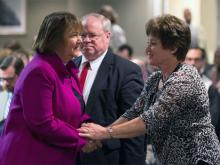
The United Methodist Church will hold a special session of its General Conference to settle questions of LGBTQ inclusion that have vexed the global denomination for years.
The announcement came on April 25, the same day the denomination’s highest court held a hearing on whether an openly gay pastor can serve as bishop.
The General Conference, the United Methodist Church’s top legislative body, typically meets every four years. At last year’s meeting in Portland, Ore., it voted to defer all decisions about human sexuality to a specially appointed commission and left the door open for a special session.

United Methodists concluded their General Conference last Friday (May 4) without voting on gay clergy or same-sex marriage, a surprising end to a disappointing week for gay activists.
Last Thursday, the nearly 1,000 delegates gathered in Tampa, Fla., soundly rejected two motions that would have amended the United Methodist Church's book of doctrine and rules, which calls the practice of homosexuality "incompatible with Christian teaching." After those votes, protesters flooded the convention floor, briefly shutting down the conference.
Conference planners, evangelical leaders and gay and lesbian advocates met later on Thursday and determined that there was little use in holding additional contentious debates on homosexuality, according to several sources. Proposals to ordain gay clergy and bless same-sex unions held little chance of passing, the parties agreed, and so were pushed to the back of the agenda, essentially assuring that they would not be debated.
"Leaders of the demonstration were told that the legislation was postponed to avoid more harm to LGBT people and their supporters," the Love Your Neighbor Coalition said in a statement. "The United Methodist Church had an opportunity to offer love, grace, and hope," the coalition said. "Sadly, we did not take that opportunity."