duane shank
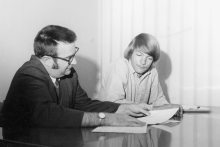
Duane Shank, a Mennonite peace activist, community organizer, and author, died on April 20 in Goshen, Ind., after two years in hospice. He was 70. The cause was complications from chronic obstructive pulmonary disease, according to his family.

Despite all that I knew 40 years ago about the policy and politics of the Vietnam war, I learned much more by simply listening to veterans. Late at night, often in bars, I heard about the war from the experience of those who fought it. And that taught me more than everything I had ever read. With tens of thousands of vets coming home from Iraq in the next two months -- and many more returning from Afghanistan over the next two years -- we'll have plenty of opportunities to say thanks, and then just listen.

With the opening of the G20 Summit in Cannes, France today, an idea that's been around for awhile is in the news again and gaining more attention as a result of the #OWS movement: The so-called "Robin Hood tax," a minimal tax on all financial transactions with the resulting revenue dedicated to anti-poverty programs....Archbishop of Canterbury Rowan Williams, in his response to the occupation of St. Paul's Cathedral in London, endorsed the Vatican proposals. Williams observed that "people are frustrated beyond measure at what they see as the disastrous effects of global capitalism," and urged a full debate on "a Financial Transaction Tax

The Occupy Wall Street movement continues to preoccupy the imagination of editorial writers across the nation.
The Rev. Fred Shuttlesworth, a pioneer and giant of the civil rights movement, died Wednesday at 89.
? U.S. troops on the front line believe that the war will go on for another 10 years after they leave.
? An audit shows that the surge of U.S. civilian advisers has cost nearly $2 billion.
? The U.S. mission in Afghanistan has suspended the transfer of detainees to several Afghan jails, following torture allegations.
Two long pieces this weekend described "one hell of a killing machine," and "the dark matter
Imagine. You're on a backpacking trip, hiking through deserted countryside on a hot day. You've been prudent, and have just enough water to get you to the next campsite that evening. Then you come across another hiker, short of water, who is beginning to show signs of stress. You don't know if there is any water nearby until you get to the campsite. What do you do?
The question was posed in a recent story about hiking in the Grand Canyon, where it regularly occurs. A spokesman at the Grand Canyon remembered at least one case in which someone died "trying to provide more help than they could physically afford to provide."
Some of the answers given by hikers were:
The avalanche of information available via the Internet is both a blessing and a curse. Used judiciously, it is an invaluable tool for research -- making what used to take hours in a library now just a few clicks away. Any piece of information, no matter how obscure, is at our fingertips.
The proliferation of blogs and listservs mean an amount of information that is simply impossible to keep up with. We have news summaries several times a day and instant breaking news headlines as they happen. And then there is the rise of a new social media. Facebook has enabled us to connect with friends and family, so we know immediately the latest cute thing their toddler did, what they're cooking for dinner, and the most recent book they read. On Twitter, we share thoughts and activities in 140-word tweets.
All of this means we know more than ever, but never have time to think about it. Neal Gabler, a senior fellow at the Annenberg Norman Lear Center at the University of Southern California, lamented in a piece in The New York Times Sunday Review:
This evening I will lead a Passover Seder observance in my Christian community. We've done it for years and always find it inspiring to reflect on God's liberation from slavery. And it's the occasion for a delicious potluck feast.
This week I saw an article written last spring on Jews' concerns over Christians celebrating Passover. It seems that more Christian churches are using "Christianized" versions of the seder, reinterpreting the meal's symbols to reflect Christian beliefs. Said one rabbi, "They take our symbols, our holiday, our ritual and start investing them in Christian meaning."
The One Percent. Dear Fork. Budget Cuts. Here's a little round up of links from around the Web you may have missed this week:
- "Of the 1%, by the 1%, for the 1%" -- Joseph Stiglitz on inequality in America.
- Dear Fork, You have a son.
- Go inside Prague's off-limits baroque library.
- We're not broke. Not even close.
- Our new and improved Daily Digest from Duane Shank is the best round up of relevant news articles out there. Yeah, I said it: It's the BEST.
- Let's thank our members of Congress for joining the hunger fast for a moral budget. (Call your member and ask them to join.)
- Stay updated on the latest news from the hunger fast for a moral budget.
- Michael Gerson on the real-world effects of budget cuts.
- Watch this CNN report on the hunger fast for a moral budget.
I watched on Al Jazeera television and followed tweets (#Tahrir) from Tahrir (Liberation) Square in Cairo, Egypt as hundreds of thousands of Egyptians awaited a promised speech by President Hosni Mubarak.