An excerpt from Radical Spirit: 12 Ways to Live a Free and Authentic Life, by Joan Chittister, OSB
Catholic nun
Jill Crainshaw 4-25-2018
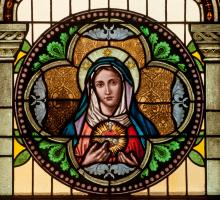
Nancy Bauer / Shutterstock
SHE: ROBED AND WORDLESS, by Sister Lou Ella Hickman, is a word-feast of poetry about often-overlooked women in the Bible.
Hickman creates a beautiful narrative and poetic arc as she explores biblical terrain. I celebrate how the book gives voice and imagery to our foremothers. Each poem is well-crafted, and the book has been organized to guide readers into the question editor Tom Lombardo asks in his introduction to the book: “After Eve, who is the next woman named in the Bible?”
Hickman, a Catholic sister, is an oft-published poet who in this book weaves together with striking lyrical threads scriptural narratives and her own substantive imaginings about the hopes, dreams, and fears of women about whom we know very little. Many women in the Bible are unnamed and have no voice, but Hickman tunes our ears to listen for these ancient unheard ones. In doing so she invites us to see and hear the countless but wisdom-filled “robed and wordless” women in our communities today.
Phil Haslanger 5-17-2012
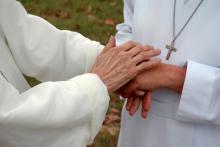
Photo by Elena Ray / Shutterstock.
The crowd in an Atlanta church on Wednesday night was mostly Protestants, mostly preachers.
The speaker was a professor of preaching at Union Theological Seminary in New York City – one of the icons of the mainstream Protestant world.
Yet Barbara Lundblad’s message was a call for the 1,000 or so people gathered for the annual Festival of Homiletics to “stand with these courageous Roman Catholic sisters.”
She was referring, of course, to the recent crackdown by the Vatican on the Leadership Conference of Women Religious, the organization that represents about 80 percent of the nuns in the U.S.
Lundblad drew on the famous story of Mary, having just learned she was pregnant with Jesus, visiting her cousin, Elizabeth, who was also improbably pregnant.
The Gospel of Luke says that Mary “entered the house of Zechariah and visited Elizabeth.” Lundblad pondered why Luke felt it necessary to put Zechariah in the story at this point. She let that hang unanswered.
Then she noted that when Elizabeth saw Mary, the baby leapt in her womb in recognition of Jesus – a sign that women often come to theology through the experiences of their bodies.
Lundblad said wryly, “Surely Elizabeth would not have been allowed to testify before the Congressional committee on contraception” – an all-male committee with all male witnesses, all representing church groups that do not allow the ordination of women.
Sheila Stroup 2-04-2012
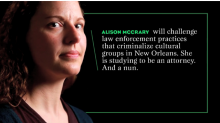
Alison McCrary
Alison McCrary starts her mornings with prayer and meditation.
Sometimes she writes in her journal, other times she draws geometric mandalas. It's a way of silencing her mind.
She thinks about what grace she wants to ask for that day. Patience? Gratitude? Understanding?
"Humility is a big one," she says. "I ask, 'How can I increase God and decrease me?'"
McCrary graduated from law school in May and is in formation to become a nun in the Congregation of St. Joseph. She lives with a group of sisters in a house, and every night they sit down to eat together and share after-dinner prayers.
McCrary tries to strike a balance between prayer and ministry. The young lawyer, who turns 30 in February, spends her days as an advocate and organizer working with a grassroots group, Safe Streets/Strong Communities.
"People are always asking me, 'Why don't you get burned out?' But I feel like the more you give, the more you get back," she says.
Often, her ministry takes her to the streets of the city, monitoring second-line parades for any police misconduct, or sitting in a bar talking to Mardi Gras groups about noise ordinances or curfews that threaten native traditions.