book of lamentations

WE FIND OURSELVES AMID “ordinary time.” Most of the liturgical calendar, like our lives, is comprised of ordinary time. Yet our readings this month remind us that the extraordinary can be found in the ordinary, just as God can be found in us. Each of the gospels this month shows us Jesus growing more into his ministry as well as his identity as the Christ. Like us, he is not always comfortable with who he is. We see him: questioning who touched and was healed by his cloak (Mark 5:21-43); rejected by his hometown (Mark 6:1-6); said to be a prophet raised from the dead (Mark 6:14-29); acting like a good shepherd (Mark 6:30-34); retreating after feeding the 5,000 because he does not want to be forced into being king (John 6:1-21).
Even amid miracles and messianic titles, there is an ordinariness about Jesus in these stories. We glimpse a familiar narrative of the suffering and joy found in following God’s call. For some, this interpretation may be too much of a “Christology from below,” too little emphasis on Jesus as divine. Yet the gift of ordinary time reminds us that what we deem too quotidian, too human, might reveal God to us after all.
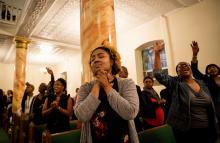
Lament is not a passive act. Many Christians may hear the word lament and assume that feeling bad about suffering is the purpose of lament. How sad that people died. How sad that the shooter had a mental illness. But lament moves beyond bad feelings for the privileged. Lament is subversive and an act of protest. The powerful and the privileged have no problem being heard. It is the marginalized that need to be heard. The voiceless speak through lament. They cry out that things aren’t right. They are not the way things are supposed to be. Lament voices the prayers of the suffering and therefore serves as an act of protest against the powers.

Most people have heard of Hanukkah and Passover and maybe Yom Kippur — the Jewish Day of Atonement. But Tisha B’Av?
Translated as the ninth day of the Hebrew month of Av, it counts as one of the most important days on the Jewish calendar. But even many Jews have not heard of this period of mourning, which requires a 25-hour fast to commemorate the destruction of the First and Second Temples in Jerusalem.
Tisha B’Av, many rabbis say, can be a tough sell, in part because a radical group of far-right Jews wants to rebuild the temple on the site of what is now the Al-Aqsa Mosque, one of Islam’s most revered sites.