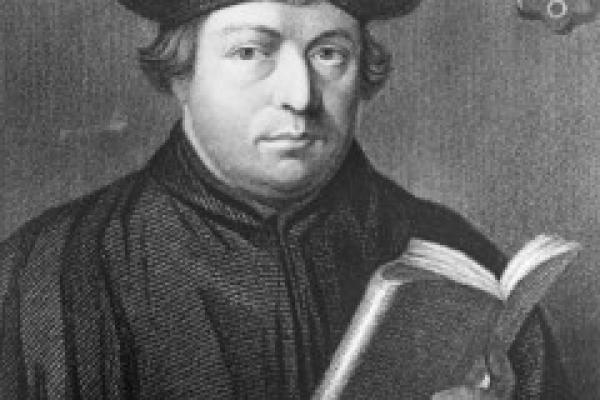
VATICAN CITY — Lutheran leaders have warned the Vatican that the creation of a structure to welcome conservative Lutherans into the Catholic Church would harm dialogue and damage ecumenical relations.
In 2009, Pope Benedict created a special church structure, called an ordinariate, to allow disgruntled Anglicans to convert to Catholicism while maintaining bits of their traditions and culture.
Ordinariates have been created in the U.S., England and Australia, attracting hundreds of conservative Anglicans who oppose female and gay bishops and who seek greater lines of authority.
In recent weeks, senior Vatican officials publicly suggested the creation of a similar structure for disaffected Lutherans; the idea was first floated last October by Cardinal Kurt Koch, the Vatican chief ecumenist.
According to Catholic media reports, Archbishop Gerhard Ludwig Mueller, who heads the Vatican’s doctrinal office, said on Jan. 11 that if Lutherans asked for the creation of an ordinariate, the Vatican would consider their request.
Mueller’s words were swiftly rebuked by the Rev. Martin Junge, general secretary of the Lutheran World Federation. “The creation of such a special structure would have deep ecumenical repercussions,” he warned on Jan. 18.

Much has been made of the "rise of the nones" — that is, the increasing percentage of Americans who identify with no religion. It is a fascinating and undeniable trend, and one that should catch the attention of religious leaders.
I know quite a few Nones. Few of them were raised in the absence of any faith tradition. Instead, most were part of a Christian denomination at some point, but consciously made the decision to leave. What interests me about their stories is this common thread: The majority left Christianity because of the attitudes of a person, and that person was not Jesus. It was an overbearing parent, or a judgmental minister, or a congregant who told them they did not belong because they were gay or they were questioning or they had conflicted ideas. In many cases, it was a combination of these types of influences.
Something is wrong when we drive so many people away. I think a big part of that something is arrogance.
This raises the question, then, of how to be a public Christian, even an evangelical Christian (which is how I identify myself), without running the risk of arrogance.
I don't embody the ideal I'm about to describe in answer to that question, but I know some people who do. These are the people who made me want to be a Christian. What I see in them are three key attributes: They are authentic, unashamed and honest.
Several months ago, the Washington Post reported that presidential counterterrorism adviser John Brennan was developing a “playbook” of rules for drone attacks:
“The “playbook,” as Brennan calls it, will lay out the administration’s evolving procedures for the targeted killings that have come to define its fight against al-Qaeda and its affiliates. It will cover the selection and approval of targets from the “disposition matrix,” the designation of who should pull the trigger when a killing is warranted, and the legal authorities the administration thinks sanction its actions in Pakistan, Yemen, Somalia and beyond.”
On Sunday, the Post followed with a report that the playbook was nearing completion, and would provide clear rules.
“In Yemen, officials said, strikes have been permitted only in cases in which intelligence indicates a specific threat to Americans. That could include “individuals who are personally involved in trying to kill Americans,” a senior administration official said, or “intelligence that . . . [for example] a truck has been configured in order to go after our embassy in Sanaa.
“The playbook has adopted that tighter standard and imposes other more stringent rules. Among them are requirements for White House approval of drone strikes and the involvement of multiple agencies — including the State Department — in nominating new names for kill lists.”
But there is one exception to the new rules. The CIA drone program in Pakistan gets an exemption for at least a year. That exemption is described as “a compromise that allowed officials to move forward with other parts of the playbook.” The disputed point that apparently led to it was the CIA’s use of so-called “signature strikes,” attacks based on behavior seen as suspicious rather than in specific identified targets.
It also appears that the coming withdrawal of U.S. troops from Afghanistan will lead to more and more drone attacks. The Post quotes a former official involved in the playbook, “There’s a sense that you put the pedal to the metal now…”
Evangelicals haven't always been part of the pro-life coalition. Prior to Roe v. Wade in 1973, the Southern Baptist Convention passed a resolution supporting abortion in certain circumstances. After Roe allowed any abortion for any reason, evangelicals began to change their stance and with Catholics formed the pro-life coalition we know today. The Washington Post reports:
The reality of abortion on demand and exposure to the logic of the abortion rights movement led to a fundamental shift in the evangelical conscience. By 1976 the Southern Baptist Convention would declare every abortion to be a “decision to terminate the life of an innocent human being.” Similarly, the large evangelical movement would develop an overwhelming pro-life consensus, seeing abortion as a great moral evil and a threat to the dignity of all human life.

While Washington, D.C., reveled in the ceremonies and parties surrounding Inauguration Day, U.S. drones were busy in Yemen. According to Reuters, four attacks in four days, from Saturday to Tuesday, killed at least 14 people. The attacks led to a protest blockade by angry tribesmen:
“On Sunday armed tribesman, angry at what they said was a drone attack on an area inhabited by civilians, blocked the main road linking Maarib with Sanaa. Earlier this month, dozens of armed tribesmen also took to the streets in southern Yemen to protest against drone strikes that they said had killed innocent civilians and fuelled anger against the United States.”
In another protest, Reuters reported a rare criticism of drone strikes by a member of the Yemeni cabinet. Human rights minister Hooria Mashhou, who was formerly a top activist in the movement that ousted President Ali Abdullah Saleh a year ago, said during a U.N. Yemen humanitarian appeal meeting in Dubai:
"I am in favour of changing the anti-terrorism strategy. I think there are more effective strategies. We're committed to fighting terrorism but we're calling for changing the means and strategies. These means and strategies can be applied on the ground without harming civilians and without leading to human rights violations."
One day after making climate change a key issue in his inaurugal address President Obama has decided to put off a decision on the Keystone XL Pipeline until April. The issue was thrust to the front of the agenda today when the governor of Nebraska approved the pipeline. The ultimate fate of the project is in Obama's hands. The Guardian reports:
Republicans immediately pushed Obama to approve the pipeline. "There is no bureaucratic excuse, hurdle or catch President Obama can use to delay this project any further," John Boehner, the Republican speaker of the House of Representatives, said in a statement. "He and he alone stands in the way of tens of thousands of new jobs and energy security."
Campaigners against the pipeline said Obama should immediately shut down the project. "Approving Keystone XL would make a mockery of the commitment he made at the inauguration to take action on climate change," said 350.org, which has led opposition to the pipeline.

Among my must reads are the Sunday New York Times Book Review and other book reviews I come across in various media outlets. There are too many books being published that I would love to read, but just don’t have the time. So, I rely on reading book reviews as one way of keeping in touch with what’s being written. Here are my picks from this week’s books.

One of my favorite views of Charm City right now is entering into the downtown area from the 395 off-ramp. Our city is painted with Ravens spirit — purple lights dancing on skyscrapers, "Go Ravens!" posters taped to city windows, and my favorite: the billboard that simply said "WOW" after the Ravens' win Sunday over the Patriots. In fact, as I sit down to write this at the Towson Public Library, a woman just pointed out that the bookshelf next to me contains an entire collection of books with purple covers, complete with a border of purple stars cut out of construction paper.
Purple has become a unifying topic, bringing complete strangers together in conversation. All week at work, I've asked patients, "Did you see the game?" or I'd see someone wearing a purple scarf and fist bump in the air an amiable, "Go Ravens!" I think this is one of the beautiful things about sports: its ability to bring people together irrespective of socioeconomic status, race or political beliefs.
But I can't help but notice something else about all this celebration — something that disturbs me.
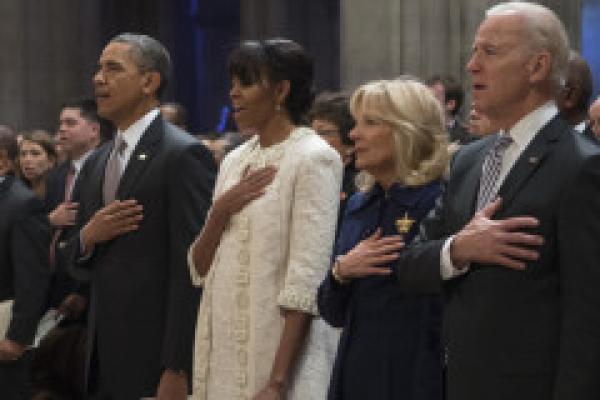
WASHINGTON — President Obama started his second term with a traditional worship service and a challenge to help heal the nation’s divides.
“We find ourselves desperately longing to find common ground, to find a common vision, to be one nation indivisible with liberty and justice for everyone,” said the Rev. Adam Hamilton, the Kansas City pastor chosen to preach Tuesday at the National Prayer Service at Washington National Cathedral. “In this city and in this room, are the people who can help.”
The inaugural service carried that theme for more than an hour, presenting the nation’s rainbow of faiths and cultures with a bilingual welcome and reading from the Gospel of Matthew, and an imam and Christian and Jewish cantors taking turns calling the congregation to prayer.
The service of petitions and patriotism included a Sikh woman calling for “concern for our neighbors” and a Catholic layman urging a remembrance of Americans’ interdependence. The red, white, and blue theme extended to the altar flowers and a worshipper’s flag-festooned headscarf.

“Now I’ve gone completely over to the dark side,” I laughed as I unpacked an Apple iMac desktop computer and set my last Dell Windows PC to the side.
Such is the teasing that goes on among computer users — teasing that occasionally turns to irate bristling and strident claims of supremacy.
But becoming “all Apple” (iPhone, iPad, MacBook, iMac) isn’t the “dark side,” is it? It’s the “other side.” It’s a new product, not a corrupt soul.
Product decisions aren’t expressions of ultimate value. They’re like selling my automobiles and moving to a walking culture in Manhattan, putting aside suits, and starting my own company. It’s the “other side,” not the “dark side” or the “light side.”
I won’t be using my new iMac to steal money from people. That would be “dark side” behavior. I won’t engage in identity theft, patent trolling, luring people into danger, slandering people with whom I disagree, threatening children, starting phony charities. Those would be “dark side” activities.
In recent years, we have seen serious confusion between “other side” and “dark side.” Led by politicians, ideologues and religious zealots, we have been encouraged to view opponents as evil, unpatriotic, a menace worthy of destruction. The opposition wasn’t content to disagree; it also wanted also to dehumanize and demolish.