In her 2023 book Doppelganger: A Trip into the Mirror World, Naomi Klein argues that the process of mirroring explains an essential dimension of today’s politics and culture. Instead of a clean divide between good and evil, just and unjust, where we can confidently position ourselves on the side of liberators, we find ourselves in a hall of mirrors, puzzled about which way to turn. Racists pursue their policy ends in the name of civil rights, quoting Martin Luther King Jr. Social media and video hosting services like Rumble, Gettr, and Truth Social replicate YouTube and Facebook, responding to “systemic bias” in the mainstream media and supposedly championing free speech. In its treatment of Palestinians, the state of Israel reflects the persecution and genocide once faced by Jews. Donald Trump’s first go-to insults are the ones that are most obviously true of himself.
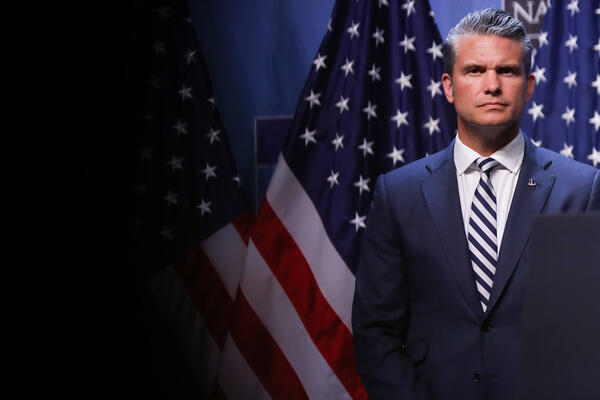
Defense Secretary Pete Hegseth’s short-lived plan to livestream the execution of Nidal Hasan was a product of our age of mirroring. While Hegseth was an officer in the U.S. Army, al-Qaida and Islamic State militants performed executions in public and circulated them online, shocking the world. Now, Hegseth shocks the world by recommending a similar practice, but ostensibly performed by the good guys, in the service of justice. While livestreamed execution might seem rather close to pornography—encouraging viewers to derive pleasure from dehumanizing another, and right-wing Christians find pornography deeply vexing as a political and personal matter—the world of mirrors we inhabit distracts us from noticing those similarities. That is, from making moral distinctions and judgments based on close attention to the particulars of a case and to our principles.
In the case of Hasan, the mirroring goes deep. Before opening fire at his Army base, killing 13 people and injuring 32, Hasan shouted “God is Great” in Arabic. Before launching deadly military strikes in Iran, Hegseth said “Blessed be the Lord” and called for prayers “in the name of Jesus Christ.” Hasan described his attack as motivated by his obedience to God, who wanted him to preempt the killing of Iraqis and Afghans by U.S. soldiers who were about to deploy to the battlefield. A few years earlier, describing his preemptive attacks on Afghanistan and Iraq, George W. Bush said, “I am driven by a mission from God,” who told him, “George, go and fight these terrorists.”
Some of Hegseth’s critics are themselves caught in the mirror. Atlantic writer Graeme Wood suggests that, instead of livestreaming Hasan’s execution, Hegseth ought to livestream his incarceration. Retired Admiral William McRaven adopts the popular line that we Americans should not engage in public execution because “we are better than the inhuman beings who do unconscionable things”—presumably referring to people in countries like Iran, where there are also public executions. Of course, the Iranian regime shares a similar sentiment: The U.S. represents decadence and immorality, and Iranians are better than that.
Calling attention to mirroring is not meant to construct a moral equivalence. Rather, mirroring creates an atmosphere that hollows out talk of morality, particularly religious morality. All invocation of providence becomes hollow. Any concept of God’s law becomes suspect. Worshipping God becomes no different from worshipping us, or worshipping me.
When President Trump agreed to the public execution plan, he apparently did not know that Hasan was now partially paralyzed, a result of being shot during his rampage. The optics and awkwardness of executing a wheelchair user surely contributed to the public pressure on Trump to change course and maintain the privacy of the execution. Hasan’s paralysis is, in fact, a reminder of his humanity. He is frail and vulnerable, in need of care. The firing squad would not have been taking aim at a defiant superhuman whom the state finally subdued, demonstrating the ultimacy of its authority (another mirroring). It is precisely the reality of shared humanity, the reality that each of us has weaknesses as well as strengths, ones we love and are loved by as well as those we hate, that the death penalty—whether conducted in private or public—must conceal. Humanity resists the logic of the mirror.
Dignity pierces through our world of mirrors. When we see someone in their complexity, hear their story, learn of their loves and how they are beloved, dignity shines through.
Dignity pierces through our world of mirrors. When we see someone in their complexity, hear their story, learn of their loves and how they are beloved, dignity shines through.
Nidal Malik Hasan was born in Virginia in 1970. His parents were Palestinian, and the family spent a year, while Hasan was in high school, living in the West Bank. Hasan was quiet and introverted; his family was culturally Muslim, not particularly religious. After high school, he enrolled in the military, spending three relatively pleasant years on a base in California, gaining access to funds that would pay for his bachelor’s degree at Virginia Tech. Then Hasan reenlisted in the military, this time on track to become a psychiatrist. A turning point in his life came in 2001: Hasan moved back in with his mother to take care of her as she died of cancer, and the World Trade Center attacks and subsequent Global War on Terrorism gave rise to rampant Islamophobia. Hasan turned to religion, attending a mosque and volunteering with its community service programs, searching for a pious wife, and urging his family members to increase their devotion, too. In his Army medical training, Hasan began to focus on the tension Muslim soldiers felt, and that he himself seemed to be feeling, between their religious commitment and their obligations to the U.S. Army. When he was assigned to Fort Hood, Hasan led an ascetic existence, donating 75% of his income to charity and exploring corners of the internet populated by Islamist extremists. When he received orders to deploy to Afghanistan, he decided to purchase a gun and hundreds of bullets and attack his colleagues.
READ MORE: Islamophobia Is a Threat to All Faiths. El-Sayed Shows How to Rebuke It
After an investigation, the Department of Defense classified Hasan’s act as “workplace violence” rather than terrorism, and the media commentariat debated whether this label was appropriate. Hasan’s job was to treat the shattered minds and souls of veterans coming back from Iraq and Afghanistan, and he himself seems to have been traumatized by spending so much time with their traumas. Right-wing commentators scoffed, describing Hasan as a self-radicalizing Islamist committing violence because of his ideology. Both sides hint at the basic paradox surrounding the death penalty: the sort of human who would commit such a heinous crime as would befit state execution must be deeply unwell in some respect, yet our instinct is to care for rather than kill those who are deeply unwell.
Although Hasan became increasingly pious, the elements of religion he gravitated toward had a secular tone, projecting worldly desires onto the transcendent. He developed a belief system in which heaven and hell have different levels or ranks, and acts during your lifetime determine which rank you will receive. Moreover, merits are transferable: Hasan’s virtuous acts would increase the otherworldly rewards (or decrease the sufferings) of his beloved mother. In preparation for his trial, Hasan’s defense team brought two imams to spend a week reasoning with him theologically so that he might approach the trial in a spirit of contrition—to no avail.
Theology that mirrors the world is bad theology. That is the theology we hear from Hegseth, cloaking national interest and personal self-interest (not to mention whiteness and masculinity) in the language of the divine.
(Full disclosure, and perhaps more mirroring: Hegseth and I were college classmates. He edited a right-wing campus magazine while I edited a left-wing one.)
Timothy Broglio, Catholic archbishop for the U.S. Military Services, denounced the plans for a livestreamed execution, calling it a violation of “the dignity of the human person”—both because all state executions are attacks on human dignity and because a livestreamed execution compounds these attacks. Dignity can feel like a squishy concept compared to the sense of firmness and clarity we associate with rights language. But dignity’s opacity is precisely because of its divinity: It marks the image of God in the human, and the image of God is cloaked in mystery. Mystery elicits reverence, and it warrants caution. If there is doubt about whether we might be violating the dignity of the human person, it is best to steer clear.

Vincent W. Lloyd, author of Black Dignity: The Struggle Against Domination, is associate professor of theology and religious studies at Villanova University. He lives in Philadelphia.
Did this article have an impact on you? Tell us how! Whether you’re moved to take action, have a question, or want to share a comment (good or bad), we value your feedback!