The Pro-Labor Gospel Is Back on the Ballot

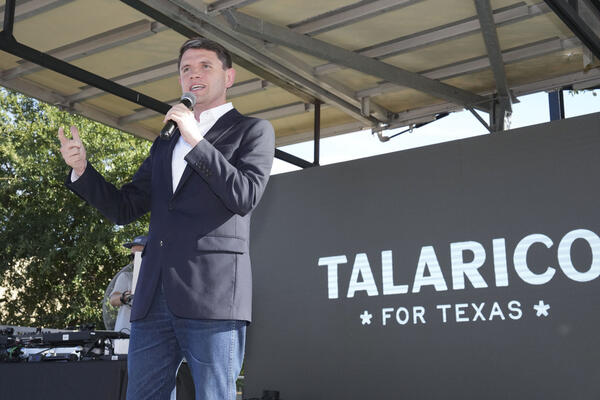
August 20, 2026, Austin, Tx, United States: Democratic candidate for U.S. Senate JAMES TALARICO of Texas holds a ''Pupplies for Talarico'' event at the Celis Brewery in north Austin, attracting scores of pet owners for a rally in the 104-degree Texas heat on August 20, 2026. Talarico and challenger Republican Ken Paxton are locked in a heated race to replace John Cornyn with 80 days to go before the November elections. (Credit Image: © Bob Daemmrich/ZUMA Press Wire)

In the months leading up to the U.S. midterm elections and in the shadow of today’s headline-dominating Christian Right, a lost gospel is getting a new hearing. In red states across the country, devout Christians running for office on the Democratic ticket are making the case, as Jesus himself once put it, that “The laborer deserves to be paid” (Luke 10:7).

A pro-labor message has come to the fore in some of the races that are likely to determine who controls Congress come January. In Texas, James Talarico, a Presbyterian seminarian and Democratic nominee for Senate, has mounted the argument that, “It is time to rebuild labor unions in this country so that employees can negotiate with their bosses for fairer pay, better benefits, and safer working conditions.” Meanwhile, Rev. Sarah Trone Garriott, who is ordained in the Evangelical Lutheran Church in America and is the Democratic nominee in Iowa’s 3rd Congressional District, has underscored that she “believes in unions” because she “believe[s] in dignity—and that every Iowan deserves to share in the prosperity their labor creates.” 

While leading Republicans have attacked the integrity of these progressive candidates’ faith, their advocacy for unions resonates with a longstanding Christian tradition, one that sprung first from the grassroots. The evangelicals and Catholics who founded the earliest trade unions stressed that God was on their side. Terence Powderly, who was Irish Catholic and an influential leader of the Knights of Labor—the 19th century’s most promising big-tent union—declared in 1891, “Christ was right, He spoke for the poor, worked for and among the poor, and died for the poor … His efforts were directed against the money changers, or bankers, of his day … and if there were railroads at that time [he] would have been demanding that the rights of the people be respected by their presidents and directors.”

Working class activists did not just gesture toward the overarching message of scripture. They loved to cite chapter and verse, and the fifth chapter of the Epistle of James was a perennial favorite. That passage confronts the exploiters of the poor with the gravest of warnings: “Come now, you rich people, weep and wail for the miseries that are coming to you” (v.1). When a conference of Methodist pastors invited the president of the blacksmiths’ union to address them, he chose this text and declared, “I believe that I can see the conditions of our day depicted in the fifth chapter of James, and would like to hear a few sermons preached from that chapter. I have never heard an interpretation.”

At first, church leaders resisted labor’s insurgent theology, rallying to the defense of upstart corporations and laissez-faire capitalism. Even liberal divines like Chicago’s David Swing—famously put on trial in the Presbyterian church in the 1870s for not hewing sufficiently to Reformed orthodoxy—long refused to acknowledge the legitimacy of workers’ grievances. “The conflict between classes in the cities of our country is not a conflict between labor and capital, but between successful and unsuccessful lives,” Swing harrumphed. But as the Gilded Age wore on, growing working class disenchantment with the churches stoked the clergy’s anxieties about the future of their institutions. While they did not call religiously disaffiliated people “the Nones” like we do today, a parallel anxiety coursed through denominational headquarters more than a century ago: Would a mass exodus of ordinary folks out of the churches permanently undermine the vitality of American Christianity? 

By the turn of the 20th century, the political calculus of those at the helm of Christian organizations was shifting. A previous Pope Leo launched the Catholic Church into the vanguard of a more progressive day. In 1891, Pope Leo XIII promulgated Rerum Novarum, a landmark encyclical which insisted—contra the prevailing economic wisdom of the time—that there existed “a dictate of natural justice more imperious and ancient than any bargain between man and man”: the worker’s right to a living wage. 

It took longer for such teachings to take deep root in Protestant denominations, but in 1908 the widespread adoption of a new “Social Creed of the Churches” left no doubt that labor’s theological vision was gaining ground. By the New Deal era, a pro-labor gospel had won not just official church sanction but also widespread influence, shaping both everyday Americans’ moral common sense as well as breakthrough legislation from the Social Security Act to the National Labor Relations Act. In the mid-20th century, Civil Rights activists organized to see that workers of color enjoyed the full fruits of these policy gains. The final fight of the Rev. Martin Luther King Jr.’s life was in Memphis, Tenn., where he came alongside striking sanitation workers insisting that “all labor has dignity.”

The story of how we got from that moment—when the U.S. was more economically equal than at any other point in its modern history—to this moment of vast inequality is tied up in the now well-documented rise of the Christian Right, which promoted a countervailing gospel of free enterprise to great effect. The legacies of that movement are as palpable as ever today. 

READ MORE: My Evangelical Faith Sent Me to the Picket Line

Private sector union density, which peaked at more than a third in the 1950s, now hovers below 7%. And workers have once again lost faith, not in Christian doctrines so much as in Christian churches. Contemporary coverage of “the Nones” tends to focus on generational dynamics, but there is also an unmistakable class dimension to the story. The people in the pews these days are disproportionately likely to be highly educated and middle class. As political scientist Ryan Burge has observed: “[T]hose who are the most likely to attend services weekly are those with a graduate degree. The least likely to attend are those with a high school diploma or less.”

But the flames of pro-union faith never completely died out, and in recent years there have been signs of an awakening. 

Shawn Fain, the president of the United Auto Workers, does not wear an “evangelical” label on his sleeve, but he attends a non-denominational church and reads the Bible every morning. On the eve of the UAW’s 2023 strike against the “Big Three” automotive manufacturers (General Motor Co., Ford Motor Co., and Stellantis), he delivered a blistering speech-qua-homily from the gospel of Matthew. “Why is it easier to pass through the eye of a needle than for a rich man to enter the Kingdom of God?” Fain asked, referencing Matthew 19:24. “I have to believe that answer, at least in part, is because in the Kingdom of God no one hoards all the wealth, while everybody else suffers and starves.” The UAW went on to win a major victory in that fight, and its once-plummeting membership has grown each year since. 

In 2025, and for the first time since the Gilded Age, a new pope assumed the name Leo. Shedding light on his choice, he said he chose this name “mainly because Pope Leo XIII in his historic encyclical Rerum Novarum addressed the social question in the context of the first great industrial revolution. In our own day, the Church offers to everyone the treasury of her social teaching in response to another industrial revolution and to developments in the field of artificial intelligence that pose new challenges for the defence of human dignity, justice and labor.” 

Earlier this year, Pope Leo XIV elaborated these parallels in a groundbreaking new encyclical, Magnifica Humanitas, which made good on his chosen name. Expansive in scope, it took care to underscore “the primacy of human labour over any mindset focused solely on finance or productivity … and the inseparable link between proclaiming the Gospel and pursuing a more just social order.” 

It remains to be seen whether this ongoing revival of pro-labor Christianity can reverse the long-declining fortunes of churches and unions alike. But an early test of whether it might shake up the U.S. political landscape is just weeks away.

Recent history gives plenty of reasons to doubt that candidates like Rev. Adam Hamilton, a United Methodist pastor running for Senate on the Democratic ticket in Kansas, can break through. Kansas has not elected a Democrat to the Senate since the Great Depression. But the fact that just last week Vice President JD Vance campaigned for Republicans in Kansas while deriding Hamilton’s faith as “left-wing radicalism dressed in the skinsuit of our religion” underscores that Hamilton’s opponents are not taking victory for granted. Polls show he has a fighting chance. And as Rob Sand, the Lutheran state auditor running for Iowa’s governorship, likes to emphasize—echoing generations of American workers—“Jesus is for the little guy.”

The flames of pro-union faith never completely died out, and in recent years there have been signs of an awakening.