In the Philippines, Christians Seek Justice After the Toboso Killings

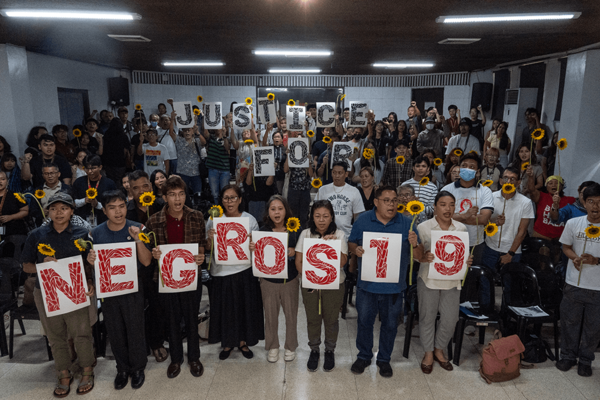
Human rights advocates and families of the victims of the Negros 19 gather to spell out ‘Justice for Negros 19’ during a symbolic action at the launch of the ‘Justice for Negros 19 Campaign Network’ at the University of the Philippines, College of Mass Communications, on June 24, 2026. Photo by Charles Perez/NurPhoto via Reuters.

After the Armed Forces of the Philippines shot and killed 19 people in Toboso, Negros Occidental, Philippines, Christian clergy have been active in efforts to seek truth and justice for the slain, including one they knew intimately as a colleague in social justice.

Lyle Prijoles was a Filipino American activist who worked alongside many Christian clergy in the U.S. Bay Area. Prijoles was in the Philippines working with sugarcane workers when he was one of the 19 killed—the Armed Forces have claimed that all those slain on April 19 were members of the New People’s Army, a revolutionary, armed wing of the Communist Party of the Philippines. But that account has been disputed. The Communist Party of the Philippines has claimed only 10 were part of the NPA. Grassroots organizations and independent fact-finding missions have found the same; Prijoles was one of at least nine people reported to be civilians. In the months following those deaths, many of those who once organized with Prijoles have joined in the resounding call for justice. 

In the months since, 11 members of Congress have called on the Philippine government to conduct an independent, impartial investigation into the killings. One of the groups that sought to perform such an investigation included several Christian clergy from the Philippines and the U.S.

Prijoles had ‘presence and calmness and political knowledge’

Rev. Sadie Stone, pastor of Jones Memorial United Methodist Church, had worked with Prijoles for the past decade while organizing in San Francisco. Prijoles started organizing while a student at San Francisco State University, where he joined the League of Filipino Students, an anti-imperialist organization of Filipino youth. Later, he served as a founding solidarity officer of Anakbayan-USA, the Philippine national democratic youth organization, and with the U.S. branch of the International Coalition for Human Rights in the Philippines.

Stone worked with Prijoles at ICHRP. She remembered that Prijoles was present at every action, planning meeting, and advocacy gathering. From doing tasks behind-the-scenes to logistics at mobilizations, Stone said that Prijoles cared about his community and served the people with everything that he had.

“Lyle was always there, behind the microphone and the megaphone,” said Stone. “He had this presence and calmness and political knowledge and read of each situation. He made me want to be better and serve the way he did.”

Fact-finding mission

Negros is the Sugar Bowl of the Philippines, known for supplying more than half of the country’s sugar. Negros Occidental, one of the island’s two provinces, is marked by deep wealth inequality; haciendas are owned by the country’s wealthiest conglomerates, and the tenant farmers and peasants who make up a majority of the archipelago have remained landless for generations.

The region has seen multiple mass killings over the last four decades: the Escalante massacre in 1985, the Sagay massacre in 2018, the Kabankalan massacre in 2022, the Fausto family killing in 2023, and now the 19 people killed in the Negros town of Toboso. Because of this, Ariel Casilao, national chairperson for UMA Pilipinas, has called Negros “the massacre capital of human rights and international humanitarian law violations.”

After the Communist Party of the Philippines announced that several of those killed were civilians—including journalist RJ Nichole Ledesma, student activist Alyssa Alano, and peasant advocates Maureen Keil Santuyo and Errol Wendel—civil society organizations Defend Negros Network, Manindigan Negros, and Karapatan began planning a fact-finding mission.

The fact-finding mission invited another UMC pastor in the California-Nevada Conference and close friend of Prijoles, whose identity is being withheld to protect their work in the Philippines—where activists are regularly persecuted and blacklisted—to travel with them. The pastor, who knew Prijoles for a decade, said they witnessed him grow in his commitment to fight for the liberation of Filipino people. They wanted to know about the place and the people with whom Prijoles had integrated.

“We were cheated out of seeing him mature and deepen even more,” they said.

The pastor left for the Philippines in May. Before the delegation got in vans to travel to Toboso, Catholic sisters working with Manindigan Negros, a church-based, ecumenical campaign network for human rights, prayed for the church workers, lawyers, and journalists of the delegation.

260818-Negros19E.png

Cultural workers from Sining na Naglilingkod sa Bayan SINAGBAYAN and the Defend Negros Network stage the play Tiempo Muerto: Paghulat sang Dugwak at the UP Film Institute in Quezon City, Philippines. The performances, held on July 18 and 19, explore alleged impunity and human rights abuses involving state forces against agricultural workers in the Negros Islands, a region that rights groups have referred to as the Massacre Capital of the Philippines. Taken on July 18, 2026 in Quezon City, Philippines Charles Edmon S. Perezx/JNA Press via Reuters

The delegation arrived at Salamanca Elementary School—the evacuation site for about 650 Toboso residents when the combat began on April 19. Once there, the pastor said armed men in civilian clothing—presumed by local residents to be military—took pictures of the delegates' vehicles and then dispersed. Throughout, the pastor said the delegation frequently noticed unfamiliar individuals following them.

Despite the threat of retaliation, the pastor said residents welcomed them and shared the testimonies of what they witnessed—testimonies that contradict the Armed Forces’ narrative.

“The military might increase their harassment and intimidation of [the residents],” they said. “And yet they continue to rise for their rights.”

For them, the trip was a reminder that Jesus was familiar with conditions in which an empire oppresses people with military might.

“This makes me feel more convicted in my faith,” they said, “to stand with the truth, to always listen and be present with the oppressed and the toiling masses.”

They said the delegation walked to two sites of the killings, seeing bullet holes in banana trees. The delegation wondered whether the Armed Forces, which had claimed to be investigating the killings, had actually gathered any evidence from the sites.

Barred from entry

Stone, the Jones Memorial pastor, had prior involvement with human rights campaigns in the Philippines, so the delegation asked her to join the fact-finding mission. But when Stone arrived, she found herself barred from efforts for justice for Prijoles and others. After arriving at an airport in Manila on May 12, she told Sojourners she was detained, interrogated, and denied entry to the Philippines.

She said she was questioned over her involvement with the ICHRP, where she is a member of the Global Council. She was also asked about her participation in the Justice 4 Brandon Lee campaign, after Lee, a Chinese-American activist from San Francisco, was shot four times in the Philippines but survived.

“No one was telling me anything,” she said, when they took her to a room where she was detained for 13 hours with no explanation and no passport. The next morning, she was escorted on a plane back to the U.S. According to Stone, she was blacklisted from the Philippines. But for her, as an American, the injustice is a reminder of the interconnection between her own government and the injustice in the Philippines.

“Our own government is not far off. It funds a lot of the militarization in the Philippines,” she said.

The two countries have a deep relationship going back 80 years. Most recently, in December 2025, the U.S. Congress approved $2.5 billion in foreign military financing to allow the Philippines preferential purchasing options of equipment, as well as approving a $1 billion loan to facilitate those purchases. On the island, activists fear that increased military partnership will put Filipinos in the middle of the U.S. and China’s saber rattling.

“We know [the military’s account] is not the truth,” Stone said. “A government who has nothing to fear will not be afraid of people who stand with the marginalized.”

The Church in Negros

In June, Rev. Melvin Fajardo of Human Rights Advocates Negros went to Toboso to conduct relief operations for 100 families with the help of the National Council of Churches in the Philippines. Fajardo was part of the quick response team that looked to identify the bodies of the killed back in April.

They gave dried fish, canned goods, and bags of rice to the residents. They offered trauma debriefing and crisis therapy to families, many of whom had been interrogated at gunpoint by the Armed Forces.

Fajardo said the residents of Toboso want the military out of the countryside. Many are angry and want justice for those murdered, especially for the nine civilians who had built deep relationships with them. They told Fajardo those civilians never left their side, living and learning from the community.

Fajardo personally knew Ledesma, leader of alternative media outfit Paghimutad-Negros, and an active member of the One Negros Ecumenical Council. Ledesma covered land conversions happening in Silay and Candoni, issues otherwise overlooked by mainstream media.

Immediately following the killings, Fajardo saw the military move the bodies, wrapped in plastic, to two funeral homes.

For him, the Toboso killings are not an isolated incident. Peace talks, he said, need to be conducted nationally, not just locally.

“Armed resistance won’t stop until the struggle for land and livelihood is resolved,” Fajardo said. “Our lives have dignity. It is made in the image of God, and our God is loving and asserts justice for the oppressed and needy.”

“Our God is loving and asserts justice for the oppressed and needy.”—Rev. Melvin Fajardo