I love too much to battle.
–el-Hajj Malik el-Shabazz
Did you finish killing everybody who was against peace?
–Wendell Berry
I saw a lot of things in Palestine that made me think about my gun. I had purchased it some years ago, when I realized what little democracy we had left in the United States was deteriorating. When you live in a country where an individual has the right to bear arms as a stopgap against tyranny, and then you suddenly realize you are witnessing tyranny’s rise, you arm up.
One of the lessons I learned in Palestine is that some people shouldn’t have guns. The soldier I saw with a gun yelling at schoolchildren doesn’t need one. The settler I saw with a gun intimidating pedestrians doesn’t need one. When I saw those people, I patted myself on the back for not being like them. But my self-congratulatory mood was fleeting, as I kept wondering the same thing each time I saw someone with a gun: Did my country give you that weapon?
According to an October 2025 report from the Council on Foreign Relations that looked at foreign aid from 1946 to 2024, when adjusted for inflation, it is estimated that Israel has received $300 billion in total economic and military assistance from the U.S., which is more than any other nation received during that same period. Throughout the U.S. and Israel’s relationship, the U.S. has consistently been willing to provide Israel with weapons. As the Gaza-born poet, writer, professor, and activist Refaat Alareer wrote in a 2012 poem, these weapons are then cast, like lead, upon people’s heads.
The relationship between Israel and the U.S. goes back to Israel’s founding. The U.S. was the first country to recognize Israel after its establishment in 1948, which was predicated on expelling some 750,000 Palestinians from their ancestral lands, an event Palestinians refer to as the Nakba—nakba being the Arabic word for “catastrophe.” After the Six-Day War in 1967, a war in which Israel broke international law by occupying the Golan Heights, the West Bank, East Jerusalem, and the Gaza Strip, forcibly displacing an estimated 300,000 Palestinians, the U.S. became Israel’s largest military backer. But the screeching crescendo of this special relationship reached a new peak over the past three years as the U.S. aided and abetted Israel in obliterating Gaza and committing the first live-streamed genocide in history. More than 75,200 people have been killed, and more than 200,000 tonnes of explosives have been dropped on Gaza, which is the equivalent of 13 Hiroshima-type nuclear bombs. Catastrophe.
After visiting Israel/Palestine for 10 days in May 2023, the journalist and writer Ta-Nehisi Coates observed in his book, The Message, that Israel’s disenfranchisement of Palestinians “had the specific imprimatur of the United States of America.” Having been to Palestine myself on multiple occasions, I echo Coates’ observation, but would add that the United States’ hard pivot toward ultranationalism, technological surveillance, and repression of “the enemy from within” has the specific imprimatur of Israel.
For too long, people in the U.S. believed our country could support Israel’s colonial politics while preventing the fascist chickens from coming home to roost.
My trips to Palestine were watershed moments for me in terms of connecting what’s happening in Palestine with what’s happening in the U.S., but it was back at the end of Donald Trump’s first term that I began to fear that my country was descending into apocalyptic fascism.
“As with rage, there is an invisible force to fear, a gravity,” writes journalist and writer Omar El Akkad in his book, One Day, Everyone Will Have Always Been Against This. The people whose fears are based on paranoia, avarice, or racial animus hold a significant amount of political power, and they leverage their fear “with terrible force, onto the lives of those below.” The fear that belongs to those below is visceral and legitimate, but its purchasing power pales in comparison to the fear of those at the top.
A few weeks before the 2020 election, I exercised what little bit of purchasing power my fear could afford when I bought a Ruger 10/22 semi-automatic rifle.
Then, on Jan. 6, 2021, I witnessed a lame duck Trump launch a failed coup, deceitfully insist he had won reelection, and then incite a crowd to storm the Capitol to overturn the election. In March of that same year, I felt an intense dissonance about being a gun owner while also accepting an editorial position at a Christian publication that was celebrating 50 years of covering stories about peacemaking and social justice. But by January 2025, after Trump pardoned more than 1,500 people who had been charged in connection with attacking the Capitol, I no longer felt that same dissonance.
I am for peace, and I am for justice, and yet some might read what I write here and accuse me of supporting violence or “terrorism.” But this is a misunderstanding. What I actually believe is that we must imagine an alternative to the military empire that the U.S. and Israel have created. My recent trips to Palestine encouraged me to build a better arsenal toward this end, giving me a vocabulary and an analytical framework to articulate the current situation of the U.S. and the human condition itself.
“Palestine,” writes journalist and poet Mohammed El-Kurd in his book Perfect Victims, “is a microcosm of the world: wretched, raging, fraught, and fragmented. On fire. Stubborn. Ineligible. Dignified. The lens we lend the Palestinian reveals how we see each other, how we see everything else.” Or as the journalist, human rights researcher, and rhetorician Budour Hassan told me last October, the situation in Palestine has taught Palestinians to universalize what they’ve been experiencing, “to think broader; to think beyond Palestine; to see Palestine as part of other struggles, as intertwined with other struggles.”
The way
My first 10-day tour was in October 2024 and my second was in October 2025. Both of my trips were hosted by the Palestinian liberation theology organization, Sabeel. Sabeel, which is Arabic for “the way” or “spring of water,” was founded in 1987 by Palestinian liberation theologian Naim Ateek. Sabeel functions as an ecumenical and interfaith hub for nonviolent resistance against Israel’s occupation. “Witness tours” are one of Sabeel’s main programs, and the purpose of these tours is to invite people from around the world to travel to the West Bank to learn about Palestinian liberation theology and the Palestinian struggle for self-determination. A common refrain among Sabeel staff is “Come and see, go and tell.”
“It’s both selfish and treacherous to keep a story to yourself—stories are meant to be told and retold,” wrote Alareer in 2014. Storytelling “is one of the ingredients of Palestinian sumud—steadfastness,” he explained. “Stories teach life even if the hero suffers or dies at the end.”
Omar Haramy, who is a Palestinian activist, liberation theologian, and a friend, is the director of Sabeel. Omar usually plays host and entertainer to the delegates who make the trek, and he has a knack for doing both. He tends to maintain an optimistic disposition, which he mixes with dark humor, and his voice—to borrow a character description from the late playwright Lorraine Hansberry—can sometimes carry a quality of indictment.
Omar Haramy_image 1.png
In 2024, while offering a brief history of Sabeel and describing what Palestine was like during the 1980s, Omar asks the 10 delegates—the majority of us being from the U.S.—if we remember the children throwing stones at the Israeli tanks that the U.S. had provided. Before anyone can answer, Omar interjects, “I was one of these children.”
Palestine question
What’s Palestine like? When I’m asked this, I try my best to offer a variety of textured descriptions, but I don’t know if they ever do justice.
Palestine, or at least Israel’s occupation of it, is like what activist and philosopher Angela Y. Davis compared it to in her 2015 book, Freedom Is a Constant Struggle: The Jim Crow South, apartheid South Africa. More recently, I’ve taken to approximating Palestine to cities like Los Angeles, Chicago, and Minneapolis, pointing to the brutality that Immigration and Customs Enforcement has unleashed on (perceived) immigrants and protesters.
In her 2025 Boston Review article “The Boomerang Comes Back,” Noura Erakat, a human rights attorney and professor at Rutgers University, predicted that the Trump administration would hunt down immigrants, drastically restrict free speech, and use military precision to surveil and brutalize dissidents. She foresaw this because the U.S. was already doing these things to Palestinians, Arabs, and Muslims, at home and abroad. Erakat notes that abuses against these groups have been “normalized, and harmful precedents have been established that make other vulnerable communities less safe as well.”
So, what’s Palestine like? If you reside in the U.S., Palestine is like a mirror. “I am your past haunting,” wrote Alareer in a 2012 poem, “Your present and your future.”
This mirror forces us to reckon with Israel’s occupation of Palestine—the U.S.-made monstrosity that outlines and restricts it like a taut noose.
Israel’s occupation was initiated and is currently maintained by a settler colonial mentality, buttressed by laws that explicitly legitimize Jewish supremacy and Palestinian subjugation. This mentality was incisively described by the late intellectual and literary critic Edward Said in his 1979 essay, “Zionism from the Standpoint of Its Victims.” The idea of Israel developed out of a Zionist conviction that Palestine was to be colonized “for and by the Jews” and that the displacement of the Palestinians was central to this development. Said explains that Zionism first attempted to “minimize, then to eliminate,” and then to finally “subjugate the natives as a way of guaranteeing that Israel would not be simply the state of its citizens (which included Arabs, of course) but the state of ‘the whole Jewish people,’ having a kind of sovereignty over land and peoples that no other state possessed or possesses.”
Said, who died in 2003, did not live to see the passing of the Jewish Nation-State Law in 2018, which the sociologist and anthropologist Honaida Ghanim has characterized as a dangerous escalation by Israel to eliminate any hope for Palestinian self-determination. This law officially formalized a hierarchy that placed Jews above Palestinians, and effectively crushed any illusions about the democratic nature of the state. Ghanim, who is the director of the Palestinian Forum for Israeli Studies in Ramallah, noted in her article for the Critical Times’ December 2021 issue that the nation-state law enshrines hierarchy and “places Palestinians in real danger. It opens the door widely to dealing with them according to whim, without any controls or restrictions guaranteeing their protection—particularly necessary under conditions of emergency, such as war.”
Israel is currently in a state of emergency, which it uses to place Palestinians under “administrative detention,” wherein a person—including children as young as 16—can be detained for months, years, or in perpetuity based on alleged evidence that remains hidden by the state. This state of emergency is not in response to the Hamas massacre on Oct. 7, 2023. This state of emergency has been ongoing since 1948, and it allows Israel to revoke habeas corpus and operate as if all Palestinians were enemy combatants. Three-quarters of the approximately 6,000 Palestinians from Gaza who were arrested and detained as “unlawful combatants” since Oct. 7 are actually civilians, according to a database managed by Israel’s Military Intelligence Directorate.
Such a situation in a country like Israel, which claims to value human rights and democratic ideals, seems oxymoronic. But think of the situation in the U.S. Even as Trump actively works to dismantle U.S. democracy—exercising emergency powers, looking to revoke habeas corpus, and baselessly accusing innocent people of being “domestic terrorists,” illegally sending immigrants to foreign gulags, and openly opining about how he hopes to do the same with “homegrown criminals”—members of his administration have guilefully maintained that the U.S. remains to be a nation that upholds basic rights and liberties.
A democratic nation that, as The Guardian pointed out in January, allowed 32 people to die in ICE custody in 2025. A democratic nation that alleges its criminal legal system is based on a presumption of innocence, even though it has allowed ICE to hold an estimated 60,311 people in detention as of April, with approximately 71% of those detained having no criminal convictions. Occupied Palestine holds up a mirror to the U.S. empire.
Occupied Palestine holds up a mirror to the U.S. empire.
Street witness
The dire brutality of the occupation is on full display in the city of Hebron.
In 1994, an American-Israeli settler shot and killed 29 Palestinians while injuring at least 125 others who were praying at the Ibrahimi Mosque in Hebron. In response, Israel began restricting Palestinian movement for fear of retaliation. In the settlement of Kiryat Arba, the murderer’s tomb is well-preserved; this settlement is also home to a park dedicated to the founder of an ultranationalist party that was banned and designated as a terrorist organization by Israel in 1994. In the years following the massacre at the Ibrahimi Mosque, restrictions in Hebron have only intensified and metastasized as an official policy of apartheid. As journalist Maya Rosen reported for Jewish Currents in February 2024, Israel uses Hebron as a laboratory for experimenting with restrictions and tactics—namely, segregated roads and facial recognition technology—that it then applies throughout the rest of the West Bank.
On Oct. 17, 2024, our delegation and another delegation joined together to visit Hebron.
We pass through the Ibrahimi Mosque checkpoint without much fanfare and then head down toward Al-Shuhada Street. “‘Shuhada’ in Arabic has two meanings,” Omar explains, “One is ‘the people who are the martyrs’ or ‘the people who give witness.’”
Ramallah Martyrs Memorial image 2.png
Palestinian culture was once the backbone of Shuhada Street before the doors of Palestinian homes and businesses were welded shut by the IDF, before the settlers invaded. By 2000, Israel had prohibited Palestinians from even setting foot on the street.
And yet here was Omar, in 2024, doing just that.
Soldiers patrolling the area are giving him an extra measure of attention. One soldier seems almost shy to start in on him. “And you,” the soldier begins, “you are Muslim?” “I haven’t decided yet,” Omar wryly replies, pausing for dramatic effect. Omar stares the soldier down, and then flips the interrogation: “I’m a Christian. Why?” The soldier searches. “Because Muslims not, eh, not…” The soldier falters. We walk on.
We hear soldiers chattering indecipherably on their walkie-talkies as Omar continues his revolutionary jaunt down Shuhada Street, leading us toward the Palestinian neighborhood of Tel Rumeida. The sun is hot, and the wind is strong. Aside from the soldiers’ walkie-talkies and the muezzin’s call to prayer, there is an eerie silence.
I think of an observation made by the character Kevin Pace in Percival Everett’s novel So Much Blue: “Little things and big things, bad things happen in singular moments, in singularly real places, not points on a map, not in regions.” A pall falls over the group. We have arrived at another checkpoint.
Omar casually bulldozes toward the yellow gate that must be opened to ascend the steps up to Tel Rumeida. A soldier sits sentry at an outpost. Suddenly, three settlers clad in white, all of whom look to be in their mid-20s, approach Omar. Our group halts. One of the settlers, who has an assault rifle slung across his chest, speaks aggressively to Omar in Hebrew. Omar does not understand. I’m next to Omar, but when the rifleman approaches, I stumble backward, only to find my path impeded by a black jeep. Omar stands still on the land. The only thing from the man with the gun that I can understand is the twice-repeated word, “Passport, passport,” which I quickly realize is a command for Omar to show his papers. “What do you want?” Omar demands. “Who are you?” The settler with the big gun takes Omar’s ID and examines it before passing it to the soldier stationed at the checkpoint. While we anxiously wait for the soldier to finish with the ID, Omar looks his intimidators in the eye. One person from our group hums a song; another person grows faint and falls to the ground. As I regard the settler’s gun, I think about my rifle back at home.
The whole saga takes less than three minutes to unfold, but it took more than seven decades to build the conditions leading up to it. Having satisfied himself, the soldier waves us through.
Omar, never one to be detoured or defeated, leads us up to Tel Rumeida. Now that the guns are out of the picture, I am again sidled up to him when we pause for what would ordinarily be a smoke break if either one of us still smoked. Instead, we both stand heaving air, working to regain our composure.
This is what Palestine is like.
Contact marks
“Witness is a burden,” Budour Hassan told my delegation in October 2024.
In reference to the genocide in Gaza, El Akkad asks, “How does one live, hearing the screams, bearing witness to the bodies?” For those of us who have witnessed these things, we cannot go on living as we once did. We are compelled to testify about what has been revealed to us. But such testimony can prove costly.
The liberation theologians John S. and Samuel S. Munayer explain in The Cross and the Olive Tree that the “cost of bearing witness is multifaceted, with emotional, social, political, economic, and physical ramifications.” For the majority of us in the West, especially those of us in the U.S., the weight of testifying about Palestine is relatively light: Someone yells at you on social media; you are arrested on trumped-up charges that violate your First Amendment rights; after returning from a witness tour, you are forced to reacclimate yourself to polite society.
But for Palestinians who testify about the things that they have seen or experienced, the burden of their witness can weigh as much as a 2000-pound bomb. Israel has actively tried intimidating people into silence, and when that hasn’t worked, it has sought to legitimize the bombing of civilian witnesses—including journalists.
For Palestinians who testify about the things that they have seen or experienced, the burden of their witness can weigh as much as a 2000-pound bomb.
In his book The Palestine Laboratory, journalist Antony Loewenstein notes how the IDF overtly censors all media related to Israel’s “foreign affairs and security.” The past three years have shown us just how far Israel is willing to go to ensure this censorship.
“Israel won’t allow international journalists into Gaza and is killing those reporting from within,” photojournalist Motaz Azaiza told The Guardian in February 2024. “It is a deliberate attempt to obscure the Palestinian narrative and erase the truth.”
In May, the Committee to Protect Journalists, a nonprofit that seeks to safeguard the freedom of the global press, reported that “at least 263 journalists and media workers are among the more than tens of thousands killed across Gaza, Yemen, Lebanon, Israel, and Iran” since Oct. 7. Since beginning documentation in 1992, CPJ has found that the IDF “has committed more targeted killings of journalists than any other government’s military[.]”
For more than a year, the photojournalist Fatma Hassona, through her songs, poems, and photos, documented the devastation and steadfast resilience of Gaza. Three hundred days into Israel’s siege, Hassona offered the following reflection: “I have experienced such a massive loss. I have lost 11 members of my family, the dearest to my heart. Still, nothing can stop me. I roam the streets every day without any master plan. I just want the world to see what I see. I am taking photos to archive this period of my life. I am taking photos of this history which my sons might hear of, or might not.” On April 16, 2025, Hassona’s home was hit with a targeted strike by the IDF, killing her and six members of her family.
“If I must die,” Hassona wrote before her death, “I want a resonant death. I want to be neither a newsflash, nor a number within a group. I want a death heard by the whole world, an impact imprinted forever, and everlasting photos that won’t be buried by time or place.”
I’ve heard English-speakers describe people like Hassona and the other 75,200 people killed in Gaza as “martyrs.” But I personally think it’s better to refer to them as “witnesses.” My discomfort with the word “martyr” revolves around the fact that Westerners, especially Christians, often use the word “martyr” to suggest there is something noble or redemptive about suffering.
But the Arabic word “shaheed,” which means both “martyr” and “witness,” offers a more expansive interpretation than what the English language allows. In discussing the many facets of meaning and history behind the word shaheed, journalist and writer Sarah Aziza explained in her January 2024 Jewish Currents essay that shaheed “carries connotations not only of seeing, but of presence and proximity. To be a witness is to make contact, to be touched, and to bear the marks of this touch.”
Gun conscious
Omar bears the marks of this contact. But these marks are not the entirety of his life, despite what you and I might be tempted to assume, and in defiance of what Israel has tried to make him believe. “Resistance is existence,” he will often say, repeating a popular phrase among Palestinians. And his resistance-existence ethos, although completely nonviolent, is not laden with Christian platitudes about perseverance through suffering for some glory in the hereafter. Omar is invested in this world, and a central part of his daring witness is to look everyone he meets in the eye and let them know he is free and that they can be free too.
Omar does not need me or anyone else to humanize him. I agree with El-Kurd that the humanity of Palestinians shouldn’t be tied to “proximity to innocence” or “whiteness, civility, wealth, compromise, collaboration, nonalignment, nonviolence, helplessness, futurelessness.”
Omar is a Palestinian, a revolutionary, and a Christian, but that does not endow him with mythical powers to endure suffering or offer sage insights. His self-identity and convictions are crucial to his personhood, but his beliefs, identity, sagacity, and willingness to suffer for righteousness spring from an ordinary human consciousness. All people have recourse to tap into this consciousness, but many of us are afraid to do so. Omar is not.
Nor is Omar afraid to use tendentious humor to provoke people’s consciousness. During the October 2024 trip, I stand in the courtyard of activist Fakhri Abu Diab’s home in Silwan, East Jerusalem, despairing over the fact that Israel is displacing Palestinians by destroying their homes and that U.S.-based charities are providing financial support to settlers looking to move to Silwan and other settlements throughout the West Bank. Abu Diab’s home was demolished by Israeli authorities on Feb. 14, 2024. Omar approaches me while I am staring at a gaggle of geese in the courtyard, listening to their shrill honking sound, finding it to be the perfect anthem for the scene of devastation that surrounds me.
“You like geese?” he asks with a smirk.
“No, I’m more of a birds of prey guy,” I reply, still staring at the geese.
“Ah,” he clicks his tongue. “You Americans, you always like things that kill.”
Fakhri Abu Diab image 3.png
For however funny Omar’s jokes might be, they are also biting. I had half a mind to tell him he’d never understand and that I wasn’t that kind of American. But then I thought about my gun back at home.
Toward the end of the 2024 trip, I began to suspect that I was overrelying on my gun as the primary weapon to beat back tyranny. My fear was real, but the thing that my fear purchased had not made it less acute, nor had it tangibly helped me or anyone else. What to do? I felt I had to suss this out with Omar. Maybe it’s just because I perceived him to be someone whose primary weapon was his consciousness.
“Omar,” I begin as we prepare to say our goodbyes, “I need to tell you something. I have a gun.”
“Here? In Ramallah?”
“Omar, no—I—obviously not here. I—”
“You’re being serious?”
I let out a wobbly sigh. “I am.”
“Why do you have it?”
“Because I’m afraid of my country,” I confess with some effort. “But if you tell me to get rid of it, I will.”
“I cannot tell you to get rid of it. All I can tell you is that you don’t need it. Your writing is your weapon.”
As far as I knew, Omar had never read anything written by me, so I found it absurd that he had more confidence in my writing than I did. Did I really not need a gun? Could my writing—my witness—actually be my weapon?
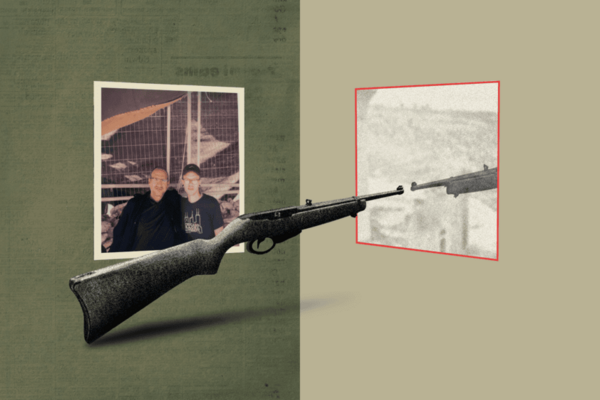
When I got back to the U.S., I was still so agitated by Omar’s words that I determined there was only one thing I could do: Rend the gun in two. Through RAW Tools, a nonprofit that decommissions guns and turns them into tools or art, I got connected with someone to destroy the gun; I met them in a church parking lot, watched them load the gun into a vise, and then I witnessed it get sawn in half.
After it was destroyed, I anticipated that the burden would be lifted and a sense of newfound freedom would hit me. But my symbolic act did not leave me feeling lighter or freer. The symbolic world indeed shapes the material world, but I’ve learned that there can be discrepancies between the two. Sometimes these discrepancies can invite hope, other times despair.
The late poet Mahmoud Darwish demonstrated the symbolic power of words when he imagined a Palestinian mother transforming the loss of her son into the hope that he might live on as the rain, a tree, a stone, or the moon. For some, her hope might appear to be uselessly symbolic because it cannot resurrect her beloved. But this mother does not dismiss the symbolic as a hopeless or false reality; instead, she uses the symbolic to reconfigure reality. No, her son will not literally live on in the natural world, but he will live on through the power of her words.
Ultimately, when I destroyed my gun, all I could see was the reality that my weapon was split in two, and that left me with a profound sense of despair. When Trump was reelected two days later, I was still wrestling with why I destroyed my rifle and asking myself what it might look like to fight against tyranny and colonialism without a gun.
Armed struggle
I didn’t destroy my gun to become an apostle of nonviolence or to condemn Palestinians or other colonized people who have been driven to arm themselves for self-defense or self-determination. It should be noted that the majority of Palestinians have historically resisted Israel’s occupation nonviolently with little to show for it except more displacement, destruction, and death. I think a critical appraisal of nonviolence is warranted, but I also admire certain aspects of nonviolence which are identifiable in the peroration of Omar’s May 2025 acceptance speech for the Berrigan-McAlister Award: “Rest assured, comrades, brothers and sisters: We are not powerless. We are not defeated. We are the ones who are already free—because we have chosen to love, to stand for justice, and to affirm life even in the face of death.”
Destroyed Gun graphic.png
Of course, whether violent or nonviolent, empires perceive any resistance as a threat. If there is an argument for eschewing violent resistance, it is, as El Akkad notes, an ugly and pragmatic one: Violence is the exclusive domain of the state, and it is in this domain that it “maintains every advantage, from bigger guns to total immunity to the privilege of perpetual victimhood.”
But this reality does not make all resistance obsolete, or leave us weaponless against the empire. We already have, in our possession, the ultimate weapon to make empires come undone: our witness. When we testify about the injustice we’ve seen or experienced—whether it’s via writing or some other medium—we bring people’s attention to it, and we begin to unmake the empire’s claims to superior weaponry, total immunity, and perpetual victimhood. Writing for The Yale Review in September 2024, the Black studies scholar and writer Christina Sharpe argued that “Language is one way we make and sustain relation. Words are one way we begin the work of unmaking and changing the shape of the world.”
This is why an Israeli general once compared reading a poem by Fadwa Tuqan (who was referred to as the “Poet of Palestine” and died in 2003 at 86-years-old in her country) to facing 20 enemy commandos. By writing about the things she witnessed, she unmade the empire and equipped others to do the same.
Changing the shape of the world is not achieved, first and foremost, through wielding a gun or the use of force. It is achieved through our witness.
Through telling stories about what we’ve witnessed, we arm others with what Said identified as the “weapons of criticism and dedicated consciousness.” Not only do these weapons equip us to strip the empire of its power, but they also enable us to fight together for our rights, history, and future. “Empires have no chance against the people. Empires can only enter history through the massacres and atrocities that they do,” Omar told my delegation in October 2025.
If you are unconvinced that these weapons in the hands of the people are powerful enough to threaten empires, then look no further than the example of Refaat Alareer. Alareer was someone who taught his students in Gaza and around the world to wield their witness as a weapon.
During an interview with Democracy Now! on Oct. 10, 2023, amid the early days of Israel’s genocidal campaign against Gaza, Alareer gave an account of what he was witnessing while also offering prescient analysis: “We are dealing with a systematic, structural, colonial attempt to annihilate and exterminate the Palestinians, with the aid and support of the West and American tax money.” The day before he made these comments, in an interview with Electronic Intifada, Alareer said that if soldiers invaded his home, he would defend himself and his family with the toughest object he had: an Expo marker.
In their October 2025 co-authored article “Witnessing Genocide,” Yousef M. Aljamal and Mohammed Sulaiman, both former students of Alareer, acknowledged that while Alareer carried neither a gun, a grenade, nor a missile, he nevertheless carried weapons that posed a threat to the occupation and its allies: Gazans’ eyewitness accounts and true tales of his own. On Dec. 6, 2023, Israel executed a targeted airstrike on the building where Alareer was sheltering, turning it into rubble, killing him and six members of his family. Nakba.
Interior blues
Perhaps you are like me, and you sometimes feel you are searching for an answer that will end this catastrophe, while simultaneously losing hope for any answer at all. Darkness sets in.
But as Tuqan reminds us in her poem “Existence,” this encompassing darkness cannot permanently conceal answers that we search for together. When I was last in Palestine, Omar helped me find an answer that had been hidden in this darkness.
It’s Oct. 13, 2025, the final night before those of us who came on the delegation exercise what El Akkad refers to as “the privilege of leaving.” Tomorrow we begin making our way back to our respective homes, but right now, we are enjoying food and drink at a restaurant in Ramallah. There are no checkpoints within the city, and it retains much of the Palestinian culture and symbols that would surely be ruined if it were to be annexed by Israel. If careless, you can forget all about the occupation when in Ramallah. Palestinian flags fly high, a memorial to honor the shuhada features as a prominent landmark, and the nightlife scene is better than anything Tel Aviv has on offer.
This is what Palestine is like.
And yet, the apparent normality of Ramallah is offset by the fact that Israel has the power to steal land and turn every Palestinian here into an exile at a moment’s notice. This dynamic underscores Said’s observation, made in his 1986 essay “Interiors”: “discrepancies between symbol and reality remain[.]”
But tonight, I’m not thinking about these discrepancies or anything else. Instead, I’m humming “On Man” by Sabreen, enjoying the present company, and relieving pain in my hand by pressing it against a cool beer bottle. My hand is swollen because seven days ago, during the first night in Palestine, I saw a man clad in white standing in the middle of my hotel room. When I awoke from the dream, I sprang out of my bed to meet him with a fist of fury, but no one was there, and I fell to the ground and crushed my hand. Maybe it was that settler, or maybe it was Jesus Christ. Either way, I gave a strong right hook and whiffed. Perhaps Omar’s witness has been lost on me. Never mind.
Omar and me image 5.png
Right now, Omar is regaling all of us with his stories. The hour has grown late, and during a pause in the laughter, one of the delegates asks if we can return to the hotel. “Return to the hotel?” Omar repeats the request, feigning offense. “The people of Palestine want to return to the lands that were stolen from us in 1948!”
After the laughter dies down, there’s silence again. But this time, I get lost in it and spiral into catastrophic thinking.
I don’t know if destroying my gun was the right decision. I don’t know if I can love my enemies. I don’t know if there’s a God. I don’t know what type of future my child or any of our children will inherit. I don’t know how the hell I’ll ever write about what I’ve seen here. And even if I do write something about this trip, I don’t know if the occupying forces will ever let me back into this godforsaken country so that I can again witness my brother, Omar Haramy. I wish I knew. But I don’t.
I just need to know the answer to one thing. If I can know this, everything else will be fine.
“Omar, do you think Palestine will be free the next time we come back?”
He looks me in the eye and doesn’t hesitate in his reply.
“Palestine is already free, my friend. Quote me.”
“Palestine is already free, my friend. Quote me.” —Omar Haramy
Did this article have an impact on you? Tell us how! Whether you’re moved to take action, have a question, or want to share a comment (good or bad), we value your feedback!