This Nation’s Violence Is No Longer Private

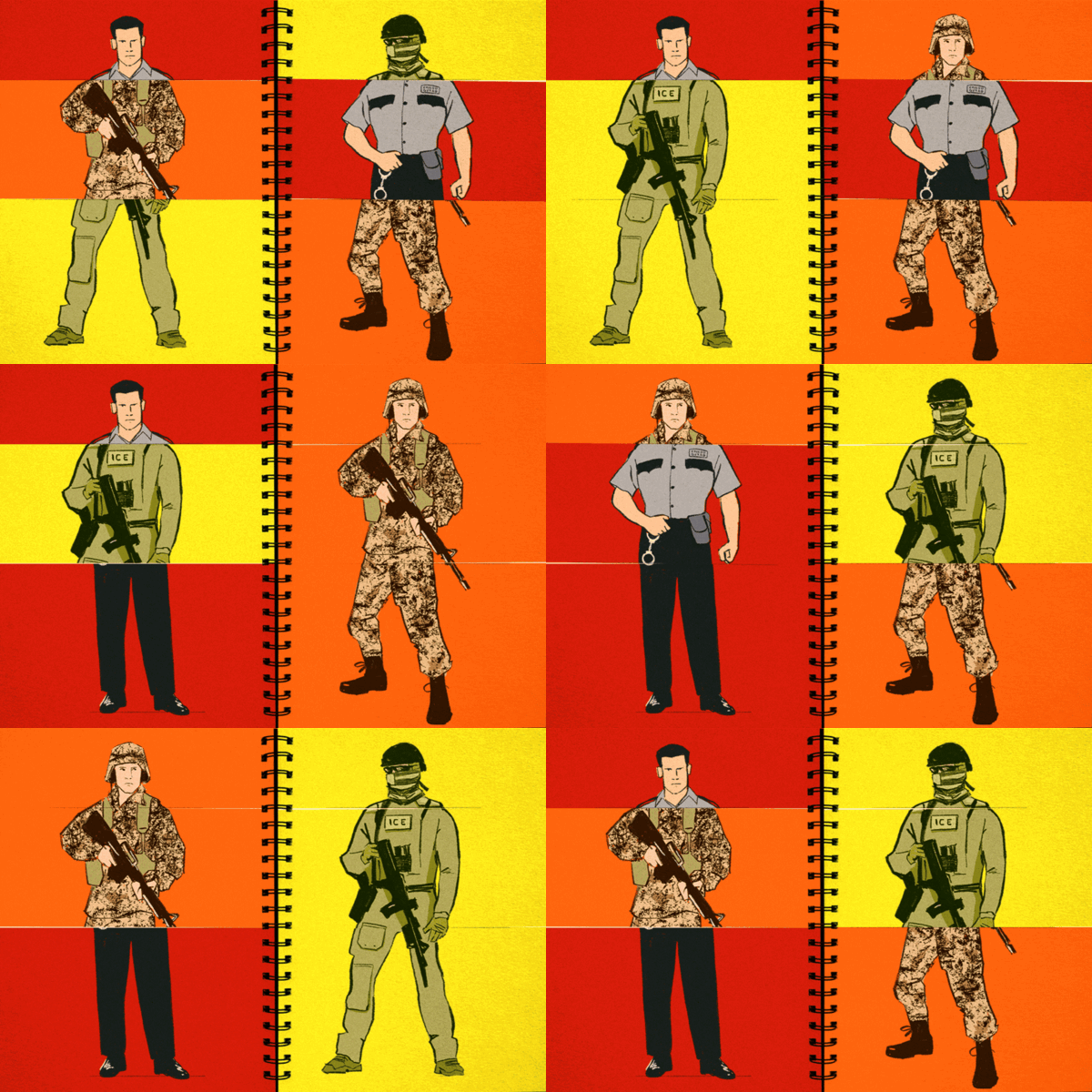
Animated illustration by Ryan McQuade / Sojourners.

The only time I heard my father speak Spanish was in prayer. Before dinner, he thanked God for the food we received and for our presence to each other in the language of his home country. He still does.

We lived in Minnesota from 1993 to 1999, and on wintry nights, when the wind chill might dip so low that Fahrenheit equaled Celsius, our meal was blessed with words that seemed out of place and yet essential to who we were—as prayer should.

At the time, the infrastructure of immigrant communities in Minnesota was only beginning to develop. The number of families from Southeast Asia and Somalia was just starting to increase; it was still far from the critical mass that would make possible civic and cultural organizations, restaurants, and stores, let alone political power. In my school, I recall no other families from Latin America. The local Mexican restaurant was Taco John’s.

When I return to the Minnesota city where I came of age, the transformation is dramatic. Cosmopolitan is not the right word to describe it now, but it is culturally plural: Rather than isolated individuals disoriented in the cold, snow, and whiteness, there are communities. People who support each other, celebrate their culture, and pray together in their own tongues.

Or so it was, until very recently.

The military-style occupation of Minnesota by federal immigration authorities, presenting themselves as law enforcement agents, changed all that. It strains the richly woven fabric of the complementary cultures and communities that now make up the state. Gone, for now, is the vibrant public life of diverse peoples that once was. And while this is heartbreaking, we remember what was and will be again, one day.

It is tempting to understand today’s struggle against state-sponsored violence and terror, in Minnesota and around the U.S., as a continuation of previous generations’ social justice struggles. Once there was the fight against Nazis, against segregation in the U.S. South, and against apartheid. Now, a marginalized group, immigrants and refugees, faces violence, and it is our duty as Americans or Christians or human beings to stand with them.

While it is motivating and orienting to frame the struggles of the present as continuing those of the past, it is just as important to notice what is distinctive about the injustice we face today, and how it marks a sharp break with the past. Dynamics of oppression that were once found only at the margins of U.S. public culture we now find everywhere.

At the margins, out of public view, figures of authority such as soldiers and prison guards would sometimes unleash their worst instincts on those they encountered. There is growing awareness of the moral injury of war, the long-lasting trauma soldiers endure because their roles push them to take actions that run against their moral principles—shooting those who may very well be innocent, terrorizing civilians in the interest of rooting out terrorists, and turning violence into an abstraction or calculation. Worse: The basest human cruelty on display in the torture inflicted by U.S. military and intelligence personnel at Abu Ghraib and at black sites during the “war on terror” is surely only the tip of the iceberg when it comes to abuses committed by representatives of the U.S. overseas.

As a scholar who studies the U.S. prison system and as a friend of people who have been incarcerated, I know very well—even as I cannot comprehend the lived reality of enduring it—the condition of tyranny that is prison life. From the arbitrary creation and enforcement of rules to the constant threat of bodily violence and normalized sexual abuse in the form of strip searches, the nearly two million disproportionately poor, disproportionately Black and brown people housed in U.S. prisons and jails are intimately familiar with terror inflicted by agents of the state.

Like military conflict, prison is presented to the public as well-ordered and rule-governed, but it is not. In fact, the particular horror of these sites of abuse involves precisely this duplicity. People with power inflict disorder in the name of order. They arbitrarily inflict their will in the name of enforcing the rules, and they conceal their violence in the cloak of safety. So, they need to dissimulate. They need to bend the truth. They need to layer falsehood upon falsehood in order to turn away from the hypocrisy at the root of their vocations. To outsiders, including family and friends, the fabrications seem plausible. Surely prisons keep us safe. Surely foreign wars prevent terrorism at home. With co-workers, falsehoods are mouthed cynically, the way we all talk about our jobs. Alone with their thoughts, the powerful who find themselves in spaces of abuse know that something is amiss in their souls, but the inertia of life—and financial necessity—dampen that disquietude.

READ MORE: Read This Before You Compare What’s Happening in the US to Nazi Germany

Part of the ethicist’s vocation, and the task of the responsible citizen, is to look carefully at spaces concealed from public view where power is imbalanced, where the powerful claim that all is well but where the weak experience unspeakable cruelty. When images and stories from these spaces emerge—when the world’s attention focuses on Auschwitz, or Montgomery and Selma, or Soweto, when we hear stories from those at Guantánamo and in solitary confinement, when we see the videos of police violence that fueled #BlackLivesMatter—our moral outrage is compounded by the sense that we were tricked. Public discourse has no space for the realities of those living in spaces of abuse; we, too, have been duped by the duplicity of the torturer, prison guard, or police officer.

The videos from Minnesota that show, for all to see, the murderous violence of federal authorities who purport to be protecting the “homeland” might seem to continue the tradition of making visible what had been cordoned off in spaces of abuse. But now something is different. What is happening in Minnesota is not happening in private. Renee Nicole Macklin Good and Alex Pretti’s killings by federal immigration agents were both recorded in public; the unrestrained violence and unthinkable cruelty of federal immigration agents has been captured on video by hundreds of Minnesotans. Federal immigration agents’ actions have been memorialized in scores of court cases. Abuse is happening in public, not private. And there is no shame.

Violence that was once concealed and contained to spaces where the most marginalized live is now happening out in the open, and that change requires a fundamental reconfiguration of the logic of abuse. Duplicity was once essential to abuse because it had to be concealed from someone—from the world at large, from friends and family, from the abusers themselves. Now, there is duplicity without an audience. Everyone sees murder, and public officials call it fighting domestic terrorism. Who are they convincing? We have entered an age when moral shock may no longer be possible, yet the presence of cruelty and violence in our world has not diminished.

Violence that was once concealed and contained to spaces where the most marginalized live is now happening out in the open, and that change requires a fundamental reconfiguration of the logic of abuse.

Times change. The way the world works changes. Nostalgia gets us nowhere. Our hope for a world of justice remains, and we must figure out how to act on that hope in our changing world.

I no longer live in Minnesota, but a few days ago, I brought my son to a protest in solidarity with Minnesota immigrants and organizers. At 3-years-old, he wants stories of good guys and bad guys. Such narratives, condensed into slogans and chants, are the bread and butter of protests: “Every city, every town, ICE out, shut it down.” At his age, you can appreciate that people should not be locked up. It means separation, severing the bonds that hold together families and communities, the bonds that make us feel loved and that make us who we are.

Then the chanting turned to expletives, as it often does today, in contrast to a decade ago. Language that was once private, reserved for moments of rage and intimacy behind closed doors, is now part of public discourse. I hesitated. I felt old. Are we acceding to the collapsed boundaries between public and private, like our opponents? Or is this the prophetic voice of righteous indignation? Is it a new form of prayer, again in a language foreign to me?

Minnesotans do not fear the cold. It brings us together. The same with ice. We are living in new times, and it is right that we proceed hesitantly, attending to the unknown. But it is most right, most true, when we proceed together, when we care for each other in ways both practical and spiritual. This is the lesson we are reminded of by so many activists, organizers, and ordinary people in Minnesota defending their communities with grace, whether that grace is quiet, rowdy, or strange.