
Carmen Celestini, a lecturer in religious studies at the University of Waterloo in Ontario, Canada, is the author of God’s Angry Men: The Political Legacy of the John Birch Society.
Posts By This Author
How Christian Nationalists Took Control of the U.S. Military
The conflation of God, war, and country did not begin with Pete Hegseth.
FORMER FOX NEWS host and current Secretary of Defense Pete Hegseth has some revealing tattoos. Across his right bicep is the phrase Deus Vult (“God wills it”), a rallying cry from the 11th century Crusades, and on his right pec is the Jerusalem Cross, which was carried by Christian crusaders on medieval campaigns to conquer the Muslim Ottoman Empire.
Back when Hegseth was a TV commentator, he laid out his vision for a new wave of American holy wars, both foreign and domestic, in American Crusade: Our Fight to Stay Free. “Surrounded by the Left, with the odds stacked against us,” he wrote, “only a crusade will do.” Since becoming defense secretary in 2025, Hegseth has attempted to implement a Christian crusade mentality within the U.S. military.
In the buildup to the U.S.-Israeli war on Iran in late February, Hegseth held a Christian worship service at the Pentagon. He prayed for God’s blessing on “overwhelming violence of action against those who deserve no mercy,” and said, “Let every round find its mark against the enemies of righteousness and our great nation.” While President Trump warned Iran to “Open the F***in’ Strait, you crazy bastards, or you’ll be living in Hell,” Hegseth provided the religious apocalyptic validation for the violence—both positioning the U.S. war machine as being on the side of the angels: Deus vult.
Where Did the ‘Great Replacement’ Theory Come From?
The roots of the “super conspiracy” that influenced Trump’s presidency and stoked the paranoia of his followers.

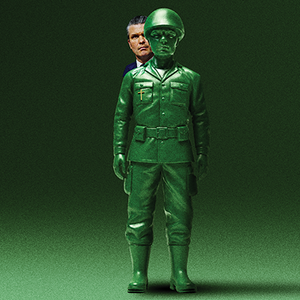
Illustration by Mark Harris
RELIGION PROMOTES WHAT is good in humanity — mercy, wisdom, charity, justice, compassion. These are fundamental to most religious traditions. But religious institutions and movements consist of humans capable of both good and evil, truth and lies, peaceableness and violence. Most Americans have positive feelings about the role religion plays in American life, according to recent surveys. But more than 75 percent are against religious organizations endorsing political candidates or getting involved in partisan politics.
Religious zeal and political power can be an explosive combination — which is why the First Amendment promotes the separation of these powers. Yet the heart and faith of voters impact their choices in the polling booth — and the emotions and imaginations of voters can be swayed by media, social groups, and targeted manipulation to impact an individual’s vote.
One form of manipulation is through conspiracy theories — and conspiracy theories that manipulate religious and social imaginations are particularly potent. They are not new — recall the early U.S. grassroots movements, such as the Anti-Masonic Party and the Know-Nothings, who fought against perceived threats to Protestant Christian values, as well as the John Birch Society’s modern links to the Christian Identity Organization.
As conspiracy theories, disinformation, and populism become more mainstream, one less-understood conspiracy is having an outsized impact on immigration laws: The “great replacement theory” promotes the idea that nonwhite people are brought into the United States and other Western countries to “replace” white voters as part of a godless, liberal political agenda.
The 2017 “Unite the Right” rally in Charlottesville, Virginia, reminded many Americans that the horrors of organized hate were not something in the past. The refrain by white nationalists of “You will not replace us!” recalled virulent antisemitism and anti-immigrant rhetoric of earlier eras. The media repeated the slogan as it tried to make sense of how domestic terrorism, spurred on by online rhetoric regarding the removal of Civil War statues, could have culminated in such social violence and the murder of Heather Heyer by neo-Nazi James Fields Jr. It was a traumatic moment among many in America.