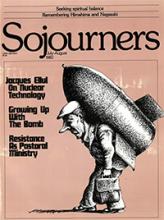
This article was taken from Waging Peace: A Handbook in the Struggle to Abolish Nuclear Weapons, edited by Jim Wallis. Published by Harper and Row, it appeared in fall 1982.
--The Editors
I want you to know, dear brothers and sisters, that what has happened to me has really served to advance the gospel, so that it became known throughout the whole praetorian guard and to all the rest that my imprisonment is for Christ; and most of the sisters and brothers have been made confident in the Lord because of my imprisonment, and are much more bold to speak the word of God without fear.
--Philippians 1:12-14
By the grace of God and the confirmation of my church, I am a Methodist pastor. By that same providence (the givens of history and the leadings of the Spirit) I begin these reflections sitting at a hard metal table in tier F-2 of the Richmond City Jail, where several of us are confined for a month as the result of a simple symbolic witness at the Pentagon. The action with friends from Detroit was dramatic and liturgical and prayerful, an attempt to publicly confess and repent, in ourselves and before all, the nuclear arms race.
From this table I have been trying clumsily to carry forward my pastoral responsibilities among the folk of a small congregation in Detroit. By correspondence I attempt little administrations, gather thoughts for a Bible study group, convey greetings to Sunday morning worshipers, and attend to some pastoral needs.
This week a dear friend who has been languishing for many months died. So I suffer here the agony of separation and write to her husband a letter which cannot suffice (for either one of us) in place of being there.
I get pulled in a kind of tension.
It is put to me repeatedly from various quarters, left and right, near and far, that there is a choice to be made: be a pastor or be a resister. The choice is tempting, an easy out. But given the gospel, given the bomb, given the calling of my heart, these two things (pastor and resister) seem to me inextricably one. Any forced choice, any "either/or" is falsely put: a violation of both, and finally of myself and my vocation.
I take up these reflections again, now many months later at the relative comfort of my desk at home. The intervening months, however, have not been so comfortable. Every attempt to return to this meditation has been frustrated or pre-empted by continuing crisis in my congregation concerning my jail time and debate over whether the arms race bears in any way whatsoever on my pastoral duties.
I have wished to resume writing in the same bold hope that informs Paul's letter to the Philippian community. But my experience, I confess, has been otherwise. My failings of heart and faith, my seeming failure in the congregation, have made me doubt any authorization to speak. Nevertheless, by inspiration or bullheadedness, I remain steadfast in refusing false choices. I remain firmly convinced that nuclear resistance is pastoral business.
On my Pastor-Parish Relations Committee (where voices and opinions have been gracefully mixed) sits one member who utterly and forthrightly disagrees with me in substance over the arms race question. Strangely enough, he goes so far as to suggest that the bishop (who actively supports me) ought to grant me a full-time special appointment doing "peace work."
The apparent contradiction is not just an easy get-him-out-of-my-pulpit solution; it is an intuition and an insight. If "peace ministry" and resistance can be categorized and specialized and professionalized, they will never truly connect with the life of a local congregation. They will never penetrate the church. Questions about the bomb can be kept political and thereby outside of worship, outside of faith, outside of that peculiar pastoral territory: the heart.
The fundamental problem, however, is that the bomb has already cast its shadow across our worship: it has launched a frontal assault on faith; it has invaded our hearts. The bomb is, and has been from the beginning, a pastoral concern.
In the Sermon on the Mount, Jesus makes clear that to imagine and intend a deed of violence is already to have done it in reality, in the heart, in the light of God's judgment. A warhead is armed and pointed at a city of human habitation. Where is the spiritual location of that intention? In the nether abstractions of computer program coordinates? In the mind of the powers? Or deeper, in the heart of a people?
When the Hiroshima and Nagasaki bombs were set loose on the far side of the planet, they struck home in our hearts. When the MX or the cruise missile or the Trident are designed and built and targeted, they have already wreaked their devastation within us. Guilt, hardness of heart, despair, and spiritual confusion are the interior landscape (personal and communal) of that act and intention. They are cause and consequence of the arms race. And they are the field of the pastoral task.
We have, for example, entirely underestimated the dark burden of Hiroshima and the arms race guilt (I take them to be one and the same). That guilt functions politically in a very potent way precisely because it has been so little acknowledged. In the post-war years, as now, it was not seriously confronted, confessed, exposed, or otherwise ministered to.
Unacknowledged, unconfessed guilt strives with a hidden passion for self-justification. An early form of that justification was the yearning to believe that this terrifying new weapon held a secret good, a leap forward, a progress for all humanity.
When "Atoms for Peace" was conceived it tapped that yearning to be justified in the bomb. The government's nuclear power program was not only a masterful cover for continued weapons development, but a brilliant stroke for the national psyche. It treated what the churches apparently failed to face. And we are still living (and slowly dying) with what has been called a "technological guilt trip": nuclear power.
It is not to minimize the economic powers, the military institutions, or the structures of ideology to say that guilt also drives the nuclear arms race forward. In the Hiroshima advent of atomic weapons there was a choice: we could either turn from them in horror, or justify them (their saving power to bring the boys home and end the war) by building more, choosing them yet again.
To be "right" in choosing them then, we are compelled to choose them now again and again. Billions upon billions of dollars have been poured into the arms race; that is justified only if we carry it all absurdly forward. Guilt has a tenacious grip. There will be no letting go of these weapons apart from confrontation with our own personal and corporate guilt.
To say amen to Hiroshima, to claim it as victory and embrace it, was also to harden our hearts to the voices and sufferings of the victims. We could not look them in their burned and anguished faces and at the same time dance in the streets a victory celebration. Nor can we (please dear Lord) truly imagine the suffering and death of a nuclear blast and at the same time aim the missile, or even pay for it. Nuclear weapons harden our hearts. And not just to the nuclear victims.
Once we have accepted as a matter of policy a deliberate willingness (for whatever security or political motive) to destroy entire cities--indeed the planet--how can we expect to take compassion on our neighbor next door or across town? Contempt for the poor, for the aged, for our own cities is simply an extension of the contempt which the bomb holds for all humanity.
Hardened against the nuclear victim, hardened against our neighbor, we do well to remember that we become hardened against Christ, against, let us say, the Word of God. The parable of the sower might read something like this: A sower went out to sow and some of the seed fell on the hardened concrete of a missile silo...
It is as though our hearts have been encased in (or worse, supplanted by) the super-hard concrete vault of a silo or a command post. Super-hardened hearts are the most indispensable feature of any nuclear weapons system--more a cornerstone than any single piece of technological hardware.
Nearly all the same things can be said of despair as well. Not long ago I was talking with some friends--an informal premarital counseling session in preparation for their marriage. When pressed on the meaning of long-term commitment, one of them replied, "Well, with the bomb and all, never knowing when some big catastrophe will hit, it's hard to think about the long term and make those commitments."
Knocked me over! These are not anti-nuclear activists counting down minutes on the doomsday clock of the Bulletin of Atomic Scientists, or calculating the technological timeline for first-strike capability. These are just sensible and sensitive folks who live with a largely unspoken sense of doom: there is little or no future. And that sense affects their thinking about marriage commitments.
How much of the breakdown and breakup and break-apart we've all seen (trooping, for example through this pastor's study, not to mention his life and community) is related to the shadowy despair of the bomb?
More in the same vein: how much of our personal consuming, our heavy credit buying, our devouring culture, our get-it-quick, use-it-all-now approach to economy and environment is based on despair of the future? Simply put in economic terms: you may as well buy it now and pay up later, because there may not be any later. A half-thought, smart-money wager. No one can measure, but it's not just speculation to suggest that our burning consumerism and mushrooming inflation are fueled in spirit by nuclear weaponry.
And, as with hardness of heart, this hidden, half-conscious despair functions politically on a massive scale. I believe that even more than fear, despair is the primary method of political control today. People resign themselves to inevitability, to the overwhelming momentum of the powers, before whom they feel so helpless. And they are thereby rendered passive spectators in their own history.
In the Book of Revelation, when the whole world follows after the Beast they chant, "Who is like the Beast and who can fight against it?" Those are surely words of idolatrous awe and fear, of fascinated transfixion; but first and foremost they are words of despair. The whole world (save the faithful) falls into line and are led off captive by despair.
All of this traverses some landscape much too quickly. It is on the one hand political landscape which more deeply seen turns out to be interior, spiritual landscape. It covers just enough ground of the arms race to see that the heart of the matter is substantially a matter of the heart.
A ministry and community which calls itself (or better, is called to be) pastoral must attend to the real causes and consequences of the bomb. It will be no surprise to suggest that such a community might begin at its own center, at the heart of its life together: our Lord's Supper. In the simple mystery of the sacrament, grace has its means. There, in confession, we are freed from guilt. There our hearts are renewed. There our hope embodied.
I am prone to complain that my church's conventional communion liturgy is overly penitential, relentless with heavy-handed breastbeating. Still, confession is prerequisite to the meal. It is preparation and approach. It is laying out our broken lives and history up front and on the table, before one another and before the Lord. Communion is the singularly proper place to encounter and confess the nuclear arms race.
How can we ever forgive ourselves for the dropping of the Hiroshima bomb? How can we forgive ourselves for launching and loosing Trident? How can we forgive ourselves for active, tax-paying complicity? How can we forgive ourselves the creeping sins of omission: our passive, idle silence? If we confess our sins, we can, because we are forgiven in Christ--so say bread and wine.
Now there is a pastoral word. I don't say lightly that we are forgiven Hiroshima. But I believe it, and I proclaim it as good news. The forgiveness of God (which not incidentally is near the center of any gospel nonviolence) is the only thing by which we are finally able to disentangle ourselves from the nuclear web. It is the freedom in which our own right action can arise. Apart from it, even good and solid nuclear resistance may be driven by guilt. That freedom and forgiveness are made concrete and accessible at the Lord's table.
Another way of saying this is that in Eucharist we are given a new heart. In the suffering death of Jesus, the body broken and the blood spilled, we come face to face with the suffering of the nuclear victims. Our hearts (God willing) get broken. Our super-hard concrete is pierced and crushed. What a grace it is when we can weep at the table of the Lord.
In that meal, in the new covenant in Christ's blood, an old promise is fulfilled: "And you shall be clean from all your uncleanness, and from all your idols I will cleanse you. A new heart I will give you, and a new spirit I will put within you; and I will take out of your flesh the heart of stone and give to you a heart of flesh" (Ezekiel 36:25-26). A healing in the deepest possible sense is effected.
Which is also to say again and again that the Eucharist is the sign of hope, in heart and in history. We eat the feast of promise "until the Lord comes." We live, even in the shadow of death, not resigned to death's final victory, but in daily anticipation of the kingdom, of the coming of judgment and grace, the vindication of truth, the sovereign rule of Christ. In communion, our hope of "what is and is to come" is nourished. Those who gather with bread and wine in their midst are precisely those who are not led off by despair and the nuclear beast.
Well, given the efficacious freedom of forgiveness and renewed hearts and embodied hope, you would think that congregations breaking bread day after day would be hotbeds of nuclear resistance. Needless to say, that has not heretofore been so. The Lord's Supper has in fact been subjected in our time to a great spiritual confusion. It has been betrayed and diluted and compromised. (Here we come closest to the matter of pastoral negligence.)
I hear it said, directly and indirectly, that our freedom to celebrate the Lord's Supper is won and secured, granted and guaranteed by our nuclear arsenal! I have this picture of the altar ringed with missiles pointing outward, guarding and protecting the elements of freedom. The vision is extreme, but not I think unfair to what is being proclaimed even from some pulpits.
That "freedom" proffered by the powers, and the freedom--even to die--proclaimed and offered by Christ at table, are two categorically different things. And yet they have been confused, and mingled, and mistaken.
When Paul writes to the community at Corinth, the very letter in which he delivers again to them that which he received from the Lord, the words of eucharistic institution (our earliest record of the communion prayer), he proceeds all that with a great warning:
Therefore, my brothers and sisters, shun the worship of idols. I speak as to sensible people; judge for yourselves what I say. The cup of blessing which we bless, is it not a participation in the blood of Christ? The bread which we break, is it not a participation in the body of Christ"?...What do I imply then? That food offered to idols is anything, or that an idol is anything? No, I imply that what pagans sacrifice they offer to demons and not to God. I do not want you to be partners with demons. You cannot drink the cup of the Lord and the cup of demons. You cannot partake of the table of the Lord and the table of demons.
--1 Corinthians 10:14-22
Yes, of course, communion is a gift. Its healing forgiveness and renewal and hope are a grace which we receive with empty and open hands. But it is also a choice: between Christ and the idols, between God and the gods of this world. American Christians, especially, have tried to have it both ways, barely noticing the missile come close and come between at the altar. I submit that this is why the healing and freeing power of the Eucharist has been minimized and muted. The pastoral task, the sacramental task, is to make that choice simple and utterly clear.
Pastors and pastoral communities will make the choice clear at the altar with bread in hand and whispered intercession. But they will also need to make it clear, let us say, "in the streets." It remains a twofold mystery that this most interior, contemplative act of choice and grace in the community is a "political" threat to the rule of the powers (that is partly the implication of all that goes before) and, at the same time, that the public, dramatic acts of confrontation which well might be called "political" are among the most pastoral ministrations to the heart.
This is most clearly the case with our Pastor, Christ. He attends to the deepest needs of our hearts by his bold actions in the streets of Jerusalem. In his arrest and trial and execution on the cross, Jesus is being our pastor. It is, in fact, that public drama which the Last Supper contemplates. It points to and remembers and rehearses exactly those events.
When Jesus speaks openly about pastoring in John 10, he doesn't invoke an idyll of lambs gamboling quietly in summer pastures. The Good Shepherd passage is a straightforward warning about deceivers and confusers and misleaders, about thieves who come to "kill and destroy." It is about not heading the other direction when the devouring beast appears on the prowl. It is, let us be utterly clear, about risk and action. The Shepherd and Pastor lays down freely his life.
I will be the first to confess my weakness and fear before such a call and claim. But I come back to it. I believe it has everything to do with how Paul is able to write of pastoral encouragement from jail to the congregation at Philippi. It certainly authorizes some hope for going to the Pentagon or GE or Lockheed or an arms bazaar or such like with an intercession for history and heart. And I'm thoroughly convicted that it requires us in community and ministry to explore active resistance as a pastoral tactic and concern. ?
Bill Kellermann was a contributing editor for Sojourners when this article appeared.
Got something to say about what you're reading? We value your feedback!