Subscribe and Get Our New Book Subscribe

My Wife and I Married on the Feast of Our Lady of Guadalupe

What if sexual identity holds a special place in the complex beauty of the natural order?

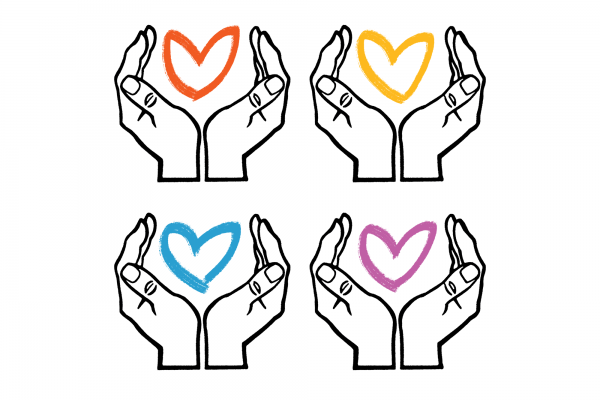
Illustration of hands holding drawings of hearts.
Illustration by Matt Chase

AT AGE 43, I found the person I wanted to marry. At 50, I proposed. And she said yes. I, a generations-long Roman Catholic, was proposing to a United Methodist (with deep ancestry in Presbyterianism). We wanted our marriage witnessed and blessed by the church. We wanted to hear our community pledge to uphold and care for us in marriage. But we were not of opposite genders—a prerequisite for marriage in both our denominations.

For seven years we prayed and wrestled over our “mixed marriage” and what to do with our respective denominations’ position, which amounted to “love the sinner, hate the sin.” The priests in our Catholic community recognized us as a couple and tended our wounds when anti-gay teaching came from the pulpit. But they could not invite us on couples’ retreats, consecrate our marriage, or even offer us a blessing. Our evangelical and Methodist communities defended our civil rights, but not our ecclesial ones. If we asked for liturgical rites, we became a “problem.”

Eventually, we found an Episcopal community that not only welcomed us but offered marriage preparation tailored for same-gender couples. We signed on the dotted line, completed the pastoral process, and sent out invitations for our April 2020 wedding. A global pandemic scuttled our plans.

This spring, the Vatican office responsible for Catholic doctrine published a response to the question: “Does the Church have the power to give the blessing to unions of persons of the same sex? Response: negative.” The one-word answer was followed by a 975-word explanation that included a reminder that God “does not and cannot bless sin.”

In Homophobia: A Weapon of Sexism, Southern writer Suzanne Pharr asked what would “the world be like without homophobia in it?” If patriarchy is held in place by sexism, Pharr argued, then sexism is held in place by “economics, violence, and homophobia.” I would argue this is the root of institutional Roman Catholicism’s homophobia: It sees gender and sexual identity issues as existential threats, not doctrinal ones. Give an inch on same-gender blessings and the whole patriarchal system falls apart.

Howard Thurman once said, “There is in every person something that waits and listens for the sound of the genuine in herself.” What if Christians were to say that sexual identity across the spectrum is neither sickness nor sin; it’s not “intrinsically disordered,” but holds a special place in the complex beauty of the natural order? What if church was a place where we raised our children to be judged not by their sexual identity but by the “content of their character”? Can our churches cultivate “the sound of the genuine”?

My wife and I married on the Feast of Our Lady of Guadalupe at the height of the pandemic. Just the two of us, in a nearby oak and beech woods. Ironically, four generations earlier, an ancestor of mine in Louisiana relocated his unorthodox family into the wooded hinterlands to get “beyond the oversight of the [local] priest” and avoid the church’s anti-miscegenation laws.

A commitment to Catholic faith and to the “sound of the genuine” still runs deep.

This appears in the June 2021 issue of Sojourners