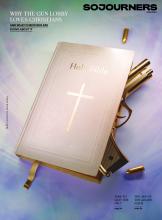
A fringe Christian ideology helped stoke an out-of-control gun culture. People of faith are working to take back the conversation.
interview
Liz Bierly 10-13-2022

Graphic by Candace Sanders
IN THE NOVEMBER 2022 issue of Sojourners, author and researcher David E. Kresta suggests that community economic development is one significant way that churches can bring hope and healing to their neighborhoods. Editorial associate Liz Bierly spoke with Kresta about how he connects his faith and his vocation, his book Jesus on Main Street and his Ph.D. research on the connection between churches and gentrification, and some steps faith communities can take to truly love their neighbors. You can read his article, “Your Church's Soup Kitchen Doesn't Create Social Change,” here.
This interview has been edited for length and clarity.
Liz Bierly, Sojourners: You went from a degree in computer engineering to having experience in marketing and management to a Ph.D. in Urban Studies that you leveraged to explore the role of churches in neighborhood change. Can you tell me more about that career trajectory?
David E. Kresta: I started out, as you noted, in the high-tech field as a software developer; I had this parallel journey, I guess. I had my vocation, and then I had my Christianity — and when I was raised, those things were separate. I grew up in this space where I was essentially living my “American dream life” — following and pursuing high tech, making money, having a job, and having a family — and then [having] my spiritual journey, and they weren’t connected. Over time, I think God sought me out and said, “Hey, these are things that need to be connected.”
And through a long process, I became aware of things that I had been blissfully ignorant of. I grew up in Detroit, which was hyper-segregated; I was very much isolated from poverty, and I didn’t even know anything about gentrification as I was growing. I think that captures a lot of what people live today: Things that are out of sight, they really have no connection to, and they don’t even know about them other than what they maybe hear on the news. To make a long story short, I started doing some volunteer work with churches to serve their communities and really became more aware of the things that are going on in the world around us, and the brokenness at the systems level.
God really challenged me through this process of discernment to dive in and, as best as we can, try to understand what is going on in the world around us. That’s why I decided to pursue that Ph.D.: Because I felt like the church really had something to say in this space, and we need to be better equipped to speak into and address the issues that are going on around us.
Liz Bierly 10-13-2022
Graphic by Candace Sanders.
IN THE NOVEMBER 2022 issue of Sojourners, culture columnist Josina Guess explores the legacy of Denmark Vesey, Mother Emanuel AME Church, and the stories that resist removal. Guess spoke with editorial associate Liz Bierly about the connection between art and practice, the mentor that impacted her life and writing, and the full-circle moment of being back in Sojourners’ pages. You can read her November column, “Remembrance as Resistance,” here.
This interview has been edited for length and clarity.
Liz Bierly, Sojourners: You previously pursued a BA in fine and studio arts, and now you are working toward an MFA in narrative nonfiction. What led you to pursue these studies, and what does it look like for you to pursue the intersection of those topics?
Josina Guess: In college, I was just captivated by ceramics and by the process of having something that got my hands dirty and centered me every day in the swirl of college life. I think that’s why I majored in art — I could have studio time — but I wasn’t necessarily pursuing a career in the arts. I had been recognizing that words felt like a medium that I could carry with me anywhere I went, and I didn’t need to have a studio or a kiln.
I ended up not really pursuing ceramics, but I think writing was sort of a continuation of that sort of art as practice. When I’m trying to think about what my days are like [now] — like today I moved some goats, picked some cucumbers, and made some kimchi — I think it’s this combination of these real-life practices of gardening and farming and parenting, and then just engaging in and paying attention to what’s going on in the world and writing about it. [I’m] trying to find a balance in my own life of joy and centering, and then also seeing how to respond to the really broken and wounded parts of myself and of the world, and hope that healing comes in all of those practices.
Philip Pullella, Reuters 7-08-2022
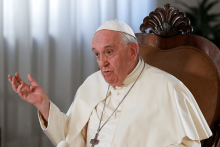
Pope Francis speaks during an exclusive interview with Reuters, at the Vatican, July 2, 2022. REUTERS/Remo Casilli
Pope Francis said he wants to give women more top-level positions in the Holy See and disclosed that for the first time he would name women to a previously all-male Vatican committee that helps him select the world’s bishops.
Josiah R. Daniels 2-15-2022
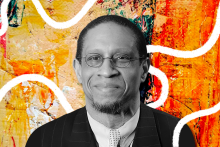
Obery M. Hendricks Jr. Courtsey photo. Graphic by Tiarra Lucas / Sojourners.
With scholarly precision and an ability to engage beyond the tired critiques of right-wing Christianity, Hendricks imagines a version of Christianity that is politically committed to social justice. Whether it is through his experience growing up in the Black church, his commitment to the revolutionary nature of Jesus’ teachings, or his insistence that leftist politics and Christianity can inform one another, Hendricks demonstrates the beauty of the Christian faith.
Mitchell Atencio 5-11-2021

Ben Kirby poses for a photo. Original photo credit: Grant Daniels.
In his book PreachersNSneakers: Authenticity in an Age of For-Profit Faith and (Wannabe) Celebrities, published last month, Ben Kirby does more than throw stones at ultra-wealthy pastors; he asks readers to self-audit and consider where they’re spending, lest they throw that stone and shatter their glass houses.
Robert W. Lee IV, Da’Shawn Mosley 8-05-2019
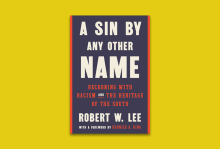
Da’Shawn Mosley: What inspired this book?
Robert W. Lee IV: I’m a pastor first. But the events in Charlottesville, and our nation’s response, terrified me and inspired me to put pen to paper and say, “We gotta talk about this, because if we don’t, our silence becomes complicity.”
This summer marks the second anniversary of the white supremacy violence in Charlottesville. What is your read of where we are as a nation? Charlottesville will live in our collective history as an event of great horror. It was domestic terrorism. As we move forward, especially in the 2020 election, we’re going to have to talk about the deep chasm of racism that exists in our country without using it as a pandering mechanism to get votes. It’s important for us to care and be deeply concerned about these issues.
As a white man, how have you navigated wanting to be an ally and not be at the forefront of the movement while at the same time being catapulted into the public spotlight? It’s a learning experience. I hate to put it like that, but it is.
Daniel José Camacho 5-09-2019
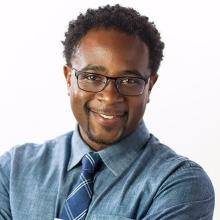
Jemar Tisby
White evangelical support for Donald Trump has led some black evangelicals to a crisis of faith and ecclesial identification. In this moment, Jemar Tisby has risen as a voice that’s unafraid to challenge white evangelicals’ complicity with racism, forging another path for those feeling alienated. Tisby is currently completing his PhD in history at the University of Mississippi. He is the president of The Witness: A Black Christian Collective, previously known as the Reformed African American Network, and writes widely about racism, the American church, and social justice. In 2017, a New York Times article quoted him saying: “Racism is not a ‘blind spot’ within white evangelicalism. It is part of that tradition’s DNA.” Now, Tisby has published a book tracing that DNA by way of history.
Juliet Vedral 5-08-2019

Still from "Tolkien" film trailer
Dome Karukoski’s Tolkien, out in theaters this Friday, focuses on another story of friendship, that of the Tea Club and Barrovian Society (TCBS) which Tolkien was a part of during his education at King Edward’s School in Birmingham. The film tells the story of Tolkien’s early life as an orphan living in poverty and at the mercy of his benefactors, and the love and friendship he finds in spite of it. Tolkien is gorgeously shot and filmed with warmth, humor, and friendship.
Da’Shawn Mosley 5-02-2019
Father Theodore Hesburgh
The new documentary Hesburgh, which premieres nationwide on Friday, May 3, and is directed by the Emmy-nominated filmmaker Patrick Creadon (Wordplay, I.O.U.S.A.) gives us a thorough look at Father Hesburgh’s walk. From Hesburgh’s origins to his decision to devote his life to the priesthood, to his appointment — at the young age of 35 — as president of the University of Notre Dame, to all the personal, national, and global adversities that the man of the cloth later faced afterward, Hesburgh weaves a beautiful and engaging story of faith lived out.
Gregory Wakeman 3-19-2019

Morgan Freeman at the 24th Screen Actors Guild Awards - Press Room at Shrine Auditorium on Jan. 21, 2018 in Los Angeles, Calif. - Shutterstock
Morgan Freeman’s dulcet tones make him one of the most recognizable voices on the planet. He has used his presence to become one of the most famous actors of his generation, during which time he won the Academy Award for Million Dollar Baby, was nominated four more times, and has also picked up Golden Globe and Screen Actors Guild gongs. In recent years, Freeman has been focused on the documentary series The Story Of God With Morgan Freeman.
Juliet Vedral 3-13-2019

Justin Baldoni arrives for the 'Five Feet Apart' Los Angeles Premiere on March 07, 2019. Credit: Shutterstock.
If you knew that your life here on earth would be short, how would you live it? Would you try to control every aspect of it to avoid the suffering and pain you knew was coming? Would you become angry, embittered, and push people away? Or would you try to make the most of it? These questions are at the heart of Five Feet Apart, starring Cole Sprouse and Haley Lu Richardson as two kids with cystic fibrosis (CF) who fall in love. The film is actor (Jane the Virgin) and filmmaker ( My Last Days) Justin Baldoni’s feature film debut.
Daniel José Camacho 2-28-2019
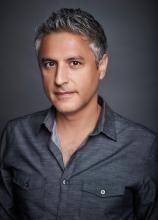
Reza Aslan
So far, Aslan’s cable shows — including his Muslim-American family sitcom that was dropped by ABC — have not panned out. But his ambitions to reach a broader audience remain as large as ever. And unlike the somewhat braggadocios and didactic style of commentary that he’s become known for in front of television cameras, he’s eager to change minds while occupying a different place: behind the camera.
John Noble 1-23-2019
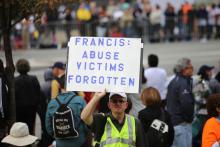
Protester on behalf of abuse victims while Pope Francis celebrateds mass at the Cathedral Basilica of Peter & Paul in downtown Philadelphia. Sept. 26 2015. By a katz / Shutterstock
Over the past few decades, sexual abuse survivors, whistleblowers, and journalists have exposed a horrific pattern of sex abuse and cover up in the Roman Catholic Church. As a Catholic millennial, I have never known a church unmarked by the abuse crisis. In the bathrooms at my Catholic high school and my small Midwestern parish, I distinctly remember posters detailing who I should call if I was abused or assaulted by an authority figure. Last year, the Pennsylvania grand jury report and Cardinal Theodore McCarrick revelations made my generation aware of this crisis in a renewed way. Too often, in responses, the voices of survivors themselves are too often lost.
I recently had the opportunity to discuss the current state of the Roman Catholic Church’s sexual abuse crisis with Tim Lennon, a survivor of clergy sexual abuse. Lennon is the president of the board of directors of the Survivors Network of those Abused by Priests (SNAP), a nonprofit support network for survivors of sexual abuse by religious and institutional authorities.
Daniel José Camacho 10-01-2018
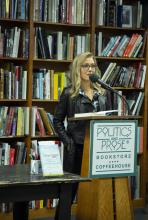
Heartland: A Memoir of Working Hard and Being Broke in the Riches Country on Earth is a gripping account traversing family, poverty, geography, history, and public policy. It’s already been longlisted for a National Book Award and is a Kirkus Prize finalist. Smarsh captures the experience of poverty in the deftest of prose: “I knew how to compare prices on tags before I knew how to read words.”
Juliet Vedral 8-23-2018

campmannathemovie.com
Camp Manna is the story about Ian, a young orphaned boy who doesn’t believe in Jesus. He is sent to Camp Manna, a Christian camp led by Jack “Cujo” Parrish (Gary Busey). Once there, he’s placed in a cabin of misfits and forced to participate in the God Games, a camp-wide competition. Antics invariably ensue.
Carrie Newcomer, John Malkin 4-25-2018
I’m inspired and troubled by the stories I have heard.
In the blue light of evening all boundaries get blurred.
And I believe in something better, and that love’s the final word,
And that there’s still something whole and sacred in the world.
—“Help in Hard Times,” by Carrie Newcomer
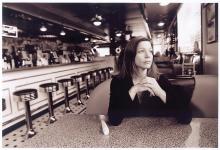
CARRIE NEWCOMER IS a Quaker singer-songwriter whose music is inspired by hope and the great human potential for peaceful coexistence. The Beautiful Not Yet is the title of both her newest album (Available Light Records) and an accompanying book of poems, essays, and lyrics. She is also working on a spoken word and music collaboration with Parker J. Palmer (author of Let Your Life Speak and Healing the Heart of Democracy) called “What We Need Is Here: Hope, Hard Times, and Human Possibility,” which is scheduled to premiere in spring 2017.
Newcomer lives in southern Indiana when she’s not traveling the world singing her folk and gospel-infused tunes and engaging social and environmental justice issues.
She was interviewed for Sojourners by John Malkin, a musician, journalist, and radio host in Santa Cruz, Calif., whose books include Sounds of Freedom: Musicians on Spirituality and Social Change and The Only Alternative: Christian Nonviolent Peacemakers in America.
John Malkin: When did you start making music?
Carrie Newcomer: I picked up a guitar when I was in my early teens and learned my first three chords and started writing songs. I’ve always loved the combination of language and music.
In the liner notes of The Beautiful Not Yet, you mention that many of these songs were written on trains and planes. How has travel been a part of your life and music?
Betsy Shirley, Maria-Jose Soerens 4-25-2018

LAST SUMMER, THE FUTURE of for-profit prisons seemed bleak. The U.S. Department of Justice announced it would begin phasing out its use of privately run prisons and the U.S. Department of Homeland Security quickly followed suit, declaring that it would reconsider its use of privately run detention centers. Stocks for companies that ran for-profit prisons plunged.
But then Donald Trump was elected president, and private prison stocks immediately soared. The nation’s largest prison company, CoreCivic (formerly Corrections Corporation of America), reported a boost of more than 40 percent in the value of its shares. Given Trump’s promises to “create a new special deportation task force,” investors bet that privately run detention centers will play a key role.
And the investors may be right. Every year, DHS detains about 400,000 undocumented immigrants in 250 centers nationwide, and 62 percent of the beds in these centers are operated by for-profit corporations.
According to Maria-José Soerens, a licensed mental-health counselor serving undocumented immigrants in Seattle, there are two major problems with for-profit detention centers. First, for-profit centers are not held accountable to the standards that govern federally run centers. In her work in these centers, Soerens has heard complaints ranging from a lack of medical attention to inadequate opportunities for parent-child visitation; one young woman who was having suicidal thoughts was kept in solitary confinement until she told guards she was “better.”
But the deepest problem, explains Soerens, is that most detention centers only exist because corporations saw a “business opportunity.” Beginning in the early 2000s, for-profit prison companies successfully lobbied Congress to expand drastically the number of beds in the immigration detention system—a move that doubled the revenue of the two largest for-profit prison companies. In 1998, there were 14,000 beds available for immigrant detention; today, there are 34,000.
Julie Polter, Chuck Collins 4-25-2018
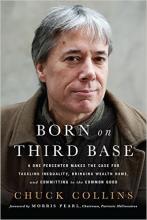
WRITER AND ACTIVIST Chuck Collins, the great-grandson of meatpacker Oscar Mayer, gave up his inheritance when he was 26 and has spent the subsequent decades working to address economic inequality and environmental issues. Via email with Sojourners senior associate editor Julie Polter, he discussed his newest book, Born on Third Base: A One Percenter Makes the Case for Tackling Inequality, Bringing Wealth Home, and Committing to the Common Good (Chelsea Green)—and why organizing and building community across economic lines is good for everyone.
Sojourners: What is your main message in this book?
Chuck Collins: I want to invite wealthy and affluent people to “come home”—to return from wandering in the desert of wealth and privilege, the disconnection from community and place. It means putting a personal stake in reversing the deepening ruts of extreme wealth inequality and the ecological crisis. If we read the signs of the times, we understand this is both in our selfish interest as well as strengthening the common good. These inequalities and ecological challenges are undermining the quality of life for everyone, including wealthy people. There is no wealth on a degraded planet.
By reconnecting with people and places, we come out of exile. Racial and economic advantage is a “disconnection drug”—distancing us from both the suffering and the joy of being a human.
Many of the ultra-wealthy are “placeless” and “stateless”—literally holding multiple passports with money globalized in offshore financial centers around the world. So “coming home” means bringing the wealth home too—taking it out of the offshore tax havens, out of the global financial casino (“going off the Wall Street grid,” as one of the people I interview in Born on Third Base says), and out of the fossil fuel industry.
Julie Polter, Judith Casselberry 4-25-2018
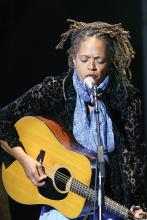
Judith Casselberry
JUDITH CASSELBERRY'S ORIGINAL LOVE WAS MUSIC. She has been a guitarist and vocalist her entire adult life, including a 1980 to 1994 stint as part of the duo Casselberry-DuPreé. She now performs with Toshi Reagon and BIGLovely. She has shared the stage with Sweet Honey in the Rock, Odetta, Stevie Wonder, Etta James, and Elvis Costello, among others.
Along the way, while still performing, Casselberry earned her bachelor’s degree (in music production and engineering) and then, a few years later, a master’s in ethnomusicology, during which she discovered a passion for teaching. So she went to Yale, earning a doctorate in African-American studies and anthropology in 2008. She is an associate professor of Africana studies at Bowdoin College in Brunswick, Maine, teaching courses on African-American women’s religious lives, music and spirituality in popular culture, music and social movements, and issues in black intellectual thought.
Casselberry’s forthcoming book, The Labor of Faith: Gender and Power in Black Apostolic Pentecostalism (Duke University Press), employs feminist labor theories to examine the spiritual, material, social, and organizational work of women in a New York-based Pentecostal denomination, Church of Our Lord Jesus Christ of the Apostolic Faith (COOLJC). In the course of her research, Casselberry immersed herself for more than two years in the life of True Deliverance Church in Queens, N.Y. She spoke by phone with Sojourners senior associate editor Julie Polter in late January.
Sojourners: You examine the “religious work” of women—including prayer, teaching, care for the sick and grieving, liturgical music and movement, and guiding converts. Why did you choose this framework?