Peace

Glancing upward at one of the six U.S.-manufactured aerostat blimps performing constant surveillance over Kabul, I wonder if the expensive, high-tech, giant’s-eye view encourages a primitive notion that the best way to solve a problem here is to target a “bad guy” and then kill him. If the bad guys appear to be scurrying dots on the ground below, stomp them out. But crushing only the right dots has proven very difficult for a U.S. drone warfare program documented to have killed many civilians.

We should have no fear of making an apology, which is the outward symbol of an inward change of heart acknowledging and renouncing our violence. We should apologize not only in Hiroshima, but in Nagasaki, Vietnam, Fallujah, Kunduz — around the world, and upon our own shores, with reparations to Native and African Americans.
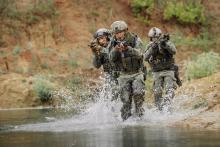
“Down by the Riverside” comes out of the same time in the history of our nation that the lingering divisions of Civil War did, and it’s a reminder to us that our hope and calling as children of God is to leave off studying war.
I believe that a Christian can nonetheless honor those who have fallen in war. They are casualties not only of the arms of a foe, but also of the failure of humanity to build a better peace. Those who hold arms take on not only the burden of risking their lives, but are also made to bear those first poisoned fruits whenever nations or radical groups turn to the sword instead of the plowshare.

The name Berrigan helped keep the possibility of coming back to my Christian aith alive. Just like the black churches that took me in, here were some Christians who were saying and doing what I thought the gospel said that nobody in my white evangelical world was. I believe the witness of the Berrigans literally helped keep my hope for faith from dying altogether.
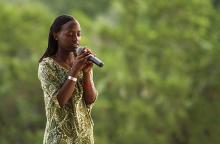
IN DECEMBER 2007, Naomi Mwangi, a Christian, fled her home in Kisumu, Kenya, as men with machetes attacked towns across the region. For five weeks violence raged nationwide. When the bloodshed ended, more than 1,300 Kenyans were dead and another 650,000 had been displaced. Mwangi and her family ended up living in the Maai Mahiu refugee camp, south of Nairobi. She was 12 years old.
Mwangi is coming of age in a society with ethnic violence in the background, extremist violence in the foreground, and massive economic inequality. Africa has the highest concentration of young people in the world and more than half of them are unemployed. Mwangi wanted something different—she wanted to work for peace.
Now 21, Mwangi is a leader in grassroots peacemaking campaigns that seek to end conflicts between the 42 ethnic groups in this majority-Christian country. The 2007 election violence pitted Christian against Christian, as ethnic ties trumped religious affiliation. Even now, during elections, Mwangi told Sojourners, “Leaders motivate youth to join in the political crisis ... to fight against another tribe.”
A major obstacle to social and economic stability among youth in Kenya is unequal distribution of government-issued identification cards. Kenyans need ID cards for everything from voting and university enrollment to obtaining grants for entrepreneurship programs. But historically, the ruling government doled them out as political favors, and they’ve often been denied to members of minority groups.
“There are plenty of applications at election time,” Mwangi said, explaining that the ID process is slowed down or delayed when it seems one ethnic group could tip the chances of a politician who represents a different group.

“Why did you, American Mother of the Year, commit civil disobedience in front of the Trident nuclear submarine?” a reporter asked the white haired, 78-year-old woman as she left the courthouse.
The woman, accused of being in a little boat blocking a nuclear submarine, answered without a moment’s hesitation.
“I did it for the children of the world,” she said.

Sisters from the Dominican Sisters of the Sick-Poor (also now Dominican Sisters of Hope) sent representatives to marches. They saw systemic injustice firsthand in their ministries as they provided nursing services to residents of Harlem, the South Bronx, and other communities that struggled to afford healthcare.
Years after participating in equal rights and peace marches, Sister Bette Ann Jaster joined LifeWay Network, one of two organizations in the New York Metro area that provides safe housing and education for women survivors of human trafficking, as a representative for Sisters and Catholics in general. Her involvement on the committee has since declined, but Sister Bette Ann is as bothered by the issue as ever. “I keep wondering, ‘What more can we do?’” she said.

This week marks 25 years since the horrific U.S. bombing of the Amiriyah shelter in Iraq. At least 408 women and children died.
As we consider what has helped fuel the rage and hostility of extremists like ISIS, we can point to concrete events like the bombing of Amiriyah. It clearly does not justify the evil done by ISIS, but it does help us explain it.

Ted Cruz ended Monday night with a yuuuuge victory over Donald Trump in Iowa. (Sorry, had to do it!) Religion played a big role in Cruz’s victory. The New York Times reports that Cruz’s victory was “powered by a surge of support from evangelical Christians.”
For his part, Cruz reaffirmed his connection with his evangelical supporters by evoking divine favor upon his victory. “God bless the great state of Iowa! Let me first say, to God be the glory.”
But I can’t help but feel uneasy about the God proclaimed by the so-called "evangelical vote." That’s because, when it comes to their evangelical faith, they have an identity crisis.

Pope Francis and Iranian President Hassan Rouhani met for talks on Jan. 26 — the first such encounter since 1999 — in a private meeting in which the pontiff pressed Rouhani on fostering Middle East peace and countering terrorism and arms trafficking.
The 39-minute meeting in the apostolic palace also touched on the landmark deal on Iran’s nuclear capacity that has been praised by the pontiff, and the two leaders discussed the situation of the church in Iran and interreligious dialogue.

If we see our interests and needs as more important than the interests and needs of others, then we’ll never have peace in our personal lives or in our world. Peace requires a recognition that we’re all equally beloved children of the same loving God.
It involves recognizing that we all matter equally — and then doing some introspection to see if we’re living up to it in our various relationships.
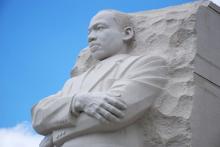
As the #BlackLivesMatter movement reminds us, the civil rights struggle is far from over. The blood, sweat, and tears of our 20th-century civil rights heroes must be followed up by the clear-eyed resolve of a new generation. Ideally, celebrations like Martin Luther King Day should help to sustain this resolve, energizing us for the hard work ahead.
That being said, I suspect that King would not be too thrilled about MLK Day.
Peace studies combine research, analysis, and practice in an attempt to answer questions of what peace actually requires, why accepted wisdom has failed to move civilization away from violence and toward peace, and how people have successfully reformed social, economic, and political relationships to achieve sustainable peace. And through this study, real-world answers are emerging.
There are different ways to understand the gospel's call to peace — and that's a good thing. In the last century alone, many influential Christian leaders have grappled with violence, justice, and peace, and ended up all over the nonviolence map. Where do you land? Take our quiz and find out!

Christian leaders have hailed as an act of bravery and selflessness the shielding of some Christians by Muslims after suspected al-Shabab gunmen in Mandera County ambushed a passenger bus.

It was a Sunday that started off like most — a mad rush to get breakfast on the table, get the kids dressed, and head to our mosque. Dec. 13 was supposed to be a special day to honor the San Bernardino massacre victims at Baitul Hameed Mosque in Chino, the Ahmadiyya Muslim Community’s Los Angeles center since 1987.

National Geographic magazine recently named Mary, the mother of Jesus, “the most powerful woman in the world” as an appraisal of her ongoing influence and popularity. But do Mary’s words and example have a prayer of being heard and effecting change in this time of war?
Indeed, this is war. America has effectively been engaged in continuous warfare since the weeks after September 11, 2001. In a few decades we’ll learn what happens when whole generations of people grow up and take charge of a society that has waged war their entire lives.
Attempts to tone down the descriptions we use for warfare or the way we conceptualize the present conflict don’t change anything. No end is in sight. Others turn up the rhetoric: after the San Bernardino shooting, at least one presidential candidate insisted the USA now finds itself in “the next world war.” Another one puffed up his chest and boasted of his resolve to “carpet bomb” people. We hear this stuff so often, we’ve become numb to its magnitude.

For the first week of Advent, my wife Amy preached about hope. She pointed out that having hope doesn’t mean necessarily that we see a way out of suffering. It does, however, give us a reason to try to keep working through it. We have to believe there’s another side to it. Another possibility. The potential for a new reality.
And that reality will never, ever be realized by responding to violence with more violence. It may make us feel better in the moment. It may seem to offer short-term relief. But ultimately, it makes everyone that participates become a little bit of what they hate. And the cycle continues.
Which story will we choose to try to live into?

I’ve heard it said that you don’t know true love until you hold your baby for the first time. I hate that, for so many reasons. And I hate whoever has said it to me or anyone else. Hate it.
This may come as a shock, but I’ve got the slightest anger issue. It’s more accurate to say I didn’t know true anger until I became a mother.
There’s the daily anger, like slaving away in the kitchen for hours only to have people gag and demand crunchy toast and cookies to eat, while they scream and scratch their sister and slip on spilled water and cry for hours. There’s the hourly anger, like the struggle between wanting to check out and check e-mail in the face of little people wanting to play or needing to be disciplined.