Immigration

In the midst of a raging discussion about what it means to be American, it is worthwhile to reflect on the profound ambivalence of American civil religion — perhaps the most powerful force for creating a shared national identity.
In 1967, Robert N. Bellah’s seminal essay, “Civil Religion in America,” created a template for how both the right and the left defined civil religion to cultivate a sense of belonging, particularly in an era of turbulence. During this period of increasing polarization, Bellah’s words are more relevant than ever.
Sessions v. Dimaya
This case concerns the scope and definition of a federal immigration statute that allows deportation of non-citizens who committed an “aggravated felony.” An immigration court ruled that burglary constituted a “crime of violence,” but the Ninth Circuit Court reversed the immigration court’s decisions, stating that the term “crime of violence” is unconstitutionally vague.

It’s hard enough for somebody who has a lifetime of experience navigating how to be a Christian in Iraq. But most of those facing deportation have no such experience. They don’t have a support network in Iraq. They don’t have homes or families to return to. They don’t even have IDs. Everything they know is in America.
Though they gave respectable answers, I was amazed no one directly quoted the Christian Gospels on the subject.
The Gospel of Mark provides one saying of Jesus directly applicable to this situation. But when we examine subsequent uses of that saying in the other Gospels, we can see why none of the 60 Minutes interviewees dared quote that particular verse.

The pastors — Rev. Luis Cortez of Esperanza USA, Rev. Gabriel Salguero of the National Latino Evangelical Coalition, Dr. Noel Castellans of the Christian Community Development Association, and Bishop Jose Garcia of Bread for the World — highlighted the negative effects of ICE in targeted communities, underscoring the fear families have lived with since the Feb. 21 release of two DHS memos. These memos expanded the scope of deportations, targeting any undocumented immigrant charged with any criminal offense, and expediting the removal process.
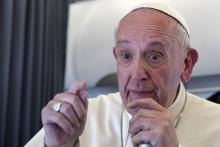
The pope's meeting with Trump could be potentially awkward given their diametrically opposed positions on immigration, refugees and climate change, which he told reporters on the plane "are well known".
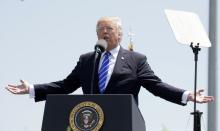
U.S. arrests of suspected undocumented immigrants rose by nearly 40 percent in the first 100 days of Donald Trump's presidency, following executive orders that broadened the scope of who could be targeted for immigration violations, according to government data released on Wednesday. The acting director of Immigration and Customs Enforcement Thomas Homan said that arrests by his agency jumped to 41,318 between January 22 of this year and the end of April, up from 30,028 arrests in roughly the same period last year.
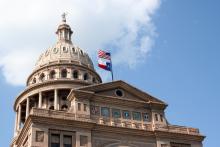
Any anti-sanctuary city measure may face a tough road after a federal judge this week blocked Trump's executive order seeking to withhold funds from local authorities that do not use their resources to advance federal immigration laws.
Trump: ‘See You in the Supreme Court,’ After Court Blocks EO Withholding Funds From Sanctuary Cities
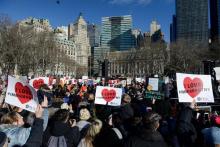
Tuesday's ruling by U.S. District Judge William Orrick in San Francisco was the latest blow to Trump's efforts to toughen immigration enforcement. Federal courts have also blocked his two travel bans on citizens of mostly Muslim nations.

Sincere love during these times means offering sanctuary for the sojourner, risking our congregations, and even putting our bodies on the line — knowing that our true citizenship is in the Kingdom, where no one is illegal and all are loved.
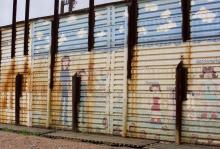
In light of these experiences and news of the reduced migrant arrests in March, here are some of the questions I’m asking and ones all Christians should consider: With the reduced movement across the border, am I celebrating what I perceive is best for my country or what is best for my human family? Do my national values conflict with my kingdom values?

Seattle Mayor Ed Murray told reporters the Constitution forbade the federal government from pressuring cities, “yet that is exactly what the president’s order does. Once again, this new administration has decided to bully.”
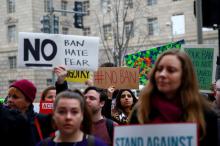
A U.S. federal judge in Virginia ruled on March 24 that President Donald Trump's travel ban was justified, increasing the likelihood the measure will go before the Supreme Court, as the decision took an opposing view to courts in Maryland and Hawaii that have halted the order.
U.S. District Court Judge Anthony Trenga rejected arguments by Muslim plaintiffs, who claimed Trump's March 6 executive order temporarily banning the entry of all refugees and travelers from six Muslim-majority countries was discriminatory.
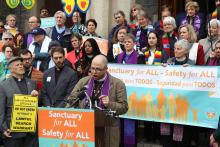
"People have asked, 'Why do you stand with these people?' Because black bodies have been assaulted since we first came to this state. And they are continuously assaulted. What we know is, if we are silent when brown bodies are assualted, when gay bodies are assaulted, when trans bodies are assualted, when female bodies are assualted, then all of us remain in prison and in bondage."
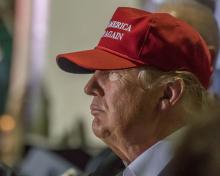
“It is a thinly-veiled reference to stereotypes about Islam and Muslims,” said Daniel Mach, director of the American Civil Liberties Union’s Program on Freedom of Religion and Belief. “This reference to honor killings is part of a broader effort to smear an entire faith by the extreme acts of a few and its inclusion in this order bolsters the argument that this is simply another attempt at a Muslim ban.”

Love recognizes that everyone is an equally beloved child of God and must be treated as such by our words and actions. Love values everyone’s dignity and worth as equal to my own. By contrast, hate rejects another person’s equal value and worth. It sees those who are different from me as less than me in some ways. It creates the conditions for people to be abused and mistreated.
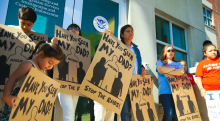
The growing momentum behind the Matthew 25 Pledge has reminded me of my old friend and mentor, Mary Glover, who helped me understand the deepest meaning of that Gospel text. She was not a theologian or formal biblical commentator, but she showed and taught me the meaning of this Scripture more than four decades ago. Matthew 25 brought me to Christ out of the student movements of my time and led me to help begin Sojourners. We moved into one of the poorest parts of Washington, D.C., in the neighborhood where Mrs. Glover lived.

In Indian American communities, we usually believe that being a certain kind of immigrant can save us. If we dress properly, no one can call us foreign. If we’re documented, no one can question our legal status. If we are highly educated, no one can accuse us of being lazy immigrants. If we (especially women) don’t go to bars, no one can accuse us of bad behavior.
We’ve convinced ourselves that if we melt into what we call American culture — into white culture — we can get by without getting killed.
The two men targeted by a racist and violent white terrorist were the quintessential “good immigrants.” But their stories of success — working at Garmin, receiving Masters degrees from the U.S. — did not protect them from hate. Economic status or education do not matter in the face of an extremist who equates skin color with terrorism.

Real people, with real stories, and real families are trembling in fear for the future of their families and, in some cases, their own lives. For those of us who follow Jesus, our faith must inform our citizenship — not the inverse. It's time for us to ask better questions, seek deeper understanding and accompany our neighbors— whether local or global — who are navigating the scariest moments of their lives.
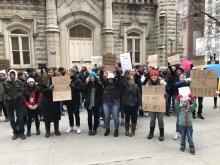
A survey released last week by the Pew Research Center suggested a very different view of the presidential actions, especially among white Protestant Christians.
There was strong support among white evangelical Protestants, with more than three-quarters (76 percent) saying they approve of the policies outlined in Trump’s order. Among white mainline Protestants, 50 percent approved.
Many Christians now are asking the question Helena Leffingwell of Arlington, Texas – not a pastor or ministry leader, just a regular member of Gateway Church, a nondenominational megachurch – put into words: “How can we see things so differently?”