Illustrations by Ryan McQuade

Even If These Forget

What my mother-in-law’s dementia is teaching me about God’s love.
By Josina Guess

MY MOTHER-IN-LAW turned 82 last fall. Like more than 6 million people in the U.S. and around 40 million people worldwide, she has dementia. And like many people living with this debilitating progressive brain disease, she doesn’t know she has it.

On her birthday, I asked her how old she was, and she said, “62, right?” She will not remember Easter or Mother’s Day, and she probably won’t be able to read this article. When she became a grandmother 23 years ago with the birth of our son, she asked to be called Nana. Since she cannot fully consent to being mentioned in this article, I will call her Nana, and pray that the blessing she gave me years ago to write and keep on writing holds even now. She broke her hip and wrist this January and has transitioned to a nursing home. Yet her “walk with the Lord,” as she calls it, continues, even as she struggles to put one foot in front of the other.

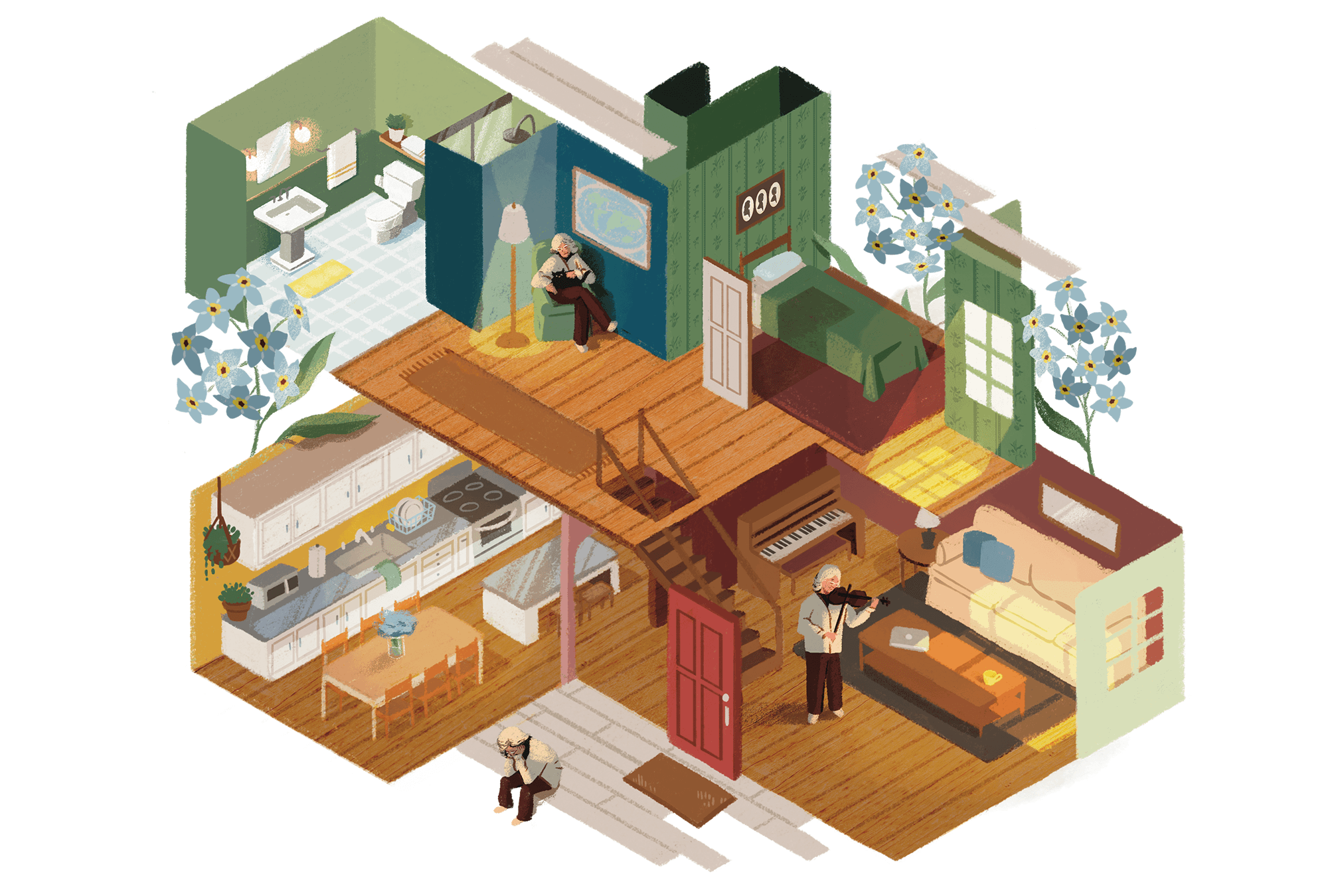
Nana had been living near my sister-in-law when the idea emerged last spring that she could move into our home a thousand miles away instead of going straight to assisted living. At that point, she had mid-stage dementia. She could still cook her eggs in the morning, keep her place clean, dress herself, and maintain a simple daily routine. But driving was unsafe, and at times she walked out of her apartment at night in a panic. She meandered in conversations and sometimes didn’t recognize her daughter. We knew it would be hard, but we wanted to savor a few months of sharing life with her. When she asked to move in with us, I was surprised at how quickly my husband Michael and I, along with our teen and young adult children, embraced the idea. We quickly shuffled our household and made way for Nana and her carefully curated collection of things, especially her violin.

Nana started playing violin when she was 9. She was obsessed. In the late 1960s, she dropped out of college and spent four years traveling professionally with Henry Mancini and Andy Williams. When she met Michael’s father, a dashing Air Force recruit, she quit touring and devoted her life to becoming a housewife and mother of three. Michael is her middle child. When he was in sixth grade, she began homeschooling, not out of any religious conviction, but because she thought it was what her eldest child needed and figured if she could do it for one, she would do it for all three. Their lives revolved around church and home, but she always made time to practice her violin. She often taught private lessons and played with local symphonies and in churches. As her dementia progressed, her most vivid memories were of her time learning, touring, teaching, and playing the violin.

Around the same time she began violin, Nana began practicing her Christian faith with deep devotion. In her family lore, her father moved to get far from his praying mother, but he and his wife “got saved” anyway. Nana began speaking in tongues as a young child. Throughout her life, she attended a variety of churches that were theologically and politically conservative. Michael grew up thinking Catholics or Democrats generally could not be real Christians. When he moved to Philadelphia for art school, he met Catholic peace activists who helped expand his worldview and differentiate himself from his upbringing. But Nana was surprising in the ways she deviated from conservative norms. When Michael was a teenager steeped in purity youth group culture, she told him something that saved him from immeasurable internal conflict: “It’s OK to masturbate.”

Her (heterosexual) sex-positive views aside, we often butted heads over politics, how we read the Bible, parenting, LGBTQ+ rights, abortion, and even Michael’s choice to have a beard and tattoos. But the love we shared for her and for one another gave us the courage to bring Nana into our home. For the almost eight months she lived with us, we did what I thought would be unimaginable. We grew closer and felt God’s love filling the spaces between us.

Illustrations by Ryan McQuade

A Foot In Both Worlds 

NANA’S FIRST FULL day living with us was the first day of Pride Month, which she does not celebrate. One of my teen daughter’s best friends came over wearing earrings, makeup, and rainbow socks. He looked gorgeous. Nana came into the kitchen and announced that she would have to move. She was very upset because she couldn’t tell if my daughter’s friend was a boy or a girl. And if he was a boy, why was he wearing makeup and jewelry? She couldn’t understand why we were not condemning him to hell and kicking him out of our house.

Michael and I said something like, “Jesus is all about welcome and love, and that’s what we are called to in our home. You can choose who comes into your bedroom; that is your private space. But this is our house. Our child’s friend is our friend and our neighbor, and he is always welcome here. We love him just the way he is, and we love and welcome you just the way you are, and there is nothing you can do about it.”

Then we asked her to pray about it. She could take it up with the Lord, but not with us. She agreed to pray, and the next morning, she told us she would stay in our home after all, a tiny miracle.

About a month before Nana moved in with us, a poet named Ketu Oladuwa, who was celebrating his 80th year by traveling the country and building community through poetry, came to our town. In his poetry workshop, I wrote about our choice to bring Nana home. In that poem, I observed that one of the only things she and I agreed on was the goodness of blueberry buttermilk pancakes. While talking with Oladuwa later, I told him how hard it would be to live with someone losing her mind. Dementia, derives from the Latin demens, with de meaning “without,” “away from,” or “out,” and ment meaning “mind.” To have dementia is, at its core, to be “out of one’s mind.”

But Oladuwa corrected me, saying, “She is not losing her mind, she has a foot in both worlds.” He told me how sacred it had been for him to care for his wife’s parents in their final years. That reframing helped change how I think and speak about Nana. I shifted my focus onto all that is there, not the many gaps in her memory.

I was surprised by how much we laughed together when she lived with us. The person who used to insist that our kids use a knife and a fork began eating with her fingers. The woman who wouldn’t let dogs near the table fed one of our dogs with her fork and talked to him like a person. We teased Nana as she snuck into the kitchen to eat another bite of ice cream straight from the container.

Many of the walls and sharp edges of politics and belief that divided us crumbled and smoothed as she became more fully immersed in the moment, filled with wonder and delight at a kitten purring in her lap, the glow of Advent candles on our kitchen table, or the taste of chocolate melting on her tongue.


We are etched into God’s palm.


Mother-in-Love

WHEN MICHAEL AND I first got married, his parents insisted on calling me their daughter-in-love. I thought it was kind of corny, but also sweet. They didn’t want us to be bound only by law; they knew love was stronger. So, his parents became my mother-in-love and father-in-love. On our wedding day, we invited all four of our parents to lay their hands on us and pray for the lives we would build together. Michael and I had many hard conversations with his parents about things that divide many families. But we stayed connected, visiting for holidays, trying to keep finding common ground in our mutual love for Jesus and one another.

Michael’s father died in February 2016. It felt like a small mercy that we didn’t have to navigate too many conversations with him about Trump. But Michael would much rather have his father around, even if it would have meant more hard conversations.

Over the past decade, a combination of grief, isolation, age, genetics, and Lord knows what else brought Nana to where she is now: hovering between a place of knowing and not knowing and homesick for her heavenly home. We never got a clear diagnosis of the root cause of her dementia because she adamantly denied that anything was wrong, insisting, as evidence, that she played in the symphony, though it had been years since she had played publicly. She seemed to believe prayer alone would give her a sound mind. Once, when I gently broached the subject of getting a recently approved blood test for Alzheimer’s, she told me, in a moment of lucidity, that she didn’t want to know.

Nana became like a monastic hermit. Each day, she would sit in her rocking chair and sing familiar hymns, pray for family members—especially the ones with whom she disagreed—and play her violin. In hindsight, the increased solitude, made worse by COVID isolation, and the intentional closing of her world were indicators that she was having a harder time knowing what to do beyond her room. She quit church because, she said, “The Lord told her to.” But maybe church became more confusing and harder for her to navigate. Though many faith communities across the country are increasing their ministries for and with people living with memory loss and their caregivers, Nana couldn’t figure out a way to stay in church. Instead, her room became her chapel.

Every day while living in our home, she stood in front of the music stand in her bedroom and played familiar tunes, like “Tis so Sweet To Trust in Jesus.” The sound of the violin reverberated through the halls. Even though it got harder for her to find the right words to speak, those tunes carried her.

Illustrations by Ryan McQuade

Forgotten Middle Child 

A WEEK BEFORE Thanksgiving, five months after moving in with us, Nana asked Michael why he kept calling her “Mom.” She remembered being the mother of his two siblings, but not him. Who else could she have been to him for over half a century? We pulled out photo albums and recalled stories. The next day, she told us she cried all night because she still couldn’t remember being his mom. She kept asking questions and listened attentively. Finally, she concluded, “If you say so, but I don’t remember being his mom.”

Weeks afterward, she would point to pictures of her three children and say, “Can you believe it? Michael is my son!”

Birth and breastfeeding were among Nana’s happiest memories before she had dementia. When I began having children, Nana told me she had an orgasm the day Michael was born. Her husband was in Korea, and she said she just felt pure ecstasy pushing Michael out, unmedicated, in the hospital. She never ceased to surprise me with the ease and joy with which she talked about physical pleasure. She often said that if there are jobs in heaven, the thing she wants to do is breastfeed all the babies. So, it was hard to see only a gaping hole where those joyful memories of mothering her sweet, easy, middle baby used to dwell.

As Michael and I came to terms with this change, I was reminded of Isaiah 49:15: “Can a mother forget the baby at her breast and have no compassion on the child she has borne?” In Always With You: Spiritual Comfort for Those Living in the World of Dementia, Donna Marie Vuilleumier includes a chapter of Bible reflections for people living with dementia and their caregivers. She, too, found that Isaiah’s words “first written to a people in geographic exile ... now speak to those exiled, displaced, by the process and progress of Alzheimer’s/dementia.” Though Nana remains Michael’s mother, we found renewed comfort in the prophet’s words reminding us of God’s presence as the eternal parent to all of us: “Though she may forget, I will not forget you!”

I shifted my focus onto all that is there, not the gaps in her memory.

A Season of Surprise

IN THE YEARS leading up to her move in with us, I had reached a point where I thought I might never talk to Nana again. Our phone calls were confusing and increasingly difficult as our divergent views about everything from COVID vaccines to drag queen story times and the Black Lives Matter movement widened the chasm between us. Her increasing dementia made our phone conversations even more confusing and challenging. I drew a line in the sand, and to guard myself, I kept her safely over there.

But then love surprised us all when Nana called and said, “Please take me home.” And I heard myself saying, along with the rest of my family, an enthusiastic “Yes!”

Michael and I raised four children; now we mother his mother. “Thank you for being a good mother to me,” she told me as I comforted her in the middle of the night. “He is like a mother to me,” she said to me about my husband, her son whom she forgot. And she said a similar thing directly to Michael, telling him, “You are like a mother to me,” bending her carefully drawn gender lines. This season of love and forgetting is stretching and changing all of us.

When she expressed distress about forgetting she was Michael’s mother, I opened the Bible, which she has read multiple times, and I read her Isaiah 49. She responded with wonder, as if hearing it for the first time. Even if we forget, God remembers.

“See, I have inscribed you on the palms of my hands.” God’s voice continues in verse 16, assuring the people that they can’t get away from this love even if they try. We are etched into God’s palm.

One of the stories Nana loves to tell again and again is of a day she was playing her violin, and a drummer threw his drumstick high in the air. The stick landed on her violin. Miraculously, her violin was unharmed. When she tells and retells the story, the drummer becomes a child, and her violin becomes her hand. She flips the story as she flips her hand back and forth, saying, “My violin wasn’t hurt. My hand wasn’t hurt. God protected me.” Her violin, her hand, herself, they are one and the same. She places her finger in the center of her palm, “You see ... God protected my hand, God protected me.”

“You see,” I tell her, “You are written on the palm of God’s hands.” God does not forget.

In recent months, Nana’s cognitive function has declined precipitously. It is no longer safe for her to live in our house. When we visit, she often weeps and says she’s not sure what to do with herself. She forgets that her hip and wrist were broken. She can’t play the violin. We reassure her that it’s safely locked at home. We don’t know if she’ll ever turn that key again. Then Michael and I sit beside her and sing, “Great Is Thy Faithfulness.” For a few moments, time stands still. The words rush like living water into her mouth, and she sings along.

Author’s note: My mother-in-love died three weeks after this went to print. She was surrounded by love and music.

This appears in the May 2026 issue of Sojourners

Josina Guess is a Sojourners associate editor and a contributor to Bigger Than Bravery: Black Resilience and Reclamation in a Time of Pandemic