Israel

Some called it “The Great War.” Others called it “The War to End All Wars.” History proves it was neither.
As the world marks the 100th anniversary of the outbreak of World War I — a conflict that left 37 million dead or wounded and reshaped the global map — a number of scholars and authors are examining a facet of the war they say has been overlooked — the religious framework they say led to the conflict, affected its outcome and continues to impact global events today.
More than that, they argue, today’s religious and political realities — ongoing wars, disputed borders and hostile relationships — have their roots in the global conflict that began when Austria-Hungary declared war on Serbia on July 28, 1914.
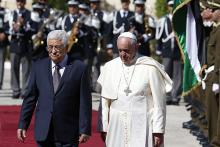
As Israel continued its ground offensive into the Gaza Strip, Pope Francis urged Israeli President Shimon Peres and Palestinian President Mahmoud Abbas to end the spiraling conflict.
The pontiff telephoned the two leaders on Friday to express “his very serious concerns” only six weeks after both me joined him at the Vatican for an historic prayer meeting.
Francis said he was concerned about the “climate of growing hostility, hatred, and suffering” that was claiming many victims, resulting in “a serious humanitarian emergency”, the Vatican said in a statement.
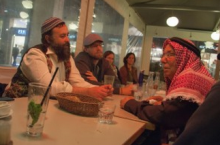
I was sitting in the airport the other day listening to yet another account of the current events unfolding in Israel and Palestine. Almost mechanically, the lips of the news anchor spilled out words like terrorists, extremist, escalating violence, detention, kidnapping, hatred, protest, etc. It was as though they were telling a story of some otherworldly reality that had virtually no human implications. It was all the stuff we are supposed to hear about the Middle East, so it successfully affirmed stereotypes, assumptions and prejudice.
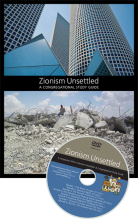
The Presbyterian Church (USA) has removed from its website a booklet that many Jewish groups have criticized as hostile to Israel and denigrating to Judaism.
“Zionism Unsettled,” published in January by the church-chartered Israel/Palestine Mission Network, is a history and commentary on the Israeli-Palestinian conflict that paints Israel as the aggressor and describes Zionism as inherently racist and theologically flawed.
The booklet played a role last month in the denomination’s debate on divesting from three American companies that, divestment proponents say, profit from Israel’s occupation of the Palestinian territories.

The Presbyterian Church (USA) voted Friday to divest church funds from three American companies it cited for profiting from the oppression of Palestinians within Israel’s occupied territories.
The 310-303 vote of the church’s General Assembly in Detroit marks a victory for divestment supporters both within and without the 1.8 million-member PCUSA, now the largest American church to embrace divestment as a strategy to pressure Israel to return its illegally held lands.
The issue has roiled the church for the last decade, and during a more than three-hour debate, many lamented the divisiveness and noted how many around the world — in the U.S., Israel, and the Palestinian territories – would be watching.

THE SHOOTINGS THAT took three lives this spring at a Jewish community center and retirement complex in Kansas are a reminder that deadly strains of what is usually called “anti-Semitism” remain with us. The fact that the shooter was a deranged white supremacist should not prevent us from coming to terms with the roots and survival of Jew-hatred in our culture.
Anti-Semitism is a made-up word that itself gives clues to the history of Jew-hatred in our civilization. The term was coined by German journalist Wilhelm Marr in 1879, one of a number of Jew-haters who were turning longstanding European Christian hatred of Jews into something modern and racial. The “Jewish problem,” therefore, became the “fact” that there was a racial group, the “Semites,” who were a mortal threat to another racial group, the “Aryans,” and therefore needed to be removed from Aryan societies. All right-thinking Germans/Europeans/Aryans, the argument went, needed to unite to combat the Semites through a scientific antisemitismus. The term is usually written “anti-Semitism” in English, but that usage profoundly reinforces the racist myth that there is a race of “Semites” needing to be opposed by “anti-Semites.” The term Jew-hatred is better because it refuses to participate in this mythology.
Modern racialized Jew-hatred flowed into the 20th century and crystallized most disastrously in Nazi Germany. There, over 12 terrible years, the 19th century anti-Jewish program was enacted, and then exceeded. Jews were to be “eliminated” from among the “Aryans,” a program that became annihilation after 1939, with 6 million Jews murdered.
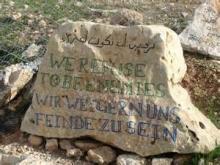
This week’s “10 Best Stories” missed an important news item from Palestine — not about Pope Francis but rather a family that practices what the pope preaches.
Tent of Nations, in the Occupied West Bank, has become a sign of hope over the otherwise fruitless last decades of peace negotiations. Interlocutors have nibbled around the edges of a “two state solution” since the early 1990s with the result that Israel has been able to confiscate vast areas of Palestine. The Nassar family, represented by Daoud and his parents and siblings, have built on their 100 acres a veritable garden of peace. This luxuriant vineyard is 15 minutes from Manger Square, Bethlehem. It has been owned by the Nassars since Ottoman times, and “Tent” has illustrated, what is declared on a stone at its entrance – non-violent action in its most faithful form. More than 7,000 visitors from around the world along with children in summer camps, as well as both Israelis and Palestinians, have been buoyed by the Nassars' 100-year commitment to living peaceable amidst turmoil by expressing biblical principles of loving neighbors, forgiving those who oppress, and peaceful coexistence with their neighbors.
Early on May 19, military bulldozers destroyed 1,500 fruit trees nearly ready for harvest in the valley below the Nassar dwellings. There was no warning of the impending destruction of the trees and terraced land, left in a state of rubble with no hope of being replanted. Daoud said the family was awaiting word on an appeal submitted after military orders to stop cultivation; bulldozers came before a legal response.
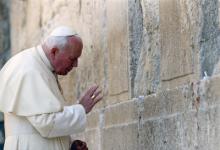
It sounds a little far-fetched and for some purists perhaps unthinkable: A pope, a rabbi, and a sheik decide to travel to the Holy Land and follow in the steps of Jesus.
The Argentina-born pope will be accompanied by colleagues Rabbi Abraham Skorka and Sheik Omar Abboud, both from Buenos Aires. It is the first time a pope’s official delegation has included members of other faiths on an overseas trip.
A public opinion war on Middle East politics is playing out this spring in new advertising campaigns on public buses and in newspapers.
It began when the American Muslims for Palestine (AMP) launched bus ads during the April Cherry Blossom Festival condemning U.S. aid to Israel because of that country’s continuing occupation of Palestinian territories.
Then on Monday, Pamela Geller’s American Freedom Defense Initiative countered by deploying 15-foot-long ads on 20 buses in the Washington, D.C., system that equate opposition to Israel’s policies with Nazism. One ad shows the grand mufti of Jerusalem meeting Hitler during World War II.
“The bus system is considered public space, so speech has First Amendment protections,” said Caroline Laurin, a spokeswoman for the Washington Metropolitan Area Transit Authority. “We have no grounds to refuse ads due to their content.”
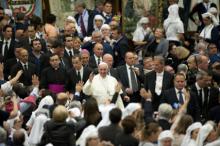
Pope Francis will be accompanied on his first visit to the Middle East by Argentine Rabbi Abraham Skorka and Muslim leader Omar Abboud — two friends from Buenos Aires.
“This dimension of interreligious dialogue has great significance,” the Vatican’s official spokesman, the Rev. Federico Lombardi, told the media.

Having just gotten home from guiding another The Global Immersion Project Learning Community deep into the lives of the unheralded heroes in the Holy Land to learn from their often untold stories, I am processing emotions, thoughts, and reflections that will soon bud into a renewed set of practices at home and abroad. I have now been to Israel/Palestine quite a few times, and it would be easy to think the experience becomes mechanical or normal or whatever. Well, for me, that simply hasn’t been the case. We encourage our participants to enter the experience in the posture of a learner rather than a hero. I try to do the same, and in doing so, am continually convicted, challenged, and inspired by our remarkable friends and peacemakers embedded within this conflict.
Here are 7 learnings that have risen to the surface since landing back on home soil:
Secretary of State John Kerry brought his argument for a two-state Israeli-Palestinian peace to the annual AIPAC conference this week, and whatever else we might know, we know this: Many evangelical Christians didn’t like it.
Or at least that’s what we’re told by some Christian leaders and their political allies. Supporting Israel’s government by opposing compromise with the Palestinians is a permanent plank in American evangelical political thought. “God told Abraham that he would bless those who bless him and the nation of Israel,” the thinking goes, “and curse those that curse Israel.”
But could it be that the truth is more complicated?
What if the loudest evangelical voices don’t represent the complexity of our community? I raise these questions as an evangelical who is fully committed to supporting the struggle for security, dignity, and freedom for Israelis and Palestinians. And I’m not alone.
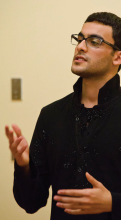
Moriel Rothman speaks candidly about his decision to not serve in the Israel Defense Forces.
THE ULTIMATE BRAVERY might well be the courage to forgive one’s enemies and hold on to hope.
Nelson Mandela famously emerged from 27 years in prison as a reconciler and uniter, somehow free from bitterness and hatred. He was able to put into practice Jesus’ call to love our enemies—and thus became the father of the new South Africa.
Far from the upper echelons of power and fame, forgiving our enemies can be a difficult task, since “enemies,” by their very definition, aren’t easy to love. But in places of oppression, occupation, and routine violence, it’s even harder.
Take, for example, the story of a young man named Yousef Bashir. He grew up in the Gaza Strip, near an Israeli settlement known as Kfar Darom. In 2000, Palestinians rose up in protest against the Israeli occupation in what became known as the Second Intifada. In response, Israeli soldiers came to Yousef’s house and told his family to leave.
His father had dedicated his life to teaching Yousef and his brothers “how to coexist with the Israelis,” Yousef explained over lunch in Philadelphia early this winter, and he insisted on staying in their long-time family home. As a result, Yousef said, Israeli soldiers moved into the Bashir family’s house when he was 11 years old. They occupied the house until he was 15.
What a relief it would be to dwell in [faith] communities where we acknowledge our shadows in a healthy acceptance of ourselves as containers of all the opposites! It may prove beneficial to be forced to face, daily, the humiliating fact that some of us are no less violent than those whose policies we oppose.
—Walter Wink, Engaging the Powers
I AM A conscientious objector, and I am drawn to violence. My attraction to violence is both innate and learned. When something frightens me, my hands clench into fists. When something angers me, I want to inflict pain upon that thing. But a person cannot inflict pain upon a thing, so I seek out those whom I deem responsible for said thing and my desire to inflict pain upon a thing morphs into a desire to do violence to another person. Since I was a child, I have fantasized about using violence to stop what I see as bad and thereby become good.
It is from this point—from these fantasies of righteous violence—that I begin this essay on my journey to principled nonviolence and conscientious objection. This is a story of change and choice, but it is not a story of transformation: I am who I have always been.
In fall 2012, I spent three weeks in Israeli military prison for refusing to enlist in the Israel Defense Forces. (Every Israeli citizen, except for the ultra-Orthodox and Palestinian citizens of Israel, must serve in the military.) My sentence was brief, but the process that brought me to the prison’s gates took almost a decade.
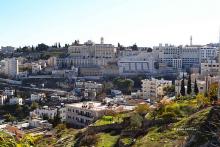
Christmas is the one time each year when much of the world turns its gaze to Bethlehem, the West Bank town at the heart of the Gospel account of Jesus’ humble birth in a stable.
But Bethlehem may be in for a second round of global publicity in the span of a few months with the expected visit of Pope Francis in May.
In an interview earlier this month, Francis confirmed rumors that he planned to travel to the Holy Land — probably stopping at sites in Jordan, Israel and the West Bank in the Palestinian territories — and said preparations were underway.
Then last week the Latin patriarch of Jerusalem, the top Catholic official in the region, revealed that the visit was set for May.
Given the political and religious combustibility that attends almost any event in the Holy Land, a papal trip was bound to be fraught and a debate over the visit quickly erupted as Israeli newspapers reported that the preliminary itinerary for Francis’ pilgrimage has him spending just one full day in Israel proper — probably arriving in Jordan on Saturday, May 24, traveling to Israel on Sunday morning, then celebrating Mass in Bethlehem on Monday before heading back to Rome.