Gaza

“I have friends and family who lost people in the attack by Hamas on Oct. 7. I have colleagues and friends in Gaza who were bombed by the Israeli attack. I go to demonstrations against the genocide in Gaza because I want to be with others that shout and call for the immediate stop of this unforgivable crime. And I cannot chant all the chants in those demonstrations. I chant some of them.”
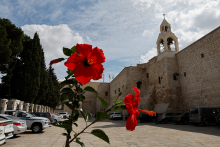
At a vigil for peace in Washington, D.C., this Tuesday, Palestinian Lutheran pastor Munther Isaac spoke about the approaching Christmas season in his home of Bethlehem in the West Bank.
“How can we celebrate when we feel this war — this genocide — that is taking place could resume at any moment?” he said.
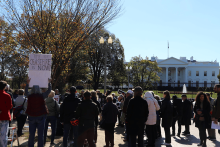
Fifty protesters gathered for a “pray-in” in Lafayette Square on Thursday afternoon, holding signs directly facing the White House that said, “Catholics say ceasefire now.”
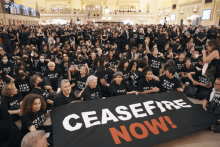
Wars, by their very nature, often force people to choose sides and dehumanize the other side to justify violence. We’ve seen the dangers of this binary here in the U.S. as some student groups in support of Palestinian liberation have wrongfully praised or failed to condemn Hamas’ attacks, while some pro-Israeli groups (including many U.S. Christians) have failed to acknowledge the injustice of the ongoing occupation of Palestine and the severe death toll Israel’s response has inflicted on Gazan civilians. Yet while the powers of the world want us to take a side and declare ourselves fully (and exclusively) pro-Israeli or pro-Palestinian, Christian compassion must be freed from favoritism. As peacemakers, we must honor the image of God in every Israeli and every Palestinian.
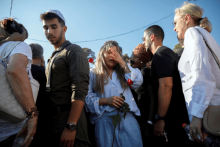
We all are shocked by Hamas’ horrific, inhumane attacks on the people of Israel, which killed more than 1,000 people, according to recent estimates. Israel’s retaliatory airstrikes have killed at least 1,000 more; thousands of people on each side are wounded. In both Israel and Gaza, innocent civilians are bearing the brunt in this latest round of indiscriminate, militarized lethal violence — violence that will solve nothing and only further entrench mutual mistrust, hatred, and the thirst for vengeance.

“We had a prayer meeting [Monday] morning with dozens and dozens of people from all different traditions, from bishops to people sitting in the pews,” Cannon told Sojourners. “We’ll have another prayer gathering on Wednesday morning. We’re grieving, we’re lamenting, and we’re also working really hard.”

My professors in journalism school taught me to avoid passive voice as often as possible. They taught me that passive voice gets in the way of giving readers a clear view of who did what. Passive voice may be innocuously overlooked in many instances (for example, in this sentence, I didn’t tell you who was doing the overlooking), but more often using it risks confusion and obscurity — and these aren’t exactly journalistic values.
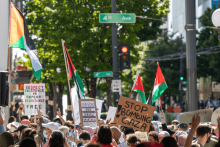
“As Black American activists are being increasingly heard and amplified, so is this message about linking national contexts and the importance of recognizing the global scope of anti-racism activism beyond national boundaries,” Roger Baumann said.
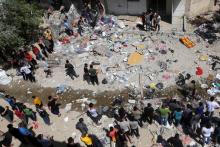
The images of civilian deaths and escalating violence in Israel and Palestine are heartbreaking. As this moral, political, and humanitarian catastrophe continues, we must urge our elected leaders to call for an immediate cessation of the current wave of violence, while also building the political will to interrogate the root causes of the crisis.
“Pray for the peace of Jerusalem!”
Palestine and Israel are back in the news. So again, we Palestinians hear this common refrain. But such calls are no longer enough. I say this as a pastor who believes in prayer, leads prayer services for peace, and genuinely values your good intentions.
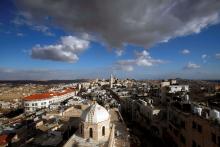
Gazan Christians will be granted permits to travel abroad but none will be allowed to go to Israel and the occupied West Bank, home to many sites that are considered holy to Christians.
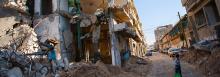
MOST CHRISTIANS KNOW about Gaza from its mention in the Hebrew scriptures in the sensuous and heroic stories of Samson, corrupted by Delilah, who lured him into showing the secret of his strength (Judges 16:5). Historically a Canaanite city and then Philistine, Gaza was conquered by Joshua as a part of his conquest of the Promised Land (Joshua 10:41). For thousands of years Gaza has had a history of being destroyed and rebuilt, from the time of Alexander the Great until today.
The Gaza Strip is now a small territory to the southwest of Israel, bordered on the west by the Mediterranean Sea, with 1.8 million people living in only 140 square miles. During my visit there earlier this year, I was overwhelmed by the place’s incredible beauty; at the same time, the lack of functional sewage treatment plants, limited electricity, and other broken infrastructure result in Gazans experiencing a severe humanitarian crisis. Beautiful and tragic.
In 1967, the Israeli military seized Gaza and remained there until 2005, when Israel unilaterally pulled out under Ariel Sharon’s “disengagement” plan. Between August and September 2005, roughly 9,000 Israeli settlers were evacuated and 21 settlements destroyed (rather than turned over to Gazans). In 2007, after Hamas took control of Gaza, Israel intensified the restriction of movement and imposed land, sea, and air blockades on the territory. The blockades have led to severe living conditions for the people there and a growing humanitarian crisis.

LIKE MUCH OF the world, I’ve been thinking quite a bit about ISIS over the past few months. I’ve been horrified by the accounts of the so-called Islamic State’s barbarism, and I lament their perversion of one of the world’s great religions.
Most of all, I’m outraged at their disregard for human life—at their wanton killing of Shia Muslims, Christians, Yazidis, and anyone else who doesn’t share their radical vision. Pope Francis has said that it’s legitimate to act to protect innocent lives in this case, and I don’t disagree with him.
Yet I believe that Jesus calls us to be peacemakers, which requires us to think beyond short-term military solutions and address the systemic issues that breed crises like this one. And I strongly believe that to have any moral authority in the current crisis, we must first confess the Western policies and attitudes that have contributed to where we find ourselves today—and then repent of those policies and attitudes.
The first thing we need to confess is a shallow and, at best, incomplete understanding of ISIS. Alireza Doostdar of the University of Chicago Divinity School wrote, “[We] seem to assume that ISIS ... has suddenly materialized out of the thin ether of an evil doctrine. But ISIS emerged from the fires of war, occupation, killing, torture, and disenfranchisement. It did not need to sell its doctrine to win recruits. It needed above all to prove itself effective against its foes.”
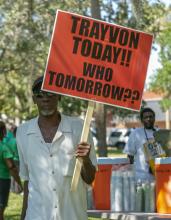
WE HAVE AMPLE reason to weep of late: war in Gaza, crisis in Syria, ISIS in Iraq, the slaying of five unarmed black men in one month at the hands of U.S. police officers, and the demise of congressional immigration reform.
Scripture calls us to cross over into the valley of lament at times such as these. Yet most of us are more comfortable on the plateau of rage or the plain of apathy.
I once led a training on lament and racial reconciliation. Twenty college students sat in the living room of a ministry house as I recited a lament from Jeremiah, the “weeping prophet”: “O that my head were a spring of water, and my eyes a fountain of tears, so that I might weep day and night for the slain of my poor people!” (9:1).
I spoke of the impact of racial injustice in our nation and on our campuses. I recounted slave narratives to the students—stories that had brought me to tears privately. Yet, when the last word was read, the students sat silent with glazed eyes staring back at me.
I didn’t get it. The whippings of human beings, the children separated from their mothers and fathers, the hands, feet, and lives lost in the midst of America’s darkest hours—these things happened. How could we not lament?

My people have committed two sins: They have abandoned me, the spring of living waters, and have dug for themselves cisterns, broken cisterns ... that hold no water.
—Jeremiah 2:13
IN THE LATE 1980s and early '90s, Palestinians rose up against the Israeli occupation of Palestinian territories in what became known as the First Intifada. Instead of acceding to the demands for justice by the "children of the stones," the response was a process of talks that led to the signing of the Oslo Accords in 1993.
The “peace process” engaged the leadership of the PLO (Palestine Liberation Organization)—then weak, corrupt, exiled, and with little vision or support—in what turned out to be a worse-than-fruitless effort that led to the perpetuation of the occupation and suffering of the Palestinian people, and which made a just peace even further away.
The process was intriguing to many of us in the peace and justice community, and it successfully co-opted us, as it co-opted the Palestinian leadership, but this process entailed both the abandoning of principled positions and the adoption of the Oslo system, a broken system that could not possibly deliver what it promised.
We were treated to a new language by Israel and the U.S., which seemed at first blush to adopt our own slogans: Where Palestinians were constantly complaining of Israel’s refusal to acknowledge them—its demonization of their leadership, and trying to have Jordan or other local collaborators speak on their behalf—the new process brazenly invited the PLO itself and its leader Yasser Arafat to participate as the “sole legitimate representative of the Palestinian people.”
Children are suffering from violence in the U.S. and around the world.
Michael Brown. The children of Gaza. The refugees of Central America. Only three of numerous heart-breaking stories to fill the airwaves in the last month. But, unlike the gruesome murders of innocent news reporters by ISIL, these news stories about violence toward unarmed children have faced loud voices justifying that violence.
These voices argue for the “rule of law.” They insist on the inherent goodness of hyper-militarized, monocultural police forces using tanks and tear gas against peaceful protestors. They claim the inherent righteousness of the state of Israel, even after the bombing of United Nations schools. They defend border guards and those who clamber into busses to scream violence and hate at asylum-seeking children.
So, the wounded or dead are put on trial and convicted for their own deaths, even though they were unarmed children. It’s their fault. To say otherwise is just foolishness.
Some Corinthian Gentiles and Jews must have reacted in exactly this way to the teaching of Paul. Jesus was crucified by the Romans — the imperial power that had brought peace to the city of Rome and quiet to the provinces, that legendary pax Romana about Augustus Caesar himself boasted. This was Paul’s testimony.
“What did you do on your summer vacation?”
Even now students may be answering that question in essays at the start of this new school year. Maybe you wrote such a paper years ago. No matter what you did or where you went this past summer, it was almost impossible to escape the heaviness of the headlines. #BringBackOurGirls has become a distant refrain, almost forgotten beneath the crush of summer tragedies:
Thousands of children traveled alone from Central American countries to enter the U.S. as refugees. Ebola deaths spread to more West African nations killing hundreds including many health workers. The forces of ISIS, intent on carving out an Islamic caliphate, took over major Iraqi cities and beheaded a U.S. journalist in Syria. Russia usurped Crimea and threatened the rest of Ukraine. The U.N. refugee agency announced in late August that “the number of refugees, asylum-seekers and internally displaced people worldwide has, for the first time in the post-World War II era, exceeded 50 million people.” Gaza has been reduced to rubble while Hamas rockets still fly toward Israeli cities. Michael Brown, an eighteen-year-old African American man who might have started college this week, was shot and killed by a white police officer in the waning days of August.
After such a summer, how can we do anything but scoff at Paul’s words from Romans?

A soon-to-be college-bound Michael Brown is shot by Missouri police, reportedly while holding his hands above himself in surrender and while unarmed. The resulting protests turn violent, leading ultimately to police setting up barricades, complete with snipers, tear gas, and flash grenades. Local stores are decimated and scores are injured in the resulting tensions.
Not long ago, Eric Garner, another African-American man, died of suffocation while being submitted to a choke submission hold by a New York policeman.
Last year in North Carolina, a black man was shot 10 times by a policeman. And all of this is in the shadow the Trayvon Martin, whose tragic and unnecessary death, is still fresh in our minds and hearts.
As cited on the Economist website , it’s enough to elicit a grim question from Delores Jones-Brown, director of the John Jay College on Race, Crime and Justice. “People are asking,” she says, “Is it open season on us?”
Meanwhile, half a world away in Iraq, ISIS continues to wreak havoc, and the United States has resumed an airstrike campaign after a decade of military force trying to maintain a tentative peace in a fractured nation. Hardly a day goes by when we don’t have reports of more Israeli and Palestinian blood spilled over the historic Gaza conflict, and Russian President Vladimir Putin continues to — in the words of a recent TIME Magazine article — “create problems only he can solve.” All the while, he stokes resentments between east and west not seen since the Cold War, seeking, too, to weaken the cohesive strength of NATO and to drive a wedge between the United States and its allies in Europe.
What’s happening to us?

A London theater is refusing to host the UK Jewish Film Festival because it receives partial funding from the Israeli Embassy.
But the theater’s artistic director, Indhu Rubasingham, the English-born daughter of Sri Lankan parents, issued a statement Tuesday saying that because of the ongoing Israeli-Palestinian conflict, the theater’s board decided not to host the festival under its current sponsorship arrangement.
“The festival receives funding from the Israeli embassy and given the current conflict in Israel and Gaza, we feel it inappropriate to accept financial support from any government agency involved,” she said in a statement. “We offered to provide alternative funding to cover the loss of the contribution from the Israeli embassy. However, the UKJFF decided it was not willing to decline sponsorship from the Israeli embassy and, to our regret, withdrew the festival from The Tricycle.”