
Our 'framing' stories aren't serving us well. But there is an alternative: the good news of Jesus.
Economic Justice
Jonathan Mendez 10-18-2007
MLK said that "injustice anywhere is a threat to justice everywhere." New York Faith and Justice believes that poverty anywhere is a threat to God's shalom everywhere. Which is why when we were invited by the UN Millennium Campaign to host a local event in support of the Millennium Development Goals, we quickly accepted. The MDGs are some pretty decent things. When world leaders come together in a covenant-like promise to halve extreme global [...]
Jim Wallis 10-12-2007
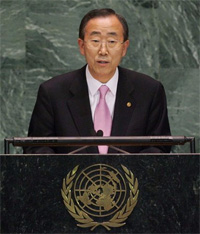 Last evening I attended a reception and dinner in Washington for evangelical Christian leaders, which is not an unusual event here. But the topic and, especially, the main speaker would seem highly unusual to many. The event, called "A Global Leaders Forum," was hosted by the National Association of Evangelicals and the Micah Challenge, a global advocacy campaign focused on achieving the Millennium [...]
Julie Polter 10-12-2007
 Mamta, a winsome, wide-eyed girl of 12 moves through her daily chores in a poor household in India. Although still a child, her life has little play, and she will too soon be bearing the full responsibilities and burdens of an adult woman: Mamta was married at the age of 7. At puberty she will quit school and move to the house of her husband, who she's had no contact with since her wedding night [...]
Aaron Graham 10-01-2007
New York Faith and Justice was inspired into being by Sojourners/Call to Renewal during their annual Pentecost Conference in 2006. It started with just a handful of committed Christians in New York who were focused on discovering how God was leading them to respond to the issue of poverty in their city.
As Becky Garrison reported last week, their mission is simple but profound: "Following [...]
Becky Garrison 9-28-2007
 When I got an invitation to attend the launch of New York Faith & Justice (www.nyfaithjustice.org), their mission statement caught my eye. Simply stated, their goals are: Following Christ, uniting the church, and ending poverty in New York through spiritual formation, education, and direct advocacy. Grounded in the words of Isaiah 61, this movement [...]
Ted Parks 9-01-2007
A black-and-white movie about the bleakness of life in Watts, California—shot for $10,000 about 30 years ago and never intended for theaters—doesn't exactly fit the Hollywood formula.
Rose Marie Berger, Jonathan Mendez 8-01-2007
Promoting "green industry" can foster an economy that benefits all Americans and is strong enough to lift people out of poverty, according to "Community Jobs in the Green Economy," a new report fro
Christina Cobourn Herman 8-01-2007
Asserting that "it takes two to tango," the Jubilee movement argues that it is high time lenders assume their share of responsibility for the debt crisis.
Christina Cobourn Herman 8-01-2007

Corruption is a problem in Kenya and many countries. Where corruption is intractable, trust funds can be used to ensure that money freed by debt cancellation is used to benefit the poor.
Bart Campolo 7-10-2007
I'm not friendly with the white-shirted drug dealers who work the corners near my house yet, but at least they acknowledge me as a neighbor now, instead of looking me over as a prospective buyer
Susan Watkins 7-01-2007
One thing missing from "A Nuclear Surge" (by Frida Berrigan, April 2007) is the money source.
Molly Marsh 7-01-2007
Encountering the Holy
The Life of Meaning: Reflections on Faith, Doubt, and Repairing the World, edited by Bob Abernethy, host of the PBS show Religion & Ethics N
Valerie Weaver-Zercher 7-01-2007
In a land of asphalt, malls, and picket fences, how do we serve God and neighbor?
Rose Marie Berger, Jonathan Mendez 6-01-2007
Christian Aid's 2007 report "A Rich Seam: Who Benefits from Rising Commodity Prices?" indicates that mining companies that extract raw commodities—such as oil, nickel, or copper—turn th