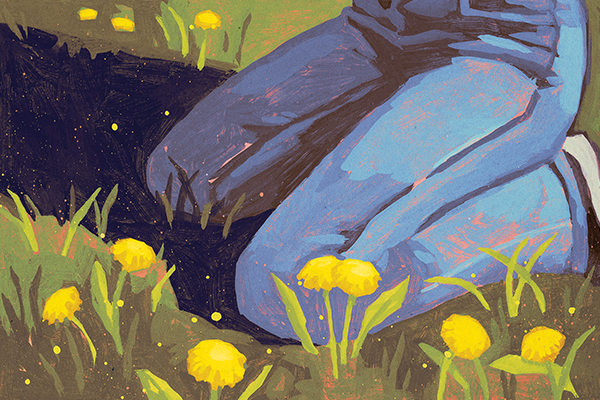
A FRIEND RECENTLY shared with me her practice of micro joy—pausing to appreciate the small things—and I can’t stop thinking about that word “micro.” When things are so very wrong on a macro level, it can be easy to neglect altogether the seemingly small stuff.
But what if the small stuff is actually the big stuff? Maybe connecting with my daughter by getting down on her level is resistance. Taking time to admire the sunset is prayer. Inviting my neighbor over for coffee is the work. I don’t suggest burying our heads in the sand about the big injustices to focus only on the here and now. I simply mean that the daily little practices and gestures contribute to a healthier soil in which liberation can sprout. These small acts prepare the ground—and that work matters.
Not all kingdom work is big or flashy or causes a system overhaul. But the little choices have ripple effects and something as tiny as a mustard seed can grow a tree. A little bit of grace, a little bit of courage, a little bit of hope, a little bit of prayer, a little bit of love can go a long way toward reorganizing the system so that everyone’s potential gets planted in equal soil.
Mary Oliver’s words keep playing on repeat in my head, “I don’t know exactly what a prayer is. I do know how to pay attention, how to fall down into the grass, how to kneel down in the grass.”
Not all kingdom work is big or flashy or causes a system overhaul.
July 5
The Call of Rebekah
Genesis 24:34-67; Psalm 45:10-17; Romans 7:15-25; Matthew 11:16-30
UNLIKE IN THE STORIES of so many women living in patriarchal times, Rebekah’s decision to leave her family and follow God’s call is portrayed as hers. Three times in Genesis 24, this ancient text centers Rebekah’s consent (Genesis 24:5, 8, 58) rather than the desire of men. She chooses; and the writer—despite all societal norms—makes sure we know that Rebekah freely went.
Abraham was not the only ancestor of our faith called to leave his homeland. Genesis 24 is the call story of a matriarch of our faith—the one woman in this longer arc who will survive her barrenness without harming other women in her orbit (Genesis 25:21). I’d like to call this a queer story. Not in the strictly lesbian sense—although I could argue Rebekah does a better job loving women than the rest of her family—but because hers is a story that defies expectations. It’s a story of leaving your family of origin for love, the most common queer narrative I know.
Jesus has harsh words for his own generation regarding their duplicity: “For John came neither eating nor drinking, and they say, ‘He has a demon’; the Son of Man came eating and drinking, and they say, ‘Look, a glutton and a drunkard” (Matthew 11:18-19). I can’t help but recognize in his words the experience of women in religious leadership. We are forever judged as both John and Jesus—i.e., wrong from both directions, all in one body. We are too much or not enough. We are too lax or too uptight. We are too bossy or too passive. I long for a church that offers the women it calls the same thing Jesus offers us: gentleness, humility, a light burden, rest for our souls.
July 12
The Right Soil
Isaiah 55:10-13; Psalm 65:1-13; Romans 8:1-11; Matthew 13:1-9, 18-23
IN THEIR THEOLOGY TODAY article “The Parable of the Sower: Rooting out White Supremacy and Institutionalized Racism in the Church,” Terrelle Sales and Kathy Rim look at the parable of the sower through the lens of Camara Jones’ allegory, Gardener’s Tale. In it, a gardener uses two different flower boxes to plant two different flowers—one pot has rich fertile soil; the other pot has poor rocky soil. The red flowers planted in the fertile soil thrive. The pink flowers in the other box struggle—some grow to partial height while others die out altogether. Sound familiar?
I’ve heard many a sermon about Jesus’ parable of the sower and the soil of the heart. But Jones’ allegory isn’t about individual receptivity. She’s teaching about institutional racism. The two soils illustrate the difference between growing up with access to goods, services, and opportunities versus growing up in an environment where those same goods and opportunities are systemically withheld. What if we read Jesus’ parable as a cautionary tale not just about the personal state of our own heart’s readiness to hear the gospel but about our community’s readiness to nurture liberation?
Isaiah prophesies that God’s word will not return empty, and I hope he’s right. The good stuff is going to happen. Isaiah isn’t talking about personal salvation but communal thriving. “Hear, everyone who thirsts; come to the waters; and you who have no money, come, buy and eat! Come, buy wine and milk without money and without price” (Isaiah 55:1). I wonder. If we always pursued thriving in communal rather than individualistic terms, would our chances for success be higher?
July 19
I Need a Weed Whacker
Isaiah 44:6-8; Psalm 86:11-17; Romans 8:12-25; Matthew 13:24-43
I STRONGLY DISLIKE the parable of the weeds. In an age where so much evil is unfolding before our eyes, I hate thinking that we have to let the bad sprout and thrive alongside the good. I am ready for the reckoning already! Give me a weed whacker. I’ll get this sorted out in a jiffy.
Then again, if I really had the power to snuff out my enemies, I’m not sure that I would. What about redemption and second chances? What if there is still time for them to change? What if I didn’t fully understand what led them to do what they did? Perhaps it is best to leave judgment up to God after all. If it were all up to me, I might write off way too many people too early.
When it’s up to God? Adoption (Romans 8:15). Redemption (Romans 8:23). Hope (Romans 8:24). Because “you, O Lord, are a God merciful and gracious, slow to anger and abounding in steadfast love and faithfulness” (Psalm 86:15).
Is it crazy to believe in hope and redemption, given the state of things? Probably. Is it nutty to think that bad seeds can produce anything other than weeds? Perhaps. But if God is still giving us a chance to set things right, then maybe we ought to grant that chance to others.
For the record, I am not talking about refusing to hold our leaders accountable. I’m talking about holding out hope, when possible, and grace, when appropriate, for our neighbors, our family members, our friends and former friends who’ve gotten it wrong, by believing they still have a chance to get it right. “If we hope for what we do not see, we wait for it with patience” (Romans 8:25).
July 26
The Spirit Intercedes
1 Kings 3:5-12; Psalm 119:129-136; Romans 8:26-39; Matthew 13:31-52
AT A LOCAL DETENTION center, I recently met a man who told me with tears in his eyes that he’d been detained just two days earlier. He has a work visa, a driver’s license, and no criminal history. “I even pay my taxes,” he said. The pain and desperation on his face was palpable, and I felt so powerless to help him. We had to part ways before I had the chance to respond, so in the last short second in his presence, I looked into his eyes and tried to convey ... something. Empathy? Some hope? A prayer? I don’t even know what I would have said had there been time. What words could possibly be adequate?
I am taking some comfort in Romans 8:26: “We do not know how to pray as we ought, but that very Spirit intercedes with groanings too deep for words.” I’m trying to trust that what I wordlessly felt in my heart was prayer, and that it was somehow, someway the type of prayer that does not return empty. I am trying to take comfort that they can take this man from his life and family, but they cannot separate him from the love of God. I am hoping that he will be returned to his life and his family.
I am trying to believe that the reign of God really is like a little mustard seed or a pinch of yeast. That this small prayer and faltering faith I offer on behalf of my brother can grow into a shade tree or a loaf of bread. I am trying to remember that it’s not just my little seed or my little prayer—that it is all of us together begging God for wisdom in the face of tyranny—and that is not nothing.

Rev. Kyndall Rae Rothaus is a preacher, spiritual director, co-founder of Nevertheless She Preached, and author of Thy Queendom Come: Breaking Free from the Patriarchy to Save Your Soul.
Did this article have an impact on you? Tell us how! Whether you’re moved to take action, have a question, or want to share a comment (good or bad), we value your feedback!