NESTLED IN THE foothills of the Blue Ridge Mountains, the city of Lynchburg, Va., is best known as the home of Jerry Falwell’s Liberty University. As the city’s largest employer, Liberty wields extensive influence: Its campus is home to more than 16,000 in-person students in a city of around 80,000. (Liberty’s online programs bring its total enrollment up to a staggering 140,000 students, making the fundamentalist Christian school one of the country’s largest institutions of higher education.)
Christian televangelist and Moral Majority founder Jerry Falwell Sr., born in Lynchburg, launched the Lynchburg Christian Academy in 1967 as a segregation academy, followed by an early version of Liberty University in 1971. Falwell’s organizations and television presence formed generations of Christians through fundamentalist values and political organizing. After Falwell died in 2007, his son and successor Jerry Falwell Jr. sought to expand Liberty’s political influence. Falwell Jr.’s personal endorsement of Donald Trump during the 2016 presidential campaign helped swing the evangelical electorate; in the lead-up to the 2024 election, Liberty University was listed on the Project 2025 advisory board. For more than 50 years, Liberty has solidified its place as a powerful culture shaper, and Lynchburg has become the geographic epicenter of a major branch of white conservative evangelicalism in the United States.
But Lynchburg has always been more than Liberty and, as with any other American city, it’s full of contradictions and complexity. Though named after a Quaker abolitionist, it was also a stronghold of slavery during the Civil War. Lynchburg is nearly 40% nonwhite or multiracial. Last year, writer and illustrator Martha Park interviewed five people living in Lynchburg—pastors, activists, and political leaders—about their work to build open, diverse, just, and affirming communities. If they can do this work in a place shaped so heavily by the entwined forces of ultraconservative Christianity and rightwing politics, then there is hope for the rest of us.
—The Editors
apr26featureking.png
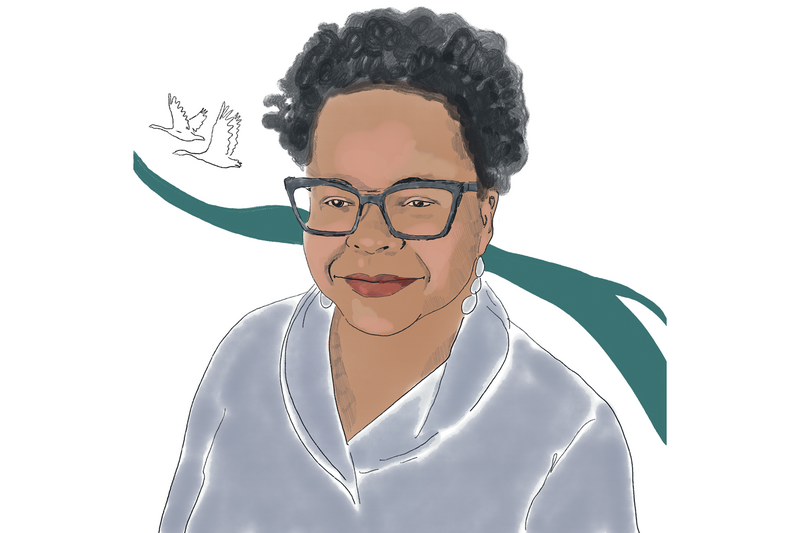
Leslie King
I’M FROM LYNCHBURG originally. I went to public schools and college here. I got involved in community work after working as a youth minister, but I have been interested in social justice issues ever since I was in school. In my professional work, I’m a consultant, facilitator, and coach. I work to help organizations build bridges around climate justice, educational equity, and public history.
My work is all about elevating other leaders. The power is in the people. I want to help equip people to advocate for change wherever they are and to build relationships and networks for that to happen. The change we want to see is systemic change, it’s institutional, it’s interpersonal, and it’s individual. That takes more than just one person. So, I work on building power, building capacity, and equipping people to make change in various ways. In the process, people learn about themselves. They do the work of understanding how, by being socialized and educated in these systems, individually and collectively, we may be participating in the same systems we want to dismantle.
There is a history of resistance and organizing in Lynchburg. Before the Civil War, Lynchburg was [one of the] richest [cities] in the U.S., a lot of that due to slave labor. Talking about the ways in which the enslaved population here resisted being enslaved—knowing that history—can impact how we see current events.
I don’t think everyone knows that history. It hasn’t been uplifted as much as it could be. Partly that’s because of who’s telling the story. There’s something about how that history is told that allows other people to recognize we have a legacy here that we can draw on in the work of resistance, organizing, and speaking up for justice.
We have an African American museum in Lynchburg [the Legacy Museum of African American History], highlighting important parts of our history. We have an HBCU, Virginia University of Lynchburg. And aside from Liberty, Lynchburg is a centrist, somewhat progressive community.
When there is a dominant ideology within a particular place, there tends to be pushback from people who don’t subscribe to it. If you’re engaged in the community, you run into various counterpublics. The type of conservatism we see here, it’s on the far end of the spectrum. The antithesis here is also on the far end of the spectrum in the other direction. It kind of has to be. We find ways of being free even under oppressive conditions.
We find ways of being free even under oppressive conditions.
apr26featurebanks.png
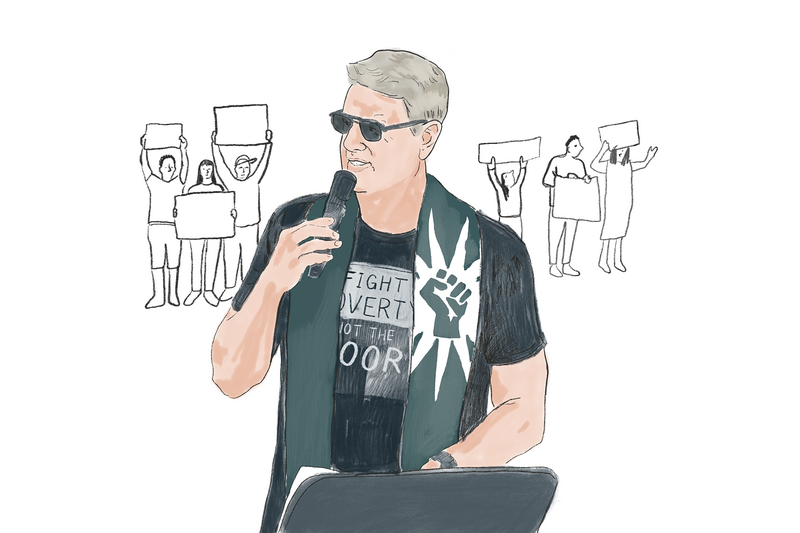
Jarrett Banks
WHEN I MOVED to Lynchburg to pastor First Christian Church, I planned to revolutionize church. I’d spent the pandemic leading a church without walls in New Orleans. We operated solely around meeting the needs of our neighbors by serving food to the hungry and doing yard work and home renovation projects for people in poverty. I was at a point in my ministry where I was done with traditional church. I felt like we needed to rethink the whole thing. The 20th-century model was no longer working. I thought my New Orleans church could be a model for all churches.
But I changed my mind because of Lynchburg and the dynamics with Liberty. I’ve found that Lynchburg badly needs what we’re offering here: a traditional church that is open and affirming, a pastor who is speaking out about white Christian nationalism, which is Liberty.
Worshipping in a service is really important here. But our church is also doing a lot more things in the community. We led a nonviolence workshop last spring. We’re partnering with several progressive, mainline churches in Lynchburg and with the local synagogue to advocate for nonviolent action. We hold a silent peace vigil every time the City Council meets, and we stand outside City Hall and hold signs that say radical things like “Liberty and justice for all.”
A lot of kids who come here to go to Liberty didn’t choose Liberty; their parents chose for them. And Liberty is not the only college here. Randolph College and University of Lynchburg are right here in the heart of town. With the name Lynchburg, the city sounds like it was named for Jim Crow-era white supremacists. But Lynchburg is actually named after John Lynch, a famous abolitionist.
Liberty students are [encouraged to attend church and] required to attend [twice-weekly religious services on campus] for academic credit. I’ve heard our church is on a list of churches that students shouldn’t attend because we’ve had a female pastor, and we’re open and affirming.
Since I’ve been here, we’ve experienced so much growth, which is a testament to the need for a church like ours in a place like this. We’re offering a voice that’s not found in a lot of churches.
apr26featuremolina.png
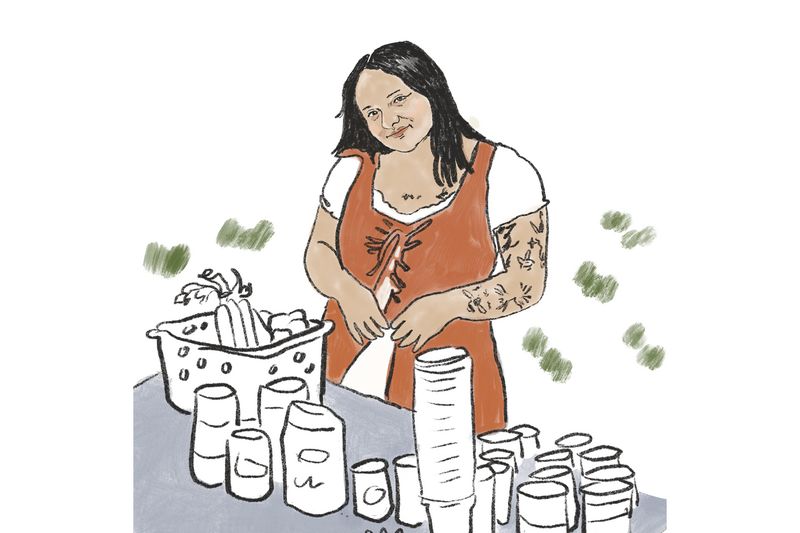
Moriah Molina
I HEARD ABOUT Food Not Bombs in 2020. I’d organized a protest in Richmond, and Food Not Bombs brought food. On a Lynchburg Reddit post, I saw that someone wanted to start a local Food Not Bombs chapter, so I went to a meeting. Now the Lynchburg Food Not Bombs meets every Saturday at Miller Park. We serve a hot vegetarian meal and give away clothes, hygiene products, harm reduction supplies, kids’ toys, and books.
There are a lot of regulars. They say they go to other food banks and get food, but it’s still not enough. We see a lot of elderly people and homeless people, people with little kids. A lot of them work and still can’t afford food.
Food Not Bombs is one of the only places where people can get harm reduction supplies with no barriers. If we’re there, and if we have it, it’s yours, no questions asked. People come get stuff and also donate stuff, or people volunteer but also receive stuff. There’s no hierarchy. At other organizations, there’s a volunteer process people have to go through to get approved to volunteer. We make it easy.
There are so many churches in Lynchburg. Small churches and megachurches. Churches have a building and tax-exempt status. And a lot of churches and nonprofits do a lot for people, but these places could do more with what they have. We’ve been able to do so much, and we don’t even have a building; we store stuff in our houses, we’re all just volunteers.
People assume Lynchburg is all conservative evangelical Christians. But there’s a big queer community here that I’m involved in. There are a lot of immigrants and a lot of left-leaning people. People can be scared to come to Lynchburg or don’t want to be associated with it. But there’s always people you can find that aren’t what you think of when you think of Liberty.
Liberty didn’t make this town.
apr26featuredavis.png
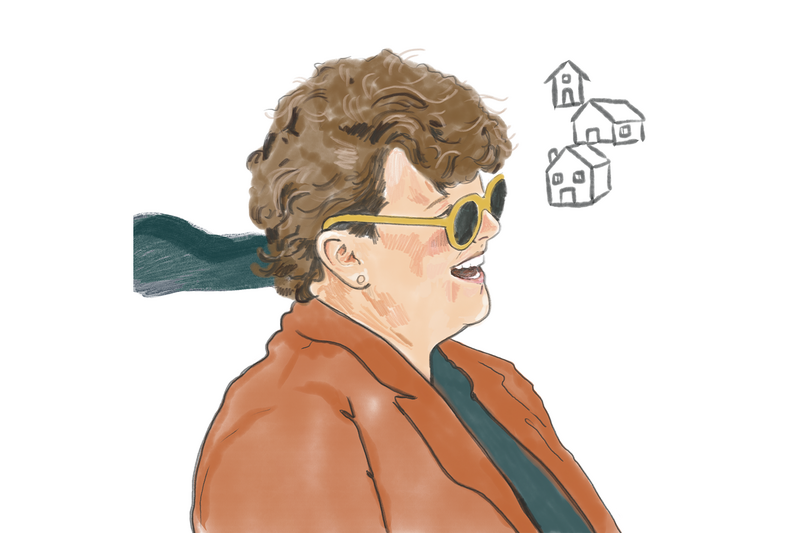
Kathleen Davis
ONE NIGHT, I was driving through rural Virginia when I passed a Moose Lodge and thought, “We need a gay moose lodge in Lynchburg.” So, I founded Lavender Lodge. It’s a queer space for queer joy in downtown Lynchburg.
We live boldly, but we do try and take care of the internet’s ability to pile on, so a lot of the details are kept under wraps. But we have a physical space, a cool building built in the 1880s. As we approach our second anniversary, we’re nearing 400 members. We have a library, a librarian, and computers for our members to use. We host monthly gatherings and provide resources and community.
Liberty didn’t make this town. As with all Southern towns, there is diversity of thought in Lynchburg. Small, rural Southern towns don’t get the same investment from the Democratic party. But we’re worth investing in. Every small town has queer people. There are queer people who go to Liberty, and they need to feel valid and alive. If we continue to try hard, we can all exist together. I know it can happen because I see it happen in practice. We’re bringing resources for our young people to exist collectively, together.
When Lynchburg does things like the Lavender Lodge, I hear other towns talk about it. Charlottesville did not have a space like Lavender Lodge, and now they do. If there is a flame of white nationalism, the hottest, blue part of the flame exists in Lynchburg. So, when we have wins here, they count 10, or 20, or a thousand times over. There’s power in saying, “if Lynchburg can do it, we can do it.”
apr26featurecarter.png
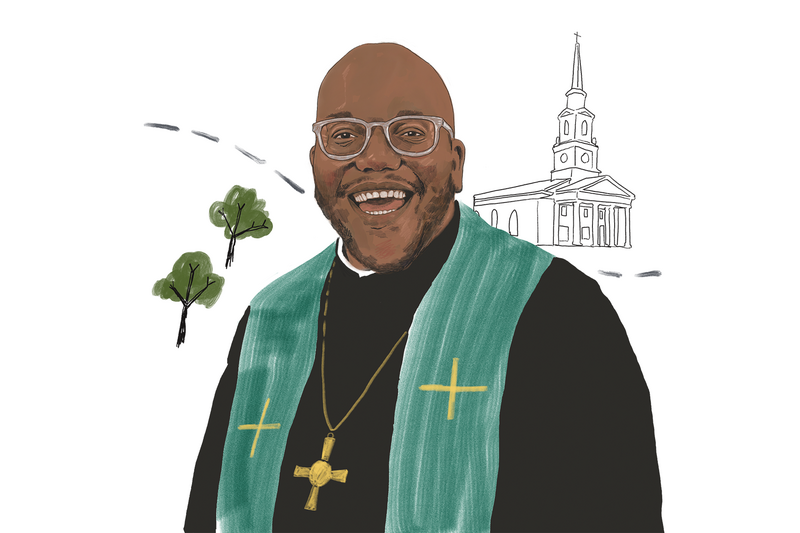
Christopher Carter
EVERYBODY CALLS ME Pastor Chris. I’m originally from Americus, Ga. I’ve been preaching for 18 years. When I heard about a church in Lynchburg looking for a pastor, I thought I may not fit in there. But I met with folks at Fairview [Christian Church]. The first interview, we all cried, and the second interview, we all cried again. I went to do a site visit, and that Sunday the congregation said, “we know you are our pastor.”
The mission and vision of the church was “Love God, Love People, and Prove It.” That attracted me, the “prove it” part. Do we actually see a church’s love for God and people in its work?
This is the fourth predominantly white congregation I’ve served as a pastor. I believe God is leading me to explore what racial reconciliation should really look like—and I’m exploring whether there might be better language to describe this work. I want to write a guide for other pastors serving in a congregation that’s different from their cultural upbringing.
When a lot of African Americans I meet hear that I’m in Lynchburg, their mindset is that I live in a racist, MAGA area. They’re worried about whether I’m going to be ok. They think Lynchburg’s name [is] referencing lynching. That’s a misconception about the area and its history. I’ve witnessed some things since I’ve been here that have been disheartening. But I think God sent me to Lynchburg to build a bridge and create a new outlook on what this community can be. I have found some of the most loving people in Lynchburg. People who are ready to see God move in a different way—in a multiracial, multigenerational, multicultural way. That’s been a beautiful thing to witness.


Did this article have an impact on you? Tell us how! Whether you’re moved to take action, have a question, or want to share a comment (good or bad), we value your feedback!