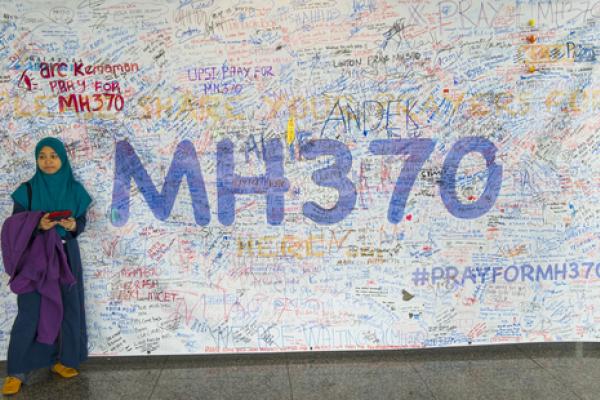
The search for Malaysia Airlines Flight 370 has captivated the media and press for days. How could we simply lose a plane? But the story reveals much more about our humanity and spirituality than we realize. Here are four simple revelations that we’ve learned about ourselves during this process:
1. We Crave Answers and Explanations:
As of this writing, Malaysia Airlines Flight 370 has yet to be found (a new breakthrough has possibly led them to the crash site), but the series of unusual circumstances has created an endless amount of theories that have fed our insatiable curiosity. As other world events continue to unfold — including the possibility of a major war involving Russia and Ukraine — we’re addicted to the story of the missing plane. But why?
Deep down, we all want answers. The worst case scenario is that we’ll never know. Mystery and confusion is contrary to everything within our current society — a culture obsessed with logic, data, information, and knowledge. Surely there’s some reason the plane is missing — there had to be — but right now we just don’t know why, and it’s driving us crazy.
The search for answers and meaning motivates our politics, jobs, relationship, and spirituality — and nothing proves this more than our current infatuation with flight 370.
We often treat our faith as an ongoing investigation — desperately looking for answers.
Oppressive poverty, like corruption and unfettered crime, is a human condition to be addressed and mitigated by principled choices to alter societal structures. This is particularly illustrated in South Africa with the ongoing historic challenge of the lingering old apartheid effects of legalized separation of races and tribal groups. Attitudes and demographics are still entrenched. The marginalized suffer most. Escalating crime is still in large measure black on black, but all sectors of society live with corruption and hear in the media the drumbeat of violence — and not only when there is a high profile feeding frenzy trial such as for Oscar Pistorius.
In a meeting with Kairos Southern Africa leaders, a senior ANC party executive acknowledged, “We have failed in service delivery and turned a blind eye to corruption … please help us make the changes necessary.” To be true to the liberation pledges, Kairos members are mobilizing civil society to act accordingly, along with an informed electorate and principled politicians, to address the residue of years of oppression both here and abroad.
A public way in which religious leaders from across the theological spectrum participated in this regard was in a solidarity conference called by the South Africa Parliament “portfolio committee” on International Relations and Cooperation. Consensus for action was not automatic on the apartheid-like oppression in Israel and Palestine. But respect for those of differing theological and political understandings was for the most part encouraging and enlightening.
Wrath
Rolling in the Deep — Adele
Mama Said Knock You Out — LL Cool J
Sloth
Lazy Song — Bruno Mars
Je Ne Veux Pas Travailler — Pink Martini
Greed
Rich Girl — Gwen Stefani ft Eve
I Want It All — Queen
Gluttony
Eat It — Weird Al Yankovich
Can’t Stop — Miley Cyrus
Lust
I Want You to Want Me — Letters to Cleo/10 Things I Hate About You soundtrack
I’m Sexy and I Know It — LMFAO
Pride
I’m the Best (clean version) — Nicki Minaj
Devil Went Down To Georgia — Charlie Daniels Band
Envy
Jessie’s Girl — Rick Springfield
Dancing on My Own — Robyn

“Humanity is intimately tied to the world we live in, and every societal action and technological advance has an effect on the earth,” reads one of the plaques in the current Unintended Journeys exhibit at the Natural History Museum in Washington, D.C.
The temporary exhibit, which runs until Aug. 13, is a powerful photographic portrait of the catastrophic effects environmental disasters are having on millions of people around the world.
The exhibit focuses on five different countries that have recently experienced or continue to experience severe weather conditions that have caused displacement, migration, intense hardship, and death for inhabitants. The disasters covered are the Hurricane in the Gulf, the Earthquake in Haiti, the Tsunami in Japan, Flooding in Bangladesh, and Desertification in East Africa.

Sloth. It’s not just a strange, adorable animal we love to watch in videos. It’s also one of the “Seven Deadly Sins,” and one that I find hanging around in my daily life.
I didn’t think about sloth in particular when I chose my Lenten practices for this year, but it turns out to be the very beast (sorry) I’m trying to walk away from.
To be clear, I’m a pretty active person. I walk to work, run long distance, and I’m also very social. But the fact is, every night I look forward to getting home and enjoying what I tell myself I’ve earned: as much time on the couch watching TV and eating as I want. It’s relaxing, I figure, and takes no mental or physical energy.
This is the proverbial sloth in the room.
Yes, unwinding is good, but here’s the problem: I’m not really getting any rest from this. Sure, I’m lounging, and my brain takes a rest if I’m watching something inane; but as a Christian, rest means something different than it does for other people. Rest means Sabbath. Sabbath is the day of the week that we hold sacred, the day when we rest from our usual work and worries, the day that we give back to God and use to worship God. So ironically, my approach to getting the sloth out of my life is to bring the Sabbath into it, at the end of each day.

Let those who boast, boast in this, that they understand and know me, that I am the Lord; I act with steadfast love, justice, and righteousness in the earth, for in these things I delight, says the Lord.” (Jeremiah 9:24, NRSV)
Pride has taken many forms in my life, but most dangerously in this: I have taken myself far too seriously. You wouldn’t think that a neurotic worrier who spent eight years in therapy would be full of pride. But for years I was utterly consumed with anxiety over what would happen in my life, because I believed that it should go a certain way and that I had both the responsibility and ability to bring that about.
So there’s nothing like having your worst fear come true — 19 months* of unemployment in a bad economy — to show you how small you really are, especially compared to God.
It was kind of amazing.

Editor's Note: Last week, Sojourners’ Associate Web Editor Catherine Woodiwiss caught up with musical collective Gungor at South by Southwest in Austin, Texas. Here’s what Michael Gungor has to say about art, liturgy, and the future of music.
This interview has been edited for length and content.
Catherine: So what brings you to South by Southwest (SXSW)?
Gungor: I guess we thought it was about time to experience the circus.
Catherine: A couple of years ago there was talk of SXSW becoming a destination for "Christian techies,” and Donald Miller premiered his popular film, Blue Like Jazz, at the film portion of the festival. Do you consider yourself part of a Christian “witness” here at SXSW?
Gungor: We are here to make some music, have a good time, and perhaps make some friends along the way. We certainly aren't here to proselytize or advance some secret religious message or anything.
But anywhere we go, we do have a desire to live the sort of life that Jesus invited people to live.