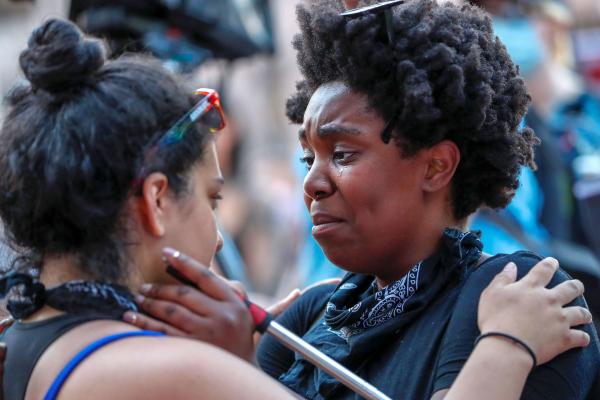
I feel the fusillade of grief all around me: Our shared planet is crumbling under the weight of human greed and exploitation; our neighbors are being snatched up and disappeared from our communities; and money for jobs and education is being used to fund wars and genocide. And I’m expected to believe that God is good? I’m still working on that.
In times of great moral cacophony, I have always preferred to hear directly from Jesus because, like the apostle Peter, I often wonder: Where else might I go? After all, Jesus has the words of eternal life (John 6:68).
I have found that Jesus’ words, although comforting, can also be troubling. Recently, I ran into this reality when reading the gospel of Matthew. A scholar of the law approaches Jesus and asks him, “Teacher, which is the greatest commandment in the Law?” Jesus succinctly replies that loving God is the first and greatest commandment, and loving your neighbors as yourself is just like it (22:34-40). According to Jesus, the entirety of what we know to be the holy scriptures—“all the law and the prophets”—hang on these two commands. I had read this exchange several times growing up, but it bore a new weight when I read it this time. I interpreted Jesus as saying that how we love our neighbors is the barometer for the health of our faith. But how we love them is not just limited to affective dimensions. It also includes grief and rage when our neighbors are in pain.
In Precarious Life: The Powers of Mourning and Violence, feminist philosopher Judith Butler argues that selective grief—the choice to grieve some lives over others—produces and maintains “certain exclusionary conceptions of who is normatively human.” In other words, who we choose to grieve indicates who we consider to be human.
I cannot help but think about Gaza. For the last two years, we have had front row seats to the world’s first live-streamed genocide. Broken bones and burned bodies have filled our social media and news feeds, yet our grief over Gaza remains tenuous. If we took Jesus’ words seriously, then we should not only be asking if Palestinians are our neighbors (that is a given) but also how we can love them fully, grieving with them, and resisting their erasure.
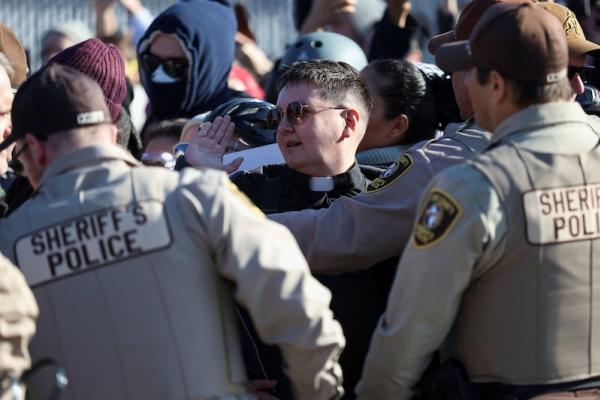
In a country where anti-genocide student protesters are arrested, and media personalities joke about dead Gazan babies, the word ‘Palestinian’ is emptied of its humanity and is used as a slur. Grieving for Palestine is anathema.
Even some Christians seem blind to Palestinian humanity. According to a 2024 survey by the nonpartisan think tank, the Chicago Council on Global Affairs, 64% of white Protestant evangelicals believe that Israel’s military actions are justified in Gaza. How does one reconcile Israel’s systematic killing of Palestinians in Gaza seeking aid, or 50,000 Palestinian children being killed or injured—clear violations of international law—with Christ’s command to love our neighbor? If by virtue of their Palestinianness, the Palestinian is rendered ineligible of our love, then we compromise the essential tenet on which our faith rests.
Palestinian life, as Butler argues, is “either no life, a shadow-life, or a threat to life as we know it.” This framing treats Palestinian death and erasure as the natural corollary of geopolitical maneuvers. According to a June report from the Center for Media Monitoring, “Palestinian deaths are treated as less newsworthy” by the BBC. In July, Writers Against the War on Gaza—a coalition of media workers dedicated to speaking out about Palestine—released a dossier detailing how The New York Times has an explicitly pro-Israel and anti-Palestinian bias. As a September Prism investigative report shows, this bias extends beyond The New York Times to include much of Western media. This bias perpetuates the dehumanization of Palestinians, discouraging the public from grieving their suffering.
READ MORE: Charlie Brown and Sufjan Know the ‘Good Grief’ of Christmas
Much of the on-the-ground reporting about the genocide has come as a result of Palestinian journalists keeping the public informed through social media. However, speaking at the Washington conference of the Jewish Federations of North America in November, Sarah Hurwitz, a former speechwriter for Barack Obama, lambasted social media for “smashing young people’s brains” with images from Gaza. These images, from Hurwitz’s perspective, wrongly push young people to sympathize with Palestinians and oppose the state of Israel. Hurwitz’s outrage is not over the carnage inflicted by the Israeli army in Gaza but the fact that people are grieving with Palestinians. Hurwitz’s role as a speechwriter for Obama—a Democratic president—emphasizes the reality that Palestinian dehumanization is not a partisan issue, as even progressives engage in such dehumanization. Beyond rhetorical dehumanization, there is also the more material dehumanization that is the bipartisan support for military aid to Israel. This support is a violation of Leahy law, which is a domestic law that prohibits the United States from providing military assistance to foreign security units that violate human rights.
I have seen the effect of this dehumanization first-hand. In 2023, my friend, Hisham Awartani, along with his two friends, Kinnan Abdalhamid and Tahseen Ali Ahmad, were shot in a Vermont neighborhood while visiting Hisham’s grandmother. All three are Palestinian. Thankfully, all three of them survived, but Hisham was paralyzed from the waist down. At the time of the shooting, Awartani and Ahmad were wearing keffiyehs, and all three were speaking Arabic. Writing for The New York Times in May 2024, Hisham connected the media’s dehumanization of Palestinians with the shooting in Vermont and Israel’s continued oppression of Palestinians in the West Bank and Gaza. “It’s difficult for me to come to terms with the reality of so much loss,” he wrote. If we cannot also be grieved and enraged over the loss of Palestinian life, then we embrace a superficial understanding of Jesus’ command to love one’s neighbor.
Grief born from the acknowledgement of our neighbor’s humanity is important, but love does not end there. In All About Love, writer bell hooks describes the love ethic as the conscious choice to extend one’s self to “nurture one’s own or another’s spiritual growth” through actions like care, commitment, respect, and trust. In the face of gross dehumanization that leads to violence, the love ethic looks like active (re)humanization of people who are being erased. We must tell their stories, sing their songs, and struggle with them to realize a more just future.
In the face of gross dehumanization that leads to violence, the love ethic looks like active (re)humanization of people who are being erased.
Jesus’ words still trouble me. It’s no small task to love and grieve with your neighbor. Contemporary political and social wisdom loudly suggests we do otherwise, but I have come to realize that the panacea for this fusillade of grief is a stubborn love that insists on seeing everyone’s humanity, including Palestinians. No excuses.

Elom Tettey-Tamaklo is an opinion writer for the 2025 Sojourners Journalism Cohort.
Got something to say about what you're reading? We value your feedback!