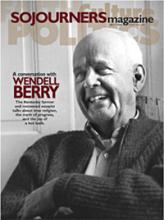
Sojourners associate editor Rose Marie Berger and
photographer Ryan Beiler spent a Sunday afternoon in February
with Wendell Berry at his farm in Henry County, Kentucky. Berry is the author of more than forty books of fiction,
poetry, and essays, including The Unsettling of America, What
are People For?, Life is Beautiful, Citizenship Papers, and
The Art of the Commonplace. He has farmed in a traditional
manner for nearly forty years. Berry spoke with Sojourners
about religious practice, Bluegrass country, defending against
Wal-Mart, usury, and Jesus. - The Editors
ROSE MARIE BERGER: Tell me about this land, about this
bioregion, about the history of your farm.
WENDELL BERRY: We're on the west side of the Kentucky
River, in the Kentucky River Valley. Some people call this the
Outer Bluegrass; there are other names for it. We have limestone
soils. An old ocean or sea laid down these layers of limestone.
There are lots of trees here. There are white, chinquapin, red,
black, and shumard oaks. Those are the principle ones. And we
have two or three kinds of ash, maples, several varieties of
hickory, black walnut, sycamore, black locust, honey locust,
cedar, basswood, red elm, slippery elm. We used to have chestnuts
once. Tanya and I have 125 acres altogether, 75 here and about 50
on Cane Run.
This place where we're sitting today, is the old property
known as Lane's Landing. Twelve acres, more or less, the
deed says. Tanya and I bought it in 1964 and moved in the next
year. So we've been here thirty-nine years.
My mother was raised in Port Royal. And her father's land
borders this. My father was born and grew up on a farm just the
other side of Lacie. My brother lives there now.
This is tobacco country. We've lost two-thirds of the
allotment in the last few years, courtesy of the global economy.
Not the anti-smoking people. This is traditionally a mixed
farming country. Tobacco was the staple crop, but we also grew
corn and small grains. The small grains were grown as cover crops
on the tobacco and corn ground.
The farms were around a hundred acres when I was a boy, on the
average; they're about 150 on the average now. But the
farming that was done here when I first knew it, in the 1940s and
'50s, at its best, was very good farming. In addition to the
crops I named, we raised cattle, sheep and hogs, sometimes all
three on the same farm. And every farm had a kitchen garden, a
flock of chickens, meat hogs, and at least enough cows to supply
the household with milk.
BERGER: You really had a working, home economy. How does the
local tobacco economics fit with the global economics? How has
that shift from local to global been experienced here?
BERRY: Tobacco acreages have declined here because the
companies can fill their needs more cheaply elsewhere. The other
products we grow are thrown into the world market to compete as
best they can. With the help of subsidies, of course. In Kentucky
we have always raised for export. One of this state's
problems is that it hasn't added value to its agricultural
products. I would say we are adding less now than ever.
Louisville used to have two or three packing plants, for
instance, and a stockyard. But no more. Most of the things that
are produced in this state are shipped out, to have the value
added elsewhere.
When you take away the subsistence economy, then your farm
population is seriously exposed to the vagaries of the larger
economy. As it used to be, the subsistence economy carried people
through the hard times, and what you might call the
housewife's economy of cream and eggs often held these farms
and their families together. The wives would go to town with eggs
and cream once a week, buy groceries with the proceeds, and
sometimes come home with money. Or they'd sell a few old
hens, that sort of thing. So that's the first lesson to
learn about agriculture, as far as I'm concerned: It needs a
sound subsistence basis. People need to feed themselves, next
they need to feed their own communities. That's what
we're working for now. We want to develop a local food
economy that local producers will supply and that the local
consumers will support. It's ridiculous that we should be
importing food into this state while our farmers are suffering.
BERGER: What are the models that are being used here in
Kentucky to resist the economic pressure from the larger market?
BERRY: Community-supported agriculture, farmer's markets,
direct marketing of meat, that sort of thing. There's an
effort under way to develop a retail market for local produce.
But this is hard to bring about.
The local landscape used to contribute food to Louisville.
There was a significant amount of truck farming going in those
days. That's gone. The stockyard's gone, the
packinghouses are gone. So there's Louisville economically
and culturally isolated from its rich agricultural landscape.
Which is ridiculous.
BERGER: It's almost a process of reweaving the city life
with its agricultural counterpart - its breadbasket.
BERRY: That's right - building commercial linkages
between the city and its local countryside. And there are good
reasons to do that. You've got the prospect, to begin with,
of better, fresher food. You've got the possibility that
consumers could influence production.
You have the possibility that urban consumers, by fulfilling
their responsibility to local producers, can make secure their
local food supply in the face of various threats. The paramount
one, now on everybody's mind, is terrorism, but there are
also the threats of epidemic and disease. In other words, the
influence of local consumers could work, not only to maintain
farming in the local landscape, but also to diversify it. And
American agriculture is badly in need of diversity. Another
threat to the present food system of course is the likelihood
that petroleum is not going to get any cheaper.
BERGER: That happened in Venezuela a few years ago. They had
an oil producer's strike and people lost their gasoline
supply. As a result they couldn't truck food anywhere. Whole
communities were starving because they couldn't get access
to food in stores, and they didn't have any capacity to feed
themselves.
BERRY: What could be more terrible? There are lots of bad
things that can happen to a food economy that's both
extensive and centralized. There's no substitute for
petroleum. And from what I read, the curve of discovery and
production of petroleum is about to decline. To have a growth
economy based on a declining fuel supply is bound to be
stressful.
BERGER: In Life is a Miracle, you talk about cloning
and genetic engineering. Genetically modified organisms are being
promoted by agribusiness as "a way to feed the poor people
of the world." What kind of ethical values should we be
operating under when we think about cloning, GMO, and genetic
engineering?
BERRY: The first ethical requirement is a decent suspicion of
the claims of people who have something to sell. I'm not
reading anything that suggests that genetic engineering is
increasing production. Some recent things I've read suggest
that productivity of Round-up ready soybeans is less than that of
other varieties.
I think that the real reason for genetic engineering is to put
absolute control of the food system into corporate hands. They
don't want anybody - farmer or urban consumer or anybody
else - to have anything whatsoever that they don't buy
from a corporation at the corporation's price. In other
words, economic totalitarianism is the goal. And I don't
think the difference between political totalitarianism and
economic totalitarianism is worth lingering over. If you're
not economically free, if you don't have economic choices,
you're not free.
BERGER: Your collection of essays, Citizenship Papers,
has been published recently and you wrote an amazing set of
articles for Orion about the national security agenda. As
I read through sections of the Patriot Act, I was reminded of an
old poem of yours titled "Do Not Be Ashamed." It says,
"Though you have done nothing shameful,/ they will want you
to be ashamed./ They will want you to kneel and weep/ and say you
should have been like them."
BERRY: Well it's sort of normal to wish that things like
that would not be applicable any longer and it's
discouraging to see that they stay current. You wish that a book
like The Unsettling of America would become obsolete, but
it's more relevant now than it ever was. I don't think
that national security can be achieved the way we're trying
to achieve it. I don't think that being the strongest
country in the world can necessarily make us the most secure
country. And the fact remains that we're destroying our
country ourselves.
It's easy to get the idea that we're stationing
troops all over the world to protect our right to destroy our own
country. I think that if you were seriously interested in
security, you would make the country secure in its regions.
You'd make it possible for the people to eat with far less
public transportation. To do that you'd have to think in a
different way. And we've got to face the likelihood that the
people in charge are simply not capable of thinking that way.
They've never thought in that way. Their doctrine is maximum
force relentlessly applied. That's the doctrine of war. But
it's also the doctrine of industrial agriculture. It's
the way the industrial system works.
Look at the way we mine coal, for instance. Look at the way
we're logging the forests. These are not sustainable
procedures. They're not even conservative procedures. Wes
Jackson has started calling this the "Prodigal Era." By
that he means the era in which we're going to use up most of
the topsoil and most of the fossil fuels.
BERGER: It seems like it always comes back eventually to the
individual's choice. Does one choose to live in an economy
of grace, based on generosity, or in an economy of scarcity based
on acquisition?
BERRY: You have to realize that people are working very hard
to remove that choice, to make it impossible to make such a
choice. And they can do that simply by putting the land entirely
under corporate control. It can happen. We're pretty well
advanced into a corporate or capitalist totalitarianism. And
it's a very strange thing to see happen, because we were
lately so much afraid of communist totalitarianism. You can
remove that choice we were talking about simply by making it
impossible for small economic enterprises to survive.
You can use Wal-Mart as a weapon, for instance, to destroy the
economic centers of small towns and small cities.
BERGER: The method of disarming such a weapon is carving out a
local economy, a local space, and defending it?
BERRY: You've got to defend it; you've got to defend
it economically. You've got to have some kind of fidelity
between consumers and producers. The great corporations can use
volume discounts to make it impossible for anybody else to be in
business. And they are doing that.
BERGER: And you have that partnership of slightly increased
unemployment - no benefits, poor wages - so it's a
push and a pull. People are pushed into the arms of Wal-Mart and
Wal-Mart is pulling them with cheap products produced in labor
conditions that are exploitative.
BERRY: Healthcare and health insurance are so expensive that
almost nobody can afford them. Most people can't.
BERGER: How do you see that playing out in terms of the rural
poverty here?
BERRY: Rural poverty happens because people aren't being
paid to take adequate care of their places. There's lots of
work to do here. And you can't afford to pay anybody to do
it! If you depress the price of the products of the place below a
certain level, people can't afford to maintain it. And
that's the rural dilemma we're in now. But you've
got to see the connection between the poverty of the people and
the impoverishment of the place. If you buy the products, and you
don't give an adequate payment in money, then that means
that the producer doesn't give adequate care.
The worst example of rural poverty we have right here is that
of migrant farm workers. Well, they're "temporary
workers," is the way to put that. They have no permanent
jobs, so they have no equity in the places where they work.
They're not shareholders, let alone entrepreneurs.
They're not small farmers, they're not market
gardeners, they're just temporary - uprooted, isolated,
easily exploitable people.
BERGER: One ends up lacking affection. The migrant workers
perhaps don't have a particular affection for the place
other than just the work and the money, and the place and the
people and economy never develops an investment in them because
they're on their way out.
BERRY: That's right. Because they're temporary and
replaceable. They're more readily replaceable than the
slaves were. Also in Kentucky some corporations, Fruit of the
Loom, for instance, have just left for places that are more
exploitable than Kentucky. And then we have, west of here, the
hog and chicken factories. That's another story of corporate
abuse of places and people.
BERGER: This organic mechanism of resistance is trying to
establish a community/regional area and beginning to develop
alternative models of connection between the producer and the
consumer, and begin to create some trading zones that are
micro-trading zones.
BERRY: Yes. You can hope only to take it back a little at a
time. There is no master plan. And I would be very suspicious of
a master plan if I knew of one. It's got to happen a little
at a time. You've got to confront the very difficult
economic problem of making a local supply and a local demand come
into existence simultaneously. I don't know that that's
ever been done before in the way we will have to do it. And
nobody knows how well it's going to succeed. But there are
hopeful signs. It would be no trouble to take you and show you
things that are working, but there are not enough of them yet.
BERGER: I want to ask you also about Harlan and Anna Hubbard,
about the influence they've had on your life. And also the
tension between the nomadic, pilgrim experiment that they
launched off into versus rootedness, staying in one place, making
a deep commitment to a particular area.
BERRY: Well, Harlan and Anna Hubbard were a married couple who
began their life together by building a shanty boat and making a
sort of epic drift down the rivers from Brent, Kentucky, above
Cincinnati, to New Orleans and then on out into the bayous. In
the early fifties, that journey having completed itself, they
returned to Kentucky and bought a remote property, known as Payne
Hollow, on the Ohio River in Trimble County. They built a house
there and remained there, living mostly from their land and the
river until they died.
They were musicians; they played duets every day of their life
together. They played Mozart, Brahms, and Bach, those people.
Harlan made prints, drawings, oils, and watercolors. And he was a
writer. He published in his lifetime two wonderful books, one
called Shantyboat that was an account of their trip down
the rivers, and another called Payne Hollow, which is a
distillation of their life at Payne Hollow. Their life was
exemplary in a lot of ways. They did little harm. They lived
abundantly, by their own efforts, and with a very small
expenditure of money. In their frugal life they experienced much
joy and made much beauty. They were teachers to a lot of people,
and I'm one of them.
BERGER: How did you come to meet them, originally?
BERRY: By accident. A friend and I were on a canoe trip. We
stopped there to see if we could get some drinkable water. We had
replenished our water supply with the city water of Madison,
Indiana, and we were finding it hard to swallow.
BERGER: I've gone back and looked again at some of the
ways that Harlan engaged his spirituality or religion, his
reading of the Bible, and how at one point I think he said
something about how he experiences the Bible not as revelation
but as confirmation, and that he comes to these lessons in his
life, and is sometimes surprised that the Bible also has come to
those lessons. And I find that sort of engagement with
Christianity very appealing in the sense that it feels very
authentic, and lets the faith be a humanizing faith.
BERRY: I think Harlan was a man with a very strong religious
impulse, or religious nature. But I don't think the formal
religions, the churches of this area, had much to offer him.
It's hard to nail Harlan's religion down very firmly. I
did the best I could in a chapter of my little book about Harlan
and his work.
Thinking about Harlan as a religious man is quite different
from thinking about, say, Thomas Merton as a religious man,
because there's not a body of doctrine that Harlan
subscribed to. He didn't endorse any creed. He was a man at
large with his faculties and his gifts and his inspiration, his
great relish of life and of his world, which he said was
"heaven." You look to see what Harlan painted when he
was "painting heaven" and you see landscapes of
northern Kentucky and Payne Hollow.
BERGER: What was your connection with Thomas Merton, the
Trappist monk who lived here in Kentucky?
BERRY: My connection with him was the photographer Ralph
Eugene Meatyard, who has grown steadily in reputation since he
died. Thomas Merton was interested in photography, and I guess
that led him to Gene, who was no more conventionally religious
than Harlan Hubbard. Gene was a wizard. He had an incredible gift
of seeing and of picture-making. But let's don't say
"incredible." It was perfectly credible when you saw
what he could do. He had a very great gift. Merton could see
that, and he made a friend of Gene. Gene and his wife Madelyn
took Tanya and me down there twice.
Merton was a man who understood how to be a companion. He had
a lot of humor, and I think he knew something about how to be
happy or how to enjoy happiness when he had it. I liked him
tremendously. He had a very lively countenance; a very bright,
curious, amused eye.
When we went down there the first time, he just dropped it out
casually, and I think with great secret amusement, that he was
thinking about joining an Indian tribe. I think Merton was a
profound Christian. Some people seem to think that when he went
East he was abandoning his faith or his vocation. I don't
think he was at all. His talks to religious groups in Alaska (Thomas
Merton in Alaska) on that last trip were wonderful.
BERGER: He just seemed to be moving deeper and deeper, which
in some ways made it easier to connect across a variety of
spiritual expressions.
BERRY: He had, I think, a very fortunate impulse to reach out
to other religions. And we need to pay attention to that, because
there are people now who would carry us right into a religious
war. That's a big problem, I think.
BERGER: The end of Christendom.
BERRY: Well, Christendom is all right, but it doesn't
have to exclude everybody else. It doesn't have to go to war
against them. And it doesn't have to be so stupid as to
condemn other faiths that it doesn't know anything about.
BERGER: One of the lines in Life is a Miracle says,
"It's impossible to prefigure the salvation of the
world in the same language by which the world has been
dismembered and defaced." It's a brilliant line!
BERRY: You've got to reach towards a better language, and
you're not going to make it up from scratch; you've got
to reach back into the tradition. Western tradition is not as
impoverished as a lot of people would like to think, but
you'd have to go back before the industrial revolution; you
may have to go back farther than that. Of course, the Bible has a
perfectly adequate language, but it's suffered a lot of
thoughtless wear.
BERGER: Some of the work being done, more by poets rather than
theologians, in reclaiming the roots of biblical
language - digging in for what almost intuitively or
artistically makes sense rather than the science of
translation - seems to bring life back.
BERRY: If you're a writer and you are at all inclined to
speak as a Christian in some way, you realize very quickly that
the conventional language is pretty much useless. It takes a long
time to get past that, or it has taken me a long time. People in
conventional Christianity have spoken lightly and sometimes
frivolously of God for a long time. It's a word that needs
to be used sparingly, in my opinion.
Any religion has to have a practice. When you let it go so far
from practice that it just becomes a matter of talk something bad
happens. If you don't have an economic practice, you
don't have a practice. Christians conventionally think
they've done enough when they've gone to the store and
shopped. But that isn't an economic life. It isn't an
economic practice. If you take seriously those passages in the
scripture that say that we live by God's spirit and his
breath, that we live, move, and have our being in God, the
implications for the present economy are just devastating. Those
passages call for an entirely generous and careful economic life.
BERGER: There are a number of explorations and economic models
in the scriptures, in terms of the Sabbath economics, jubilee
economics, but there's not enough experimenting among
Christians or people of faith with alternative models of
economics.
BERRY: There's a fairly explicit attempt back there in
the early books of the Old Testament to see that property
doesn't accumulate into too few hands. There's a real
attempt at economic democracy. The idea of the Jubilee year is a
deliberate affront to what we now call capitalism. There's a
lot that's been said, not just in the Bible, but in the
biblical tradition in literature, on the subject of usury. Dante
was pretty explicit about it. It would put you in hell because it
implied, among other things, a contempt for nature. It's an
attempt to go around the natural world and human work and make
money grow out of itself. It's an attempt to make value grow
in the abstract, without work, without a real product. As lots of
people have said, this goes against the real economy of the
world. Ezra Pound has a great canto on usury, two of them as a
matter of fact. "With usura hath no man a house of good
stone." Nobody can have good things when you let money
become its own value.
BERGER: As the epigraph to Citizenship Papers you quote
2 Peter 2:3, "And through covetousness shall they with
feigned words make merchandise of you." I don't know
that I have ever heard that phrase in this context. Suddenly it
becomes revolutionary.
BERRY: Yes. The gospels, and sometimes the epistles, are
pretty revolutionary. They propose a revolution of about 180
degrees.
One of the popular versions of the Bible has in the back an
index of great stories and great chapters, and not one of them
from the gospels.
But Christ was quite explicit, for instance, about his
pacifism. You can't be more explicit than "Love your
enemies." He did run those people out of the temple, but he
didn't kill them.
People are always talking about the first church. The real
first church was that gaggle of people who followed Jesus around.
We don't know anything about them. But he apparently
didn't ask them what creed they subscribed to, or what their
sexual preference was, or any of that. He fed them. He healed
them. He forgave them. He is clear about sin, but he was also for
forgiveness.
BERGER: Well there's so much in that way of engaging
people - and the sin and forgiveness model's a good
one - that is all about promoting life and opening up
possibilities for life. It's never about shutting life down,
closing people off, stopping them in their tracks. It's
about opening up possibilities for people.
BERRY: That's right. That's right. A completely
decent and authentic way of putting it, I think.
BERGER: Of all your writing, Life is a Miracle is the
one that I think is the most brilliant because it calls into
question the entire myth of progress.
BERRY: You know, it helps an old man to hear that!
BERGER: There are not enough people who are asking questions
about the post-Enlightenment era, and the myth of progress and
where it's taking us. Even our contemporary Christian
mindset is just built on this myth that the world just keeps
getting better and that the past was worse than the present.
BERRY: It gets taken for granted, that's why it's so
easy to attack. People are handing out this stuff without
thinking about it.
BERGER: How is that myth of progress operating on us as
people, and what are the reasons for calling it into question, or
subverting it?
BERRY: Well, that's two questions, isn't it? How
does it operate on us? It substitutes this infinite advance
toward better and better life in the material sense for the old
pilgrimage, which you make by effort and grace, to become a
better person. And I guess that's the reason you need to
subvert it if you can. It takes people's minds off the
important things. It becomes, at it's worst, a kind of
determinism: All we have to do is just passively go along and
things will get better and better, and we'll be happier and
happier. That's why we need honest accounting.
I think all the time about the medical industry's
emphasis on longevity. It's a substitution of quantity for
any idea of completeness or wholeness or any sense of real
fulfillment or real worth, so that you prolong life past the time
where it's worth living, and then you brag about it. Without
any acknowledgment of the possibility that somebody's life
might become a burden, or that some things are worse than death.
BERGER: Death becomes simply an inconvenience to be shuddered
away.
BERRY: As if it might not at some point be a great relief. As
if it might not be a blessed deliverance.
All the questions about progress reduce to the question of
what your measures are. And what is the measure of progress? It
is possible to measure the progress of the last two or three
hundred years in soil erosion. We can measure it in the rate of
species extinction. We can measure it in pollution, in the
toxicity of the world. Those things, like power and speed, are
perfectly measurable.
But we need also to raise the questions that are not
quantitative. How happy are people? What do we make of all this
complaining? How healthy are people? How are love and beauty
faring? What do we make of all this doctoring and medication
that's going on all the time at such a great expense?
That's not to deny that this so-called progress has given us
things that are worth having. A hot bath every night is a good
thing. I affirm that it is good, and wish to record my gratitude.
There are other good things, but real harms also have been done.
BETH NEWBERRY: How does your identity as a writer connect to a
region, a place, and a land?
BERRY: Well, I was born here, not in this house, but in this
county. I grew up in these little towns, and in the countryside,
on the farms. All my early memories are here. All the voices that
surrounded me from the time I became able to hear were from here.
Tanya and I came back here in 1964 and have lived here for 39
years, raised our children here. How could you draw a line
separating this place and my identity? If you've known these
places from your early youth, that means that you have a chance
to know them in a way that other people never will.
I think often of the importance of a language spoken by people
who are really local, who really know where they are and have
lived there a long time; that language has a particularity about
it that no language of bureaucracy or government or the
university can ever have. It has a designating power that's
utterly precise. Knowing the landscape in common and knowing it
intimately, minutely, that has to be the basis of a language.
That's where it starts, and you can raise it up from there,
in successive levels of abstraction. But if you lose that power
to particularize and designate precisely, in some sense you
don't have a language anymore. So having a common tongue can
mean that at one level you have the dictionary in common, you
have the English vocabulary. But to have a common tongue in the
sense that you can speak in detail, knowledgably and responsibly,
about a well-known place, a well-known ecosystem and a well-known
human community, is quite another thing.
BERGER: Is there a tension between self-sufficient communities
and balkanism? Is there a danger of isolation in developing
sustainable communities? If a community withdraws into itself so
much, or becomes removed from a larger system of relationship, is
there a danger of setting up enemy tensions between communities?
Prejudice?
BERRY: I'll honor the question if you will acknowledge
that this can happen in cities as well as in the country. People
are always saying that these terrible things happen in little
towns and rural communities, but of course they happen in cities
just as readily, and for the same reasons. I suppose the direct
way to deal with this is to point out that no community is or
ever can be entirely self-sufficient. It's dependent on
other communities, not only for supplies, but also for
conversation and goodwill.
We're a pretty bad species in a lot of ways and in other
ways a pretty good one. We can become a warrior civilization and
live by piracy; on the other hand, we're capable of
lovingkindness, of genuine affection, of generosity, of
friendship, of peaceability, of forgiveness and gratitude.
It's a question of where you want to put your influence, how
you want to apply the little means that you have. It's too
easy to say that country people are provincial and prejudiced, as
if the worst things that humans are capable of hadn't also
risen up in cosmopolitan, highly sophisticated, urban
civilizations. That's just a passing of blame. If you can
blame it all on people out in the provinces then you don't
have to worry about what's going on in your urban
neighborhood or in your urban soul.
One of the oldest human artifacts is the trade route. People
were trading in obsidian and other rare things long before
history. So we know there's going to be trade, we know that
you can't isolate a culture and keep it going without
cultural interchange. You can't live without influence, you
can't live without change, you can't live without
trade.
The serious question is whether you're going to become a
warrior community and live by piracy, by taking what you need
from other people. I think the only antidote to that is
imagination. You have to develop your imagination to the point
that permits sympathy to happen. You have to be able to imagine
lives that are not yours or the lives of your loved ones or the
lives of your neighbors. You have to have at least enough
imagination to understand that if you want the benefits of
compassion, you must be compassionate. If you want forgiveness
you must be forgiving. It's a difficult business, being
human.
Rose Marie Berger is an associate editor of Sojourners.
|