

Raul Ruano Pavon / Shutterstock.com
Author's Note: As we close out Advent, when we so quickly determine what’s our legal right or what we’re owed or what “the Bible really says” when, after all, we’re just simply too quick to judge. In these days where we must affirm #BlackLivesMatter, where we must stand up for victims of rape and abuse, and where we must struggle with our LGBTQ sisters and brothers for full inclusion, sermons like this are humbly offered.
We know the Christmas story well.
Those of us that have grown up with regular, annual, church-going rhythms — we essentially hear this story once a year.
Even so, those with no regular church commitments — people from all walks of life, people of faith or no particular faith, people from varied faiths — if you asked your friend, your neighbor, your cousin, a stranger on the street, I bet at least 50 percent of the time they’d be able to share the gist of the story:
Jesus was born to a virgin named Mary.
Mary was married to a guy (named Joseph).
There were angels, and wise men, and shepherds.
And I think there was a manger.
We know this story well.
But we hear it so often it becomes rote — literally a mechanically, automatically, mindlessly routine on repetition in our brains.
Yeah, yeah, yeah — 6lb 8oz baby Jesus, in a manger, Virgin Mary, Adopted Dad Joseph, sheep, shepherds, angels, stars at night, wise men, white Christmas, Rudolph the Red Nosed Reindeer …
You get my point.
So, let’s hear the story one more time and lean in a bit to this wild world of dreams, angels, and ancient Jewish marriage contracts.

Man wearing black holds a gift. Image courtesy Man wearing black holds a gift. Image courtesy leolintang/shutterstock.com.
On a Sunday when the dominant color in Christian churches is pink — a symbol of joy for the third Sunday of Advent — I was wearing a black shirt, black pants, and a blue tie. Others in our congregation were wearing various combinations of black or blue.
This was a modest way of showing solidarity with African Americans and a reminder that “Black Lives Matter” while still showing empathy for the police in the Madison, Wisconsin, area who have worked hard over the years to have a diverse force that works to serve rather than dominate the varied racial and ethnic communities that exist here.
But even with a nod to the pressure police are under these days, the dominant focus was on the series of killings of unarmed black people. And we know that not all police departments have made the same efforts that have happened here over a generation — and that our police departments are not perfect either.
The movement to wear black on December 14 came from several African-American denominations across the nation. Here in Wisconsin, Rev. Scott Anderson, Executive Director of the Wisconsin Council of Churches, joined faith leaders in urging people to wear black to church on that Sunday.

A man and a woman hold hands near a train. Image courtesy Pavel L Photo and Video/shutterstock.com
“If you don’t feel safe alone, I will ride with you.”
These words have so much depth.
When an armed man with unidentified ties to radical Islam took control of a Sydney café for over 16 hours on Monday, a social media campaign under the hashtag #IllRideWithYou started rapidly trending on Twitter. Australians started the hashtag to stand in solidarity with Muslims during the immediate tension following the siege. In a matter of hours, the hashtag became an international movement creating over 480,000 tweets.
The hashtag was inspired when one user tweeted the story of a young Muslim woman who removed her hijab (traditional Islamic head scarf) while riding public transportation because she feared that identifying herself as a Muslim would put her in danger of misdirected violence toward innocent Muslim citizens in the aftermath of another extremist fueled act. The tweet continued to describe another young woman who “ran after her at the train station [and said] ‘put it back on. I’ll walk with u [sic]..’”
This original tweet inspired Tessa Kum, an Australian TV content editor, to reply with a message that sparked a movement. From her handle @sirtessa, Kum tweeted,
“If you reg take #373 bus b/w Cogee/Martin Pl, wear religious attire, & don't feel safe alone: I'll ride with you. @ me for schedule.”

Ferguson solidarity vigil. Image courtesy Nisarg Lakhmani/shutterstock.com
Could it be that the crescendo of dissention is divinely synched to yet again heighten disruptive unease among the status quo? Could it be that the promise of Emmanuel — "God is with us" — as proclaimed by the heavenly host, but feared by powerful elite, is unavoidably linked through the eternal truth — such that even the Church universal cannot celebrate one and avoid the other? Could it be that through Advent, we are called to acknowledge the humanity and parity of personhood, rather than rest in the laurels of privilege? The anger of youthful Ferguson protests was marginalized and dubbed as riots, but could it be that this Advent response manifested in expanded multiethnic solidarity is of divine intent to raise challenge to elitism and to demand respect for people of color as equals rather than as patronized subordinates? Could it be that whether or not the media chooses to ignore the connection, the Advent message for those with ears to hear is that perpetrators of brutality, the comfortable protectors of privilege, and the self-serving pundits of power that tried to nullify the everlasting promise were unsuccessful then and now? Could it be by divine design that unknown names, stolen lives, are now divinely lifted to eternal and global recognition as sacrificial symbols so that truth could come to light?

A figure weeps under a tree. Image courtesy KieferPix/shutterstock.com
This Advent I am grateful for the gift of hopelessness. Yes, you read that correctly. This past year has been full of heartbreak, suffering, and lament. It follows on the heels of nearly two years of unemployment, financial insecurity, and stress-related health issues. Any hope to which I once clung — any hope outside of God, that is — has been destroyed.
And for that I give thanks.
This summer, as I waited anxiously to hear what was strangely afflicting my father (who had already had several health scares and a heart attack), as I nursed a broken heart and came to grips with personal disappointment, as I watched how a once rosy-outlook turned to a heavy-grey, I learned the true meaning of hope. Everything in this world will break or decay or simply fade away. Nothing here is permanent and even the most seemingly perfect and ideal situation has at least a hairline crack.

Three wise men, Rawpixel / Shutterstock.com
This week the streets all over our country have been filled with protesters expressing grief, anger, shock and sorrow that Officer Darren Wilson (who shot and killed the unarmed 18-year-old Michael Brown) and Officer Daniel Pantaleo (who held the also-unarmed Eric Garner in a fatal chokehold during his arrest) failed to be indicted for their actions.
Last night crowds across the U.S. staged sit-ins and die-ins, clogged bridges, and shut down major highways. Many of them chanted, “No Justice, No Christmas.”
No Justice, No Christmas.
At first glance, I agreed with them. Screw it. Let’s just shut it all down. Shut down the bridges, the roads, the rivers, the train stations and the airports. Shut down the mall Santas and the Christmas pageants and the holiday parties and the family get-togethers. And then let’s shut down Christmas itself.
Because who wants to open a stocking filled with candy and socks and lip gloss when the Brown and Garner families will be grieving for their loved ones who are no longer with them? Who wants to sing about joy when our country is feeling so much pain? Who wants to proclaim, “Peace on earth, good will to men” when peace and goodwill are precisely the things we’re lacking right now?
No Justice, No Christmas. Seems like a good idea, right?

People gather in the Father's Heart Ministries soup kitchen. Image courtesy Father's Heart Ministries.
"This will be a sign to you: You will find a baby wrapped in cloths and lying in a manger.” Luke 2:12
As the people walked into the sanctuary, the worship team behind us started to sing. “This is Jesus, in his glory.” I stood there in my apron, gloves, and hairnet — as I had many times before — and watched our guests sit down at their tables. The first few people who came in were elderly Chinese, more women than men. Then, a middle-aged Latino man came in, followed by a few more elderly Chinese women. For a brief moment, there reflected in their faces, was Jesus in his glory.
This past Saturday morning, I served at my parents’ non-profit’s soup kitchen and food pantry, as I had for half of my life before I moved to Washington, D.C. From 9:30am-11:00am every Saturday morning, unlimited breakfast is served to a range of New Yorkers: young, old, employed, unemployed, white, black, Chinese, Latino, gay, straight — you name it, we’ve got it. Our guests are seated and given all they can eat and a bag of groceries, as well as access to legal aid, GED and ESL classes, and prayer. As much as it pains me to admit it — because, well, it’s my parents’ work — it’s kind of the real deal. The sanctuary-turned-cafeteria turns back into a sanctuary as Jesus — as seen in each of these men and women and children—is seen, in his glory.

A 15th-century painting of St. Thomas Aquinas. Image via RNS.
Early on the first Sunday of Advent, I logged in to Pandora and heard the familiar chant “Adoro Te Devote.”
As a child, I knew Thomas Aquinas’ beloved text as “Humbly I Adore Thee.” At that time, faith meant standing with my family in the family church and singing such hymns with devotion.
The joining in song and prayer drew me closer to God. Or so I thought.
Later, as my life became more challenging and as I entered a world that seemed largely untouched by faith — a world where hatred, greed, violence and arrogance had free rein — I wondered if faith needed to be something more.
More rigorous, perhaps, deeper than a child’s cozy feelings. Faith needed to embrace more than lingering echoes of days gone by. Faith needed to address today’s cruelties and sadness. Faith needed to confront warfare, prejudice and unwarranted privilege.

An angel holds the earth in silence. Image courtesy Danilo Sanino/shutterstock.com
One summer my cousin Betty and I sneaked through the barbed-wire fence of a neighbor’s orchard and ate so many wild plums right off the tree that we almost made ourselves sick. Betty was 13 and I was 9, and I adored her. I still do.
Betty is dying right now. She might not make it till Christmas, which is really bad timing in my opinion. Yes, I talk with God about this. It’s one thing for me to lose a beloved cousin: I’m old enough to know from experience that, while the pain can feel like a raw wound that might never heal, losing those we love is a normal part of life. But I keep wondering, What kind of message is God sending to Betty’s family by jerking her away from them during this holy season of Advent? Doesn’t God care that they are already plunged into grief in anticipation of losing someone they love so much?
Yes, I talk with God about my fears, too, mostly in the form of questions from the little five-year-old kid inside me. What’s going to happen? Where are we going? What will it be like? Will it hurt? Do I have to? And, Why?
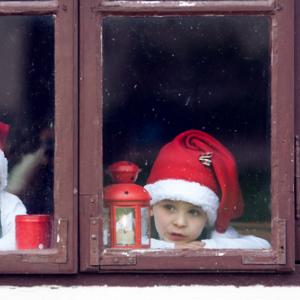
Two boys wait for Santa. Image courtesy Tomsickova Tatyana/shutterstock.com
But wait! What if we‘ve got it backward? To revisit that waiting-goes-both-ways thing: Instead of us waiting on God, what if God is waiting on us?
John Dominic Crossan poses that question in his book The Power of Parable. He notes something that’s obvious: Jesus could be very impatient. He wasn’t one to just sit back and wait for things to change. As Crossan sums it up: “You have been waiting for God, he said, while God has been waiting for you. No wonder nothing is happening. You want God’s intervention, he said, while God wants your collaboration. God‘s kingdom is here, but only insofar as you accept it, enter it, live it, and thereby establish it.”
There’s so much to be done — what’s important is to do it now. This moment is a gift. This opportunity to love someone else is too precious to waste.
If all we do is sit and wait for things to change, then we’re like people trapped in a perpetual state of Advent. We never get to our own Christmas morning. We do nothing more than wait.
And all the while, someone is waiting on us.

Pile of gifts. Image courtesy Crepesoles/shutterstock.com
Like a lot of people, I love giving presents almost as much as receiving them. And the best gifts of all are ones that come with a clear understanding of the recipient in mind — ones that involve thought and care. Maybe a weird record with cover art only your best friend would love, or a necklace that goes perfectly with your mom’s favorite dress.
But spending that much effort on gifts for every single person on your list can be exhausting. Handmade gifts sometimes take weeks to plan and make in advance, and you don’t always have the time (or gas money, for that matter) to spend an entire day driving all over town searching for the perfect present, as romantic as that sounds.
Luckily, there are plenty of great resources out there to provide you with excellent gifts that give back. You can find some of them listed in Sojourners’ Just Giving Guide, which offers options ranging from clothes and jewelry to coffee and pecans (yes, pecans!). And if you just can’t find that special something, there are also plenty of choices for giving a donation in honor of a friend or loved one.

An advent candle burns in the wreath. Image courtesy 3523studio/shutterstock.com.
The high liturgical seasons of Advent and Lent have always held a special place in my heart because of their emphasis on the life, death, and resurrection of Christ. But Advent has special significance because it, unlike any other season, most accurately expresses the now-not-yet feeling of the Kingdom of God. It highlights the fact that we are waiting. We’re waiting for the return of God, for the day when God will come and restore all things.
Many of our Advent hymns capture this beautifully, especially “O Come, O Come Emmanuel.” Before the birth of Christ, God’s people lived in a time of waiting. The space between the Old and New Testaments, between Malachi and Matthew, cover a span of more than 400 years. That was 400 years without a word from God, without a prophet. It was 400 years of one invasion after another as one conqueror overtook another. And the people began to wonder, “When will YHWH come? When will God send the Promised One?”
And then, announced by shepherds and angels, and greeted by Magi from the East, Jesus was born in Bethlehem. The Promised One had come! The Kingdom of God was at hand! But not quite. He lived, he died, he rose again … but we’re still waiting. We live between the two great Christ events of history, between his first coming and his second. We live in the in-between time as we await the return of the King and the day when God will come again to dwell with God’s people, to wipe away every tear, and to finally and for all eternity make everything new (Rev. 21).

Herod view Jesus as a rival king. Imagdb/Shutterstock
Every year, a chorus of Christians join together to bemoan the “War on Christmas,” lambasting their enemies for taking Christ out of Christmas, and yearning for the days when everyone remembered the reason for the season.
But have we all forgotten? There has always been a war on Christmas. In fact, conflict lies at the very heart of Christmas. To those who say that Christmas is all about peace on earth, a quick look at the second chapter of Matthew and the largely overlooked story of King Herod reminds us that this peace comes at a price. For it is the kind of peace that can only come through conflict. Before caroling, there was weeping in Ramah.
It’s no surprise that most Christmas pageants leave out the Herod story. King Herod jealously guarded his power, killing anyone who got in his way. When he learns of Jesus’ birth, he declares the first war on Christmas. Herod doesn’t just want to kill Jesus. He wants to destroy him, taking Christ out of Christmas once and for all. When his efforts are thwarted, he resorts to genocide to ensure Jesus’ demise, murdering every male infant in Bethlehem. This, for Herod, is a bargain to rival any department store sale: The lives of Bethlehem’s youngest? A mere pittance for unrivaled power.
In other words, Herod gets it. Herod, more than anyone else in the story so far, sees this poor, refugee child for who he really is — a rival king.
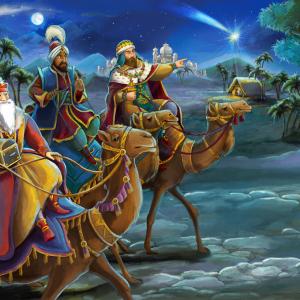
Christmas story is replete with images of people journeying to new lands Maciej Sojka/Shutterstock
Ah, Christmas! The most wonderful time of the year. A time to gather with family and friends, and, with a smile on our faces, pretend we aren’t quietly measuring who received the best present and which relative really, really needs to stop drinking. A time to hang tinsel and baubles from the tree, and a time to hang up our hopes of losing that last 10 pounds this year. Such a joyous season!
The real point here is that Christmas is what we make of it. For Christians, however, there are some very specific things you can’t do if you want to actually honor and follow the person we celebrate this season. So, I give you my “10 Things You Can’t Do AT CHRISTMAS While Following Jesus.” As with my other “10 Things” lists, this is not intended to be a complete list, but it is a pretty good start.

This elf keeps an eye out from a wine glass. Ladybugbkt/Flickr/Creative Commons
It’s taken me a few years, but I’ve decided to relax about him. I refuse to beat myself up over his presence anymore. He’s okay. I mean, don’t get me wrong — he’s annoying and I have concerns. And I know that many of my fellow parents will disagree, and that’s okay. This makes me cringe, but that little Elf on the Shelf can stay.
After some debate, my wife bought the Elf on the Shelf in 2010. If you aren’t familiar with the Elf on the Shelf myth, it goes something like this: Apparently Santa is incapable of knowing if children have been bad or good on his own, so Dec. 1 to Dec. 24 that Jolly Old Elf sends his little elves to houses to spy on boys and girls. Their job is to check to see if children are being naughty or nice. So, each morning before anyone is awake, our Elf flies in from the North Pole and hides in a different spot in our house. When our children wake up — noticeably earlier in December than any other month — they look for him. Yup, it’s hide-and-seek every morning with the Elf. Then, the National Security Agency Elf spies on our children throughout the day. When our children fall asleep at night, the Elf flies back to the North Pole to provide Santa with a report on how our children have behaved. Then the Elf promptly flies back to our house, hides in a new place, and the morning hide and seek ritual begins again.
Truth be told, my children love it. They. Love. It. They can’t wait to wake up in the morning and search for that little Elf.
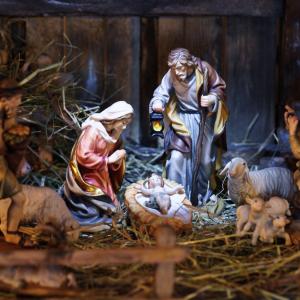
Maybe a picture-perfect nativity scene isn't the whole story. Alexander Hoffmann/Shutterstock
Last December, I decided to run after dark and entertain myself by running through neighborhoods, looking at lighted Christmas decorations as I passed by. It was a novel twist on my regular exercise, and I enjoyed gazing at the beautiful, the creative, and the tacky alike.
Then, I started noticing the insides of houses, too. The Christmas trees were lit and decorated; the insides of the houses seemed warm and inviting. Suddenly, instead of an independent adult on a crisp winter jog, I felt more like a homeless orphan from a George MacDonald Christmas story looking in at something I did not have and of which I could not be a part. Needless to say, the run lost its sense of adventure.
Recently, it has struck me how strange the situation was, both in what I saw Christmas to be and in my decision that I “didn’t have it.”

Can we celebrate Christmas with Santa and Jesus? RomanYa & zphoto/Shutterstock
There is certainly a warm, nostalgic feeling about the Christmas season. Social media fill up with pictures of Starbucks holiday cups and we get the play-by-play of Christmas trees being purchased and filled with homemade ornaments. Holiday parties become about as frequent as breathing and there is a general sense of camaraderie among people who wouldn’t otherwise interact.
As a local practitioner and neighbor, I’d even go as far as saying this season brings about the most opportunity for new relationships and shared life in the realities of everyday.
Last week I was talking to my 3-year-old daughter about Christmas. She knows we are going to see grandparents and cousins and even knows a thing or two about gifts being exchanged.
And then I asked her, "Whose birthday do we celebrate on Christmas?" With a big smile, she said, "Santa!"
Now, I get it. She’s 3 years old, it’s kinda cute and harmless and whatever.
But there is something to this.
Our family never talks about Santa Claus, but we regularly talk about Jesus and even go as far as trying to live like him as best we can. When we do talk about Christmas and presents, we try to talk about how we will be giving them away to friends, family, and people who need them.
But, despite our best efforts, Christmas is associated with Santa Claus. Now, if it were the historical “Santa Claus” who gave away his best to save the lives of some children, that’d be awesome. But, no, this is the Santa Claus of consumption who promotes values of selfish acquisition rather than sacrificial giving.

There are some who will spend this Christmas in prison due to unfair drug sentencing laws. BortN66/Shutterstock
As we prepare for the coming of Christ, the third Sunday of advent is celebrated in joy. As followers of Christ, it is reasonable to be exuberant about the birth of our Savior. The amount of happiness that can seep from the soul in response to a virgin birth, a perfect baby boy, and an adorable scene of livestock and shepherds befriending God’s family is immeasurable. Christmas music, Christmas decorations, and yes, even Christmas presents add to the joy and never fail to put a smile on my face.
This past weekend, as I tried to reflect on what it means to be joyful in Christ, my heart was temporarily hardened as I attended a Reentry Arts & Information Fair for returning citizens. I helped host a table for Becoming Church and their Why We Can’t Wait initiative.

Do you give with no strings attached? Sebastian Duda/Shutterstock
Have you ever given someone a gift knowing that person probably wasn’t going to keep it? You had no idea what to give, so you gave something — a sweater, let’s say, even though you knew the recipient had more than enough sweaters — along with a gift return receipt.
That’s kind of how God gives, isn’t it? No, no, not the sweater part. The part about giving and then letting the others choose what they’ll do with the gifts.
Isn’t that how God gives to us?
And if we’re to be like God, shouldn’t we be giving the same way?
This is a challenging question, but one that’s relevant at this season of giving. Do we give with no strings attached? Or do we give with conditions? Do we give only to those we deem worthy?

Vulnerable youths are prey to sex trafficking Key Foster/Flickr/Creative Commons
The rhythm of the skies and seasons — the rhythm of the church year — both are ancient interlocking symphonies of light that call us to watchfulness and mindfulness. A small light can illumine vast spaces and dark corners of our selves. A light can reveal new aspects to things we thought we knew about our world. And, the light of knowledge can change perceptions about things we thought we understood.
As you read these words, there are tens of thousands of homeless children (perhaps more) on the streets in the United States. Reliable numbers are hard to find, because these children for the most part are invisible. You would probably not notice them if you saw them. Nevertheless, from law enforcement and other government reports, hotline statistics, and the experience of agencies such as youth outreach ministries, we know that homeless, runaway (or “thrown away”) children are part of our communities — eating at McDonald’s, riding the subways and buses, hanging out at the mall, talking on cellphones, and sitting in the park. What we don’t often see about their lives is that, as homeless youth, they are always vulnerable to the worst kinds of danger — from inadequate shelter, to sickness, to malnutrition, to physical violence, to terrible sexual exploitation.

Fourteenth-century icon of St. Nicholas Tlegend/Shutterstock
A few weeks ago a well-meaning adult asked my youngest child, “What do you want Santa to bring you for Christmas?” She said, “Oh, I don’t believe in Santa.” I observed an uncomfortable silence, a nervous laugh, then came the question in that tone. “Why wouldn’t you teach your children about Santa? Don’t you like Santa?” Followed by: “Aren’t you concerned that they will ruin the fun for other children” and “Are you using some crazy psychological theory?” as well as “Your children must miss out on so much fun.”
Similarly a pastor friend encountered a strong reaction when he accidently revealed Santa to be a myth in a small group of Christian middle school students. A young girl became emotional and her parents were angry. Until that moment she had believed that Santa provided gifts for all children and her family had intentionally preserved that belief in service of imagination and wonder. I wonder if her parents were aware that had she grown up in a less financially comfortable situation, she would not have been a believer of Santa in middle school. That kind of “innocence” is available only to those with resources to isolate their children from the realities of the world.

Christ’s birth ushers in peace through upheaval — not so much mentioned in Christmas cards Jagoda/Shutterstock
The Metropolitan Museum of Art, on its website, has a wonderful slide show of paintings from the renaissance depicting the birth of Christ. This time of year those beautiful works of art often come to us through reproductions on Christmas cards. My husband and I support several charities that work in the emerging world so we also receive cards with nativity scenes reflecting cultures from across Africa and Latin American. Some of my favorite cards are the ones with nativity scenes from the Caribbean; I love their bright colors and exuberance.
Each of these cards, whatever the source, offers a different perspective on the birth of Christ; each presents a different emotion: serenity, joy, often the quiet peace associated with Christmas. What the artwork doesn’t convey, what our Christmas card may not fully be able to convey is the magnitude of Christ’s birth. Maybe the magnitude of this truly cataclysmic event is better depicted with words. And maybe there are no greater words then those of Mary.
The birth Christ ushers in peace through upheaval. It is a radical event. With the birth of Christ the world is turned upside down. Existing authority is challenged. Kings so terrified that their rage leads to mass killings. The significance of this night is not so gentle, not so calm. Not so much mentioned in our Christmas cards.

Sunrise in the Gulf of Mexico. Bildagentur Zoonar GmbH/Shutterstock
Editor's Note: New Vision Renewable Energy connects Christians with opportunities to provide renewable solar lights to people in the developing world. Their Christmas Lights Advent Devotional features daily readings and questions from prominent Christian thinkers, including Sojourners president Jim Wallis. This Day 10 of Advent devotional from Jim Wallis is reprinted and adapted with permission of New Vision Renewable Energy. You can find the full Christmas Lights Advent Devotional guide and solar light kits here: http://nvre.org/devotional-order.html
Proclaiming Jesus as light of the world is an audacious statement. It directly challenges all those idols that persistently attempt to replace God as the center of our lives and our world. In our culture, a selfishness that denies any obligation to anyone or anything beyond our own self-interest may be the greatest idol of all. It denies that demanding more and more energy at great cost to our environment and the people who live close to the land has problematic consequences. We have lost sight of the common good and the consequences have been devastating.
In many places, hope has turned into despair. Darkness seems to be crowding out light. From where will our help come from?

Christmas manger image courtesy gst via Shutterstock
I’d say the moment is ripe for “Christ in Christmas” — the real Christ, of course, who shunned the privileged and aligned himself with sinners and outcasts, whose heart went out to sufferers like the homeless of Rome whom a new pope risks serving.
I’d say the moment is ripe for new life being born in stables and forced to flee the powerful and greedy. We have seen Mammon’s insatiable maw, power’s absolute corruption of the human soul, and thugs murdering the many in order to protect the few — and we know our need of something better.
So, yes, it’s time for Christ in Christmas. Time for new life, time for hope, time for the faithful to say yes to God. Time for peace, not war. Time for repentance, not comfort at any cost. Time for justice and mercy and the even-handed goodness that God promised.
This, of course, isn’t what zealots mean when they vow to “defend” the faith from a culture’s “war on Christmas.” They want a free-fire zone where moralizers can denounce all but the like-minded, and churches with huge budgets can frighten or seduce worshippers into donor mode. They mean using Jesus’ name to impose the very cultural and political oppression that Jesus escaped once as a child but couldn’t escape as an adult.
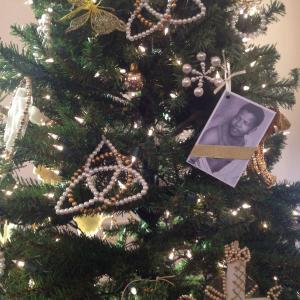
Mandela can become a symbol of God for some. Photo: Tripp Hudgins
What makes one a good person? Additionally, what makes one a good Christian? I have been spending some time wondering about this as news of Mandela’s death has been making it’s way across the planet. Was he a good man? I think so, but how do we measure that? How do we know? And if, as some have claimed, his greatness stemmed from his willing embodiment of his Christian faith, I need to know if he was a good Christian.
Guy Sorman writes of Mandela:
“The Commission for Truth and Reconciliation, founded by President Mandela and led by Bishop Tutu, is perhaps the most concrete example of Mandela’s Christian faith. Instead of the vengeance and reprisals that were expected and feared after years of interracial violence, the commission focused on confession and forgiveness. Most of those who admitted misdeeds and even crimes — whether committed in the name of or in opposition to apartheid — received amnesty. Many returned to civil life, exonerated by their admission of guilt.”
Mandela is exemplary not because he was perfect, always kind to everyone he met, an ideal husband and father, but because of these larger virtues that he also attempted to live out. He lived into these virtues — all of them, large and small, and all of them incompletely.

Americans spend $450 billion on Christmas; $20 billion would give water to the world for a year. ronstik/Shutterstock
The American Family Association has been tracking major companies to see how they promote Christmas. It came up with the “Naughty or Nice” list where it has examined different company’s websites, circulars, commercials, and stores noting how many times they use the word “Christmas,” if at all. According to the association’s website, “If a company has items associated with Christmas, but did not use the word “Christmas,” then the company is considered as censoring “Christmas.” Its research has uncovered that if you shop at Radio Shack, Barnes & Noble, Family Dollar, and Foot Locker (just to name a few) then you are part of the problem and thus should be placed on the “naughty list.”
The American Family Association believes that there is a full out “war on Christmas.” Well, I would have to say that it is correct but not for the reasons it postulates.

Ejwhite/Shutterstock
I flew to Houston over the weekend to speak at the Conspire Conference. I stood on a stage looking out over a few hundred students in grades 6-12, telling them my story of having breast cancer in my 20s.
I talked to them about what a dark season of life it was for me. The chemo and radiation were difficult, but on top of that I also lost a good friend to cancer, I was out of work for seven months, while in my apartment building’s parking lot, my car was hit by a truck, and my boyfriend broke up with me. After all of that, I ended up in the hospital with a raging lung infection and a good chance that I would die.
On the nights I spent in the hospital, I’d lie awake and stare at the ceiling and wonder where God was. “Do you see me? Do you love me? Do you care about what’s happening in my life?” I prayed. “And if you see me and love me and care about my life, why don’t you come down and make this all go away?”

Santa as a model to imitate: He gives gifts for the joy of it and so should we. Hasloo Group Production Studio/Shutterstock
When I was 4 and 5 years old, my parents hung our stockings up at the beginning of Advent. Each morning, my younger sister and I would run down to the rec room to see if Santa had left us anything during the night. Finding an empty stocking was a huge relief, because the only reason Santa would leave us anything before Christmas was if we had been bad. Bad children would get a warning, you see. An onion or turnip swelling the stocking’s toe meant we were on probation and we had better shape up before Christmas or we’d end up on the naughty list.
This put the fear of God, er, Santa in me, I can tell you! When it happened to me (and it happened a lot — I reigned over my younger sister with the zeal of a tyrant!), I would rack my brain to figure out what I had done the day before that had garnered Santa’s judgment. Sometimes I knew what it was and I’d apologize for it and promise to do better, but sometimes I didn’t know what I’d done wrong and that was the worst of all. How can you fix something when you don’t quite know what needs fixing? I would worry and fret until Christmas morning. My stocking filled with candy and the presents under the tree were a relief, tangible evidence that in Santa’s estimation, I was a good girl. At least good enough to stay off the naughty list!

Connecting calls for immigration reform to Advent Neblys/Shutterstock
On the first day of Advent, I began to fast for immigration reform.
I’m not a recent immigrant or a political activist. But I’m a mother, a teacher, and a Christian living in Asheville, N.C., a community affected by our broken immigration system. And I was raised in a faith that tells me that this country should not have an invisible class of people or a justice system that tears apart families. That’s not justice to me.
So Dec. 1-3, I joined the National Days to Act, Fast, and Pray in solidarity with those who have been fasting for three weeks in a tent on the National Mall. Their goal is to urge the House GOP, specifically U.S. House Speaker John Boehner (R-Ohio), to call for a vote on immigration reform.

Urbanlight/Shutterstock
I always had very mixed feelings about Christmas as a kid. My dad — not a religious guy — went all out for this holiday, in the typical secular ways. He bought so many presents that it would end up being hard to make our way through the dining room, where we put the tree. We’d spend at least two weekends in November hanging lights and other swag outside, and the house resonated with Bing Crosby, Dean Marin and John Denver, all wishing us merry Christmas, over and over again.
I came to hate decorating the house. All of that time spent on the roof could have been much better used playing with my friends and, of course, I never hung the lights correctly. I’d flop them along the wrong side of the roofline, only to be sent back to make it right. And suffice it to say that, although I love the Rat Pack singers in particular, hearing any carol more than 43 times in the course of three weeks can sour even the most ardent fans.
Then there was the matter of the gifts. As I said, the piles of boxes were fairly obscene, which actually proved an embarrassment if we had other family visiting for Christmas. I was not a fan of being the center of attention, and opening my remaining presents while jealous cousins looked on made me just want to get it over and done with.

Cheriejoyful/Flickr/Creative Commons
Next to biblical nativity stories, How the Grinch Stole Christmas by Dr. Seuss is one of my favorite seasonal tales. We read it as a family every Christmas Eve.
While we typically view this vintage Dr. Seuss yarn as a reminder that there is more to Christmas than its trappings, it offers something unexpected too. It shares an example of restorative justice at work.

Carsten Reisinger/Shutterstock
A predominant message of this holiday season seems to be both loud and clear: Our value as human beings is often dictated by our capacity to consume.
While the average North American consumes approximately twice as much as 50 years ago, we are significantly less satisfied with the quality of our lives, which is — of course — contrary to the mass “this stuff will make you happy” messages we receive on countless occasions each day. Nevertheless, we continue to embrace a culture of consumerism, for we consume at staggering rates, not only in an attempt to make right our perceived wrongs, but also because we are led to believe that such devotion contributes to the wellbeing of society. As Victor Lebow states, “Our enormously productive economy ... demands that we make consumption our way of life, that we convert the buying and use of goods into rituals, that we seek our spiritual satisfaction, our ego satisfaction, in consumption ... we need things consumed, burned up, replaced and discarded at an ever-accelerating rate.” According to the most vocalized narratives that affect contemporary life, to be a human of significant value in North America — especially during the month of December — is to be a committed and consistent consumer, even if it leads to our personal and public self-destruction.

If all we do is sit and wait for God, we’re like people trapped in a perpetual Advent Bine/Shutterstock
Much of our imagery of Advent is tied into the idea of waiting. Waiting for Emmanuel to come. Waiting for God to intervene. We’re in the middle of the night waiting for dawn to arrive. We’re waiting for something different to happen. One image is the pregnant woman waiting to give birth, which ties into the nativity story.
We spend a lot of our lives waiting for various things. Maybe the question for Advent is: What are we waiting for? And when does the waiting end?
So much of our religion has become about waiting. Waiting for heaven. Waiting for God to respond to a prayer and to change something. Waiting for God to right the wrongs. Waiting for God to set things straight. Waiting and waiting and waiting.
What if we’ve got it backward? What if someone is waiting for us?

Close-up of the glyphs on the Mayan calendar.
For a child has been born for us,
a son given to us;
authority rests upon his shoulders;
and he is named
Wonderful Counsellor, Mighty God,
Everlasting Father, Prince of Peace.
~ Isaiah 9:6
On the flight home from Connecticut, where we’d buried my beloved father a few days before Thanksgiving, I watched the film Seeking a Friend for the End of the World and dissolved into a wailing heap of tears and snot.
The premise of the uneven dramedy starring Steve Carell and Keira Knightley is this: An massive asteroid named Matlilda is on a collision course with planet Earth and in three weeks’ time, the world will come to an end. The main characters and others decide how – and with whom – they want to spend the last days of their lives.
Given recent events, this led to some soul searching on my part. If I had three weeks to live, what would I do? Where would I go? Who would I want to make sure I saw? With whom would I want to share my last breaths?
For most of my life the answer has been the same: I’d want to be with my family and, in particular, with my father.
Which is why I ended up bawling my eyes out for the last 90 minutes of the flight home to Los Angeles, much to the dismay of the fellow in the middle seat next to me.
If I had three weeks to live today, I wouldn’t be able to spend any of those moments with Daddy.
He’s in the More, now. On the other side of the veil. In Heaven. Resting in peace. With Jesus.
And I will have to wait until my earthly life ends to see him again face-to-face.

Photo: Hourglass, © Mihai Simonia/ Shutterstock.com
Advent candles lit round the world declare our longing for the coming of Christ. We wait. And, in our waiting we hope, we pray, we yearn. Advent is a season where our energies and passions for all things to be made right are kindled. Christ, the precious Baby in the manger, is coming for us all to celebrate. Consider Him.
Despite the hunger, the fatherless, the ailing. Despite the wars and senseless violence. Despite all of the reasons to say there is no redeemer.
We wait for the Christ child.
Our faith is rooted in such anticipation. Mockers have innumerable examples to declare the reasons why God is dead. Centuries of proof. Holocausts, molestation, shame. The Church waits despite its own pollution and contribution to the lack of justice.
Yet these things merely point to the coming of the Child. If the world were made right by our collective longings for occupation, for the 99 percent, for cosmic good, we’d see equitable dispersion of wealth, of food, of housing. We’d live the Marxist dream of community. We would all be haves.
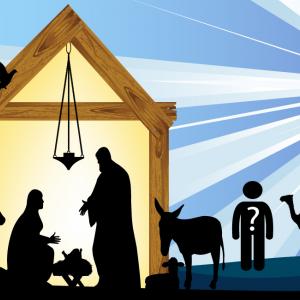
Nativity Scene Illustration, Shutterstock.com
In the church where I grew up, the first Sunday in Advent was dubbed the “hanging of the greens.” On that special Sunday, we sang carols in the decorated sanctuary, all culminating in the children’s live nativity scene. The service never changed from year to year. The only variables were how many kids needed roles and which young child would get stage fright, thus leaving part of the the story without visual representation.
It always seemed like the doves were cursed. The doves rarely remained on stage for the entire performance. Over the years, I was a variety of animals — a wise man, a shepherd, and finally Joseph. I never got stage fright. I was never a dove. I can only imagine what my mother would’ve done if I had been that kid.
It took me years to realize that there was a character missing from my congregation’s telling of the story. We always left out King Herod.
This was a huge oversight, because Herod plays a major role in Matthew’s account of Jesus’ birth.

A man holds a national flag during celebrations marking Day Of Reconciliation 2011. Photo by Foto24/Gallo Images/Getty Images
Instead of celebrating a victory in war or recognizing the founding of an armed unit, South Africa renamed Dec. 16 as “The Day of Reconciliation” for the purpose of transformation, empowerment, and multi-racial national unity. In what can now be described as a dramatic conversion of symbolism, the newly redefined public holiday was celebrated for the first time in 1995.
The Day of Reconciliation is appropriately placed within the Christian liturgical season of Advent, for this period of expectation and longing for Jesus’ birth is a reminder of the ways that God’s presence heals wounds and redefines relationships. As the people of South Africa renovated their national holiday to embrace a transformed national identity, the Season of Advent prepares us to be made new through the birth of Jesus, and thus moves us to promote restored local and global communities through the practice of radical hospitality, as is written in 2 Corinthians 5:19: “God was in Christ, reconciling the world to himself, and entrusting to us the ministry of reconciliation."

Photo: Advent candles, week 2, © haraldmuc / Shutterstock.com
This Advent, as we wait for the true light who is coming into the world (John 1:9) we pause and reflect on our Christmas hope. As a friend said last night, we do not linger forever in uncertainty but as an expectant mother who labors in anticipation of the joy her child will surely bring.
Our assurance of salvation — past, present, and future — depends on the unique person of Jesus Christ and our relationship to him, and there's perhaps nothing more central to Jesus and our relationship with him than that he became flesh, was made like us in every respect (Heb. 2:17), so that by grace we might become partakers of his divine nature (2 Peter 1:4).
This isn't something the church merely teaches but an event of history, revealed for all men and women in the one-of-a-kind person Jesus is, the human and divine Son of God. From the moment of Christ's conception, eternity himself inhabits time so that events of his life on earth long since past are forever present to us in Jesus. This is one reason our joy at Christmas is so palpable and real ... when we worship Jesus at Christmas, we are once again with Mary and Joseph on that cold, dark night as they swaddle “he who made the starry skies” and lay him in a manger.

Photo: Following the Star, © Juampi Rodriguez / Shutterstock.com
“Faith is recognizing that if at Christmas Jesus became like us, it was so we might become more like him,” wrote the well-known preacher and activist William Sloan Coffin. He goes on to add, “We know what this means; watching Jesus heal the sick, empower the poor, and scorn the powerful, we see transparently the power of God at work.”*
Christmas really is about seeing the power of God at work, but far too often pastors and churches fail to tell this story. Oh sure, we preach about Mary and Joseph, Jesus being born in a Bethlehem manger, and the Magi following a star to find him and offer gold, frankincense, and myrrh. My fear is that the story has grown familiar and routine. We have forgotten its power and no longer see its challenge.
In Matthew’s Gospel, the Magi seek out Jesus after hearing of his birth. In order to find him they ask King Herod where they can find the new king. This, of course, is news to Herod who is surprised to learn that his title has been claimed by a baby. Herod consults his advisors and then reacts with the expected calmness of a leader anticipating a conflict, which is to say his response is not calm at all.
This story is an announcement that Jesus has arrived to challenge the powerful. The Messiah was not born meek and mild.
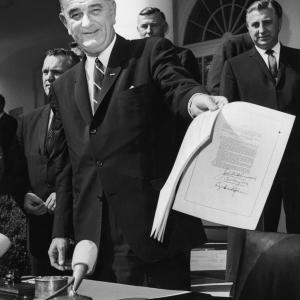
President Lyndon B Johnson smiles as he holds up the 'War on Poverty' Bill.Arnold Sachs/Consolidated News Pictures/Getty Images
I had a conversation with a young woman I met at a conference recently. The conversation rocked me.
I represented the faith voice on a panel at a major secular conference for philanthropists. The panel focused on the question: “What are we not talking about?”
One of my colleagues focused on the nonprofit sector’s inability to make real just change in our world because they are bound by the interests of donors who are, themselves, part of the 1 percent. Another colleague focused on the glut of nonprofits offering similar services in otherwise abandoned communities. I focused on the need for social movements to bring about a more just world and the role of faith communities in those movements, in particular.

Photo: Joseph and Mary travel to Bethlehem, © KimsCreativeHub / Shutterstock.com
Advent suggests so many mysteries of God's patience. One rarely commented case is God as Father and embryo. It is extra Biblical so imagination can only begin to tell the bizarre tale. Gabriel's annunciation and appearance to Joseph begins the period of waiting and soul searching, but a remarkable gap exists in the Advent story. Luke 1:56 makes this cursory remark as though it would suffice:
Mary stayed with Elizabeth for about three months and then returned home.
Presumably the second trimester of Mary's pregnancy is treated with a passing reference. If we simply take the divine conception of Jesus at face value, there was a moment in human history where God existed as Father in the heavens and embryo in Mary's uterus. Paradox of paradoxes. The Creator in utero.

There is a line from a Gerard Manley Hopkins poem about the Virgin Mary that describes the baby Jesus as “God’s infinity, dwindled to infancy.” The line captures perfectly the beautiful but also shocking idea, central to Christianity, that the infinite God who created the universe also chose to descend, dwindle, become small, become helpless, become dependent on human beings.
Hopkins is right: the baby Jesus is not merely a sentimental or cute idea but is potentially radical, transformative, and controversial.
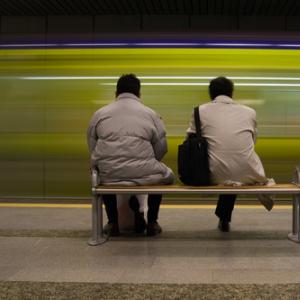
Photo: People waiting, © phototr / Shutterstock.com
As I write, I'm stuck in the Central Wisconsin Airport (near the bustling metropolis of Wausau, Wis., for those keeping score at home). And, you guessed it, I'm waiting. Fog in Minneapolis prevented our plane from landing there, and now I'm left sitting in a very small regional airport with no restaurant and no coffee and no concrete sense of what the rest of my day will look like as I make my way to California. All I can do is wait.
I do know, barring something entirely unexpected, that I'll eventually make it to San Francisco. Right now I'm living the axiom offered by Tom Petty decades ago: "The Waiting is the Hardest Part."
Advent, a season during which Christians honor and attempt to approximate the longing for a Messiah more than 2,000 years ago, is often described as a chance to exercise our patience muscles. Advent can serve as a season of anticipation and hope and longing, void of desperation. This is Advent for those who already have most of that for which they wait. But for countless people around the globe, every additional day of waiting comes with a heavy price.